FlexChords: AI That Instantly Converts YouTube Videos Into Guitar Chord Charts

FlexChords uses AI and music-theory smoothing to convert YouTube videos into editable, synced guitar chord charts.
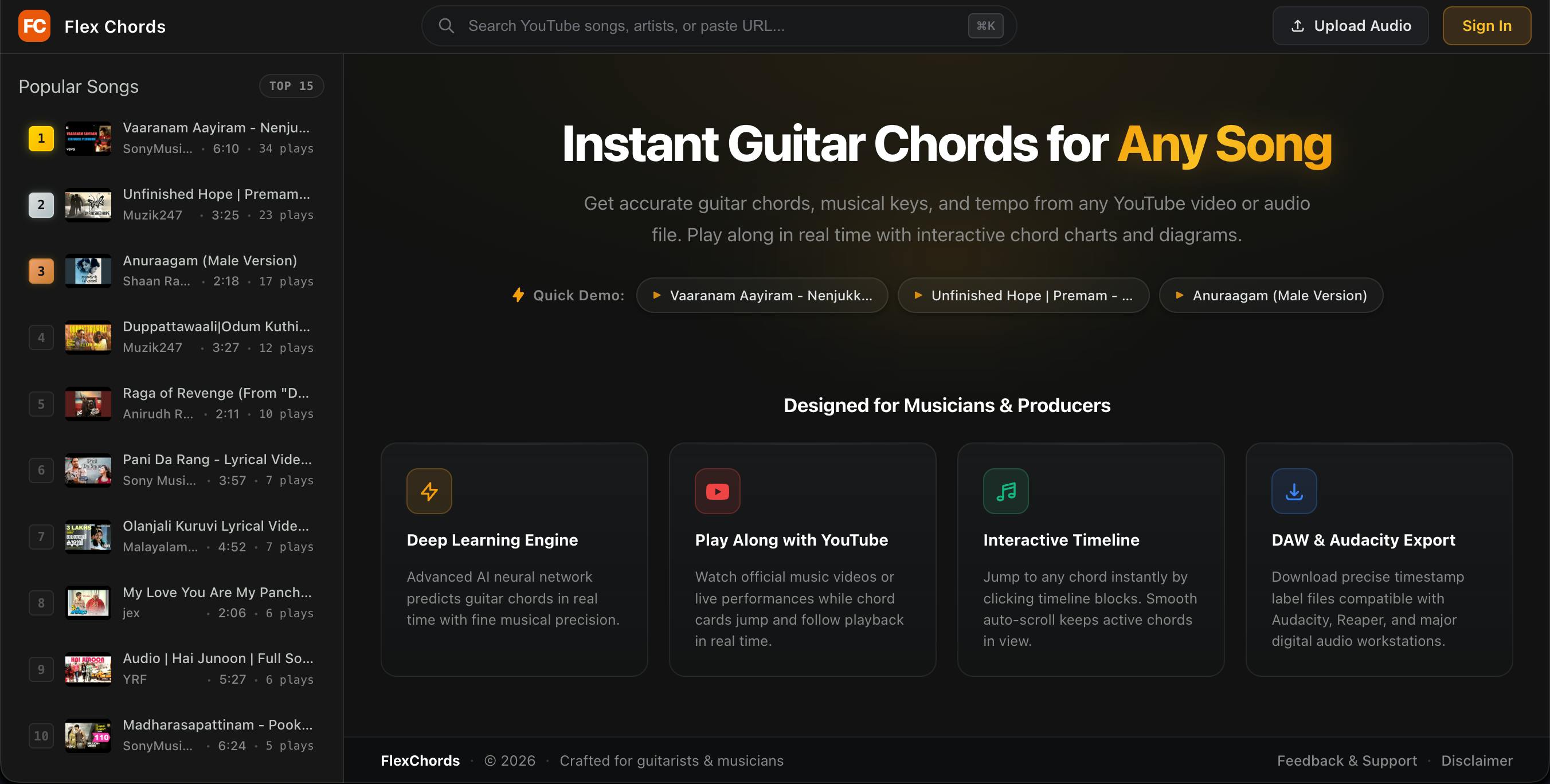
FlexChords is an AI-powered transcription tool for guitarists that converts YouTube links or uploaded audio into synchronized, scrolling chord charts in seconds. Its key technical differentiator is combining deep learning with music-theory smoothing to suppress the chord "jitter" common in pure neural network predictions, producing more musically coherent progressions. Features include real-time playback highlighting, an interactive timeline editor, and automatic key and tempo detection. It follows an "AI drafts, human refines" model and uses freemium pricing — unlimited catalog access plus 5 free custom scans per month — serving everyone from beginners to advanced players.
When guitar enthusiasts learn a new song, the biggest headache usually isn't technique — it's transcription. Listening over and over, pausing, hunting for chords: it's time-consuming and error-prone. FlexChords hands this problem off to AI, converting any YouTube video or audio file into an accurate, synchronized guitar chord chart in seconds.
What Problem It Solves
Auto-transcription tools are nothing new, but their pain points are well-known: noisy predictions, frequent chord flickering, or core features locked behind a paywall. FlexChords differentiates itself by combining deep learning with music-theory smoothing.
This combination matters because relying solely on a neural network for chord recognition tends to produce "jitter" — musically illogical jumps like a chord completely out of key suddenly appearing in what should be a stable measure. FlexChords applies music-theory rules as a post-processing step on the model's raw output, filtering out these glitches and producing a cleaner chord progression that better follows the song's musical direction. For players, this means getting a chart they can actually play from — not a list of guesses that need manual verification.
The core principle behind music-theory smoothing is worth unpacking. The vast majority of Western popular music follows a "tonal center" — within a defined major or minor key, chord progressions follow statistical patterns. In C major, resolving from G7 to C is an extremely common cadence, while a chord completely unrelated to the key has very low probability of appearing. Music-theory smoothing encodes this knowledge as a set of constraints applied as post-processing on the deep learning model's frame-by-frame predictions: replacing low-probability, contextually incoherent chord labels with more tonally appropriate candidates, while merging fragmented chords that are too short in duration. The result is a chord progression that matches the human ear's expectation of musical flow. This approach is analogous to language model decoding in speech recognition — the acoustic model provides phoneme candidates, and the language model ensures word order makes sense. Only together do they produce readable text.
Core Features at a Glance
FlexChords focuses its feature set on the "detect — sync — edit" pipeline:
- YouTube & audio chord recognition: Paste a YouTube link or upload an audio file to generate chords instantly.
- Synchronized playback with real-time chords: Chords scroll and highlight in sync with the music as it plays, making it easy to follow along.
- Interactive timeline & chord editor: Users can fine-tune chords on the timeline to correct any AI recognition errors.
- Key and tempo estimation: Automatically detects the song's key and tempo — practical for transposing and practicing to a beat.
The interactive editor is a design choice worth noting. It acknowledges that AI will never be 100% accurate, so it leaves the final call to the user, using an editable timeline to lower the cost of corrections. This "AI drafts, human refines" collaborative model is actually closer to real-world usage than chasing full automation.
Business Model and Positioning
FlexChords uses a freemium strategy: users get unlimited access to chord charts for songs already in the catalog, plus 5 free custom scan credits per month for tracks not yet in the catalog.
The design logic is smart — high-frequency needs (playing popular songs) are covered by pre-processed catalog entries at near-zero cost, while computationally intensive custom scans are quota-limited, controlling backend compute costs while creating a natural path to paid conversion. For the casual player who occasionally transcribes an obscure track, 5 free credits a month is plenty; for heavy users who need to transcribe frequently, upgrading is a natural choice.
The product was built by indie developer Amit S Namboothiry and launched on Product Hunt, earning 67 upvotes and ranking 19th, categorized under Music, Artificial Intelligence, and Audio.
Auto-transcription tools generally follow one of two technical paths: traditional signal processing methods (e.g., short-time Fourier transform + chroma features) or end-to-end deep learning models (e.g., Transformer- or CNN-based audio classification networks). Traditional approaches offer better interpretability but are sensitive to noise; deep learning approaches perform better on large annotated datasets but can produce unstable predictions at frame boundaries. Well-known open-source foundations in this space include Chordino, chord-detection, and librosa-based chroma analysis, while projects like Magenta and Basic Pitch (open-sourced by Spotify) have pushed neural network approaches to production-ready maturity. FlexChords sits at the "engineering productization" stage of this technical evolution — wrapping underlying recognition capabilities into a product aimed at everyday guitarists. Its competitive edge comes more from product experience than from pure algorithmic breakthroughs.
Who It's For
FlexChords targets guitar learners, cover artists, and musicians who need to transcribe songs quickly. For beginners, it lowers the barrier to learning new songs; for more advanced players, key and tempo estimation combined with the editable timeline can dramatically cut transcription time.
Of course, AI chord recognition accuracy still depends on source audio quality and arrangement complexity — clean vocals with simple instrumentation tend to yield the best results, while complex jazz voicings or noisy live recordings may still require significant manual correction. That's precisely why an interactive editor has become a standard feature for tools in this category. Overall, FlexChords packages "AI recognition + music-theory constraints + human fine-tuning" into a smooth workflow — a pragmatic example of AI making a real impact in a vertical music use case.
Related articles

Workbuddy for Absolute Beginners: How a Desktop AI Agent Fits Into Real Workflows
A beginner's guide to the Workbuddy desktop AI agent: installation, claiming credits, file management, and building automated workflows—compared with CodeX for fit and cost, helping professionals shift from AI question-askers to AI managers.

OpenAI's New Agent Stack: Computer Use, Decisions API, and Ultra-Fast Workflows
OpenAI Dev Day unveiled a new agent stack: Computer Use outperforms humans, Decisions API delivers ultra-low-latency classification via Luna, Agents API opens the same Computer Use capabilities, and GPT-6.1 Sol costs only one-seventh of Astra. Core updates, benchmark data, and developer insights.

Liang Wenfeng Open-Sources DeepInfo Inference Framework, Takes On U.S. Ban
DeepSeek open-sources its DeepInfo inference framework after its models, featuring GPU/CPU cross-pipelining, small-model prediction with large-model verification, and full Huawei Ascend and NVIDIA chip support—facing the U.S. federal ban head-on. This article analyzes its significance for AI deployment and open-source strategy.