Flock Demands Takedown of Surveillance Camera Map: A Battle Between Privacy and Monitoring

Flock Safety demands takedown of a public map showing its license plate camera locations, igniting a privacy and transparency debate.
Surveillance technology company Flock Safety is attempting to take offline a third-party map comprehensively documenting the locations of its Automatic License Plate Recognition (ALPR) cameras across the US. The incident has ignited a core debate over public accountability: supporters argue cameras installed in public spaces are already visible, and systematizing their locations is information aggregation, not a security breach — and that the public has a right to know about systems tracking their movements. Flock counters that centralized location data could help people evade surveillance. More broadly, the dispute exposes a structural gap: private surveillance companies operate outside FOIA and similar transparency mechanisms, leaving the public dependent on researchers and activists to map the contours of surveillance networks they are subject to.
Background: The Map That Struck a Nerve
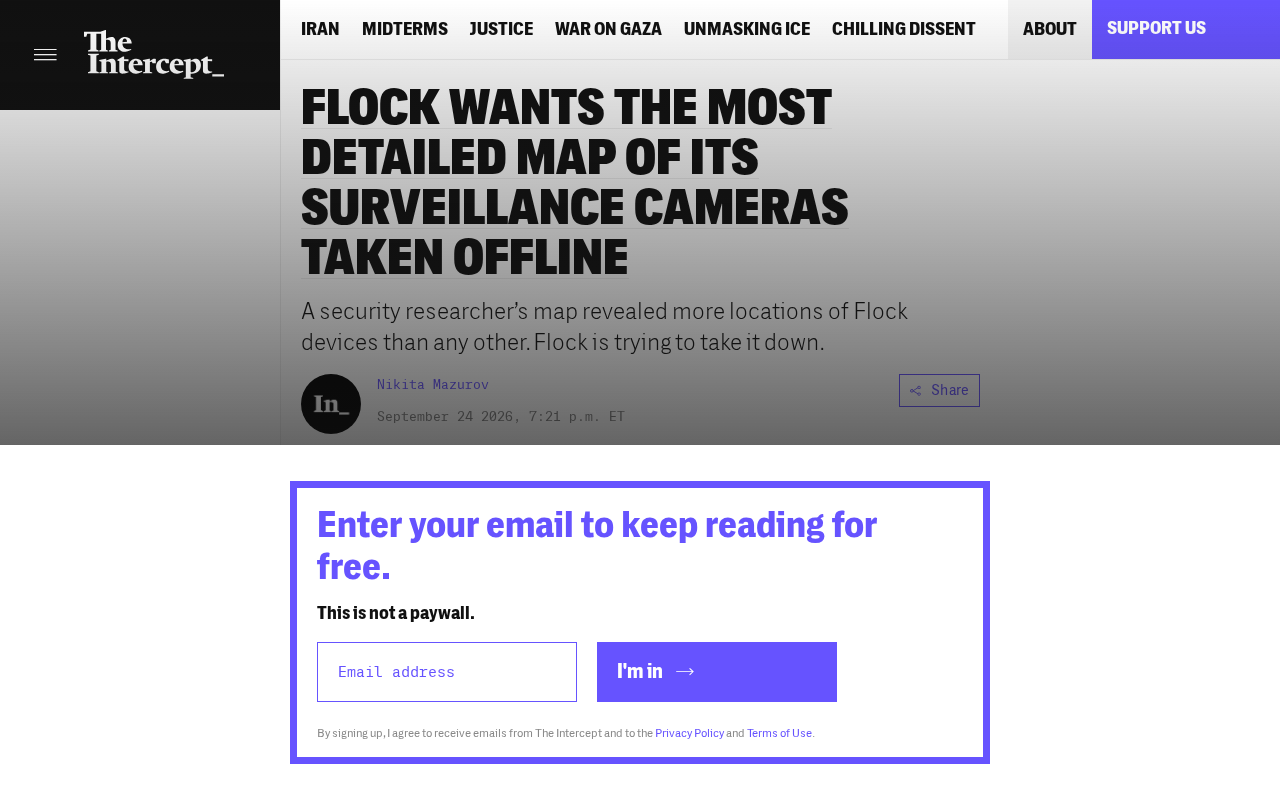
Surveillance technology company Flock is attempting to take down a detailed map documenting the locations of its surveillance cameras. Described as the most comprehensive public record of Flock's surveillance network to date, the map reveals the geographic distribution of the company's Automatic License Plate Recognition (ALPR) cameras deployed across the United States.
The story sparked discussion on Hacker News — not a viral sensation (41 points, 13 comments), but one that touches on an increasingly sensitive issue: when private companies build surveillance infrastructure at a national scale, does the public have the right to know where those cameras actually are?
Who Is Flock: The Invisible Giant of License Plate Surveillance
Flock Safety is a rapidly rising surveillance technology vendor whose flagship product is the automatic license plate recognition camera. These devices are widely deployed in residential communities, on public streets, and within law enforcement jurisdictions. They automatically record the license plates, timestamps, and locations of passing vehicles, feeding that data into searchable databases accessible to police.
For law enforcement, these systems are powerful tools for tracking suspect vehicles and solving crimes. For privacy advocates, however, a privately operated surveillance network capable of continuously tracking the movements of ordinary citizens represents an unprecedented mass location-monitoring capability — one where data retention periods, access controls, and abuse risks often lack meaningful public oversight.
Automatic License Plate Recognition (ALPR) technology uses optical character recognition (OCR) to parse license plate images captured by cameras in real time, cross-referencing them against "hot list" databases (stolen vehicles, wanted persons, etc.). Flock's business model is particularly noteworthy: the company sells equipment and data services on a subscription basis to homeowners associations (HOAs), private communities, and local law enforcement agencies. This creates a hybrid network driven by private capital yet deeply integrated with law enforcement systems. As of 2024, Flock claims its network covers more than 4,000 cities across the United States, with over 2,000 law enforcement agency partners. This deep coupling of private infrastructure with public policing means it operates largely outside the transparency requirements of government procurement, while effectively performing quasi-public safety functions — creating a regulatory gray zone.
The Core Dispute: Does a Public Map Constitute a "Threat"?
Flock's push to take the camera location map offline is broadly grounded in security and operational concerns — publicly disclosing device locations could enable people to evade surveillance or physically tamper with equipment. But opponents have fired back with pointed counterarguments.
The Case for Keeping It Public
Those arguing the map should remain online contend that these cameras are installed in public spaces where anyone walking down the street can already see them. Aggregating their locations into a map simply systematizes information that is already publicly visible — it doesn't constitute a new disclosure. More importantly, the public has a right to know: if a system is recording your daily movements, you should at least be able to find out where it operates.
The Case for Taking It Down
Flock and some supporters counter that centralized location data could be exploited maliciously — for example, helping criminals plan routes that avoid camera coverage, thereby undermining law enforcement effectiveness. This is essentially the classic security argument of "security through obscurity."
The divide reflects a long-standing tension in the surveillance technology space: how do you balance transparency against surveillance effectiveness?
The Deeper Issue: Who Watches the Watchers?
What makes this incident truly worth examining isn't the fate of a single map — it's the structural problem it exposes. When surveillance infrastructure is built, operated, and data-controlled by private companies, the accountability mechanisms traditionally applied to government surveillance often fail to reach them.
Private companies are not directly bound by public transparency laws like the Freedom of Information Act (FOIA). Their data-sharing agreements, retention policies, and technical specifications are routinely shielded as trade secrets. If the public wants to understand how they are being surveilled, they must rely on third-party researchers, journalists, or activists to piece the picture together — which is precisely the purpose the contested map served.
Flock's attempt to take the map down, in a way, confirms exactly what transparency advocates have been warning about: when the surveillance party controls the information asymmetry, the public's right to know is perpetually at a disadvantage.
The Freedom of Information Act (FOIA) is the primary legal tool through which Americans can access government records, requiring federal agencies to disclose documents and data upon request. However, FOIA applies only to government agencies — private companies fall entirely outside its scope. This legal gap has given rise to what's known as "Surveillance-as-a-Service": governments outsource data collection to private firms, thereby sidestepping the transparency obligations that would apply if they built the surveillance systems themselves. Some states have attempted to address this gap through state-level legislation — for example, requiring law enforcement agencies to publicly disclose their data-sharing agreements with private ALPR vendors — but progress has been uneven and no national standard exists. This structural regulatory vacuum makes third-party location maps one of the few ways the public can grasp the scope of surveillance network coverage.
Conclusion: The Transparency Battle of the Surveillance Age
This tug-of-war over a map is a microcosm of the broader struggle between civil rights and the power of technology companies in the era of digital surveillance. The fundamental question it raises — in a society saturated with cameras, do ordinary people retain the basic right to know when they are being watched? — matters far more than any technical detail about a particular map.
As license plate recognition, facial recognition, and other surveillance technologies accelerate in adoption, drawing the line between public safety and personal privacy, and ensuring that surveillance networks are subject to adequate public oversight, will remain challenges society must continuously confront. The map that someone wants taken down may be just a footnote in that long-running debate.
Related articles

Workbuddy for Absolute Beginners: How a Desktop AI Agent Fits Into Real Workflows
A beginner's guide to the Workbuddy desktop AI agent: installation, claiming credits, file management, and building automated workflows—compared with CodeX for fit and cost, helping professionals shift from AI question-askers to AI managers.

OpenAI's New Agent Stack: Computer Use, Decisions API, and Ultra-Fast Workflows
OpenAI Dev Day unveiled a new agent stack: Computer Use outperforms humans, Decisions API delivers ultra-low-latency classification via Luna, Agents API opens the same Computer Use capabilities, and GPT-6.1 Sol costs only one-seventh of Astra. Core updates, benchmark data, and developer insights.

Liang Wenfeng Open-Sources DeepInfo Inference Framework, Takes On U.S. Ban
DeepSeek open-sources its DeepInfo inference framework after its models, featuring GPU/CPU cross-pipelining, small-model prediction with large-model verification, and full Huawei Ascend and NVIDIA chip support—facing the U.S. federal ban head-on. This article analyzes its significance for AI deployment and open-source strategy.