Flockbay: A Free AI Game Maker with an Agent-Based Editor Built on Godot
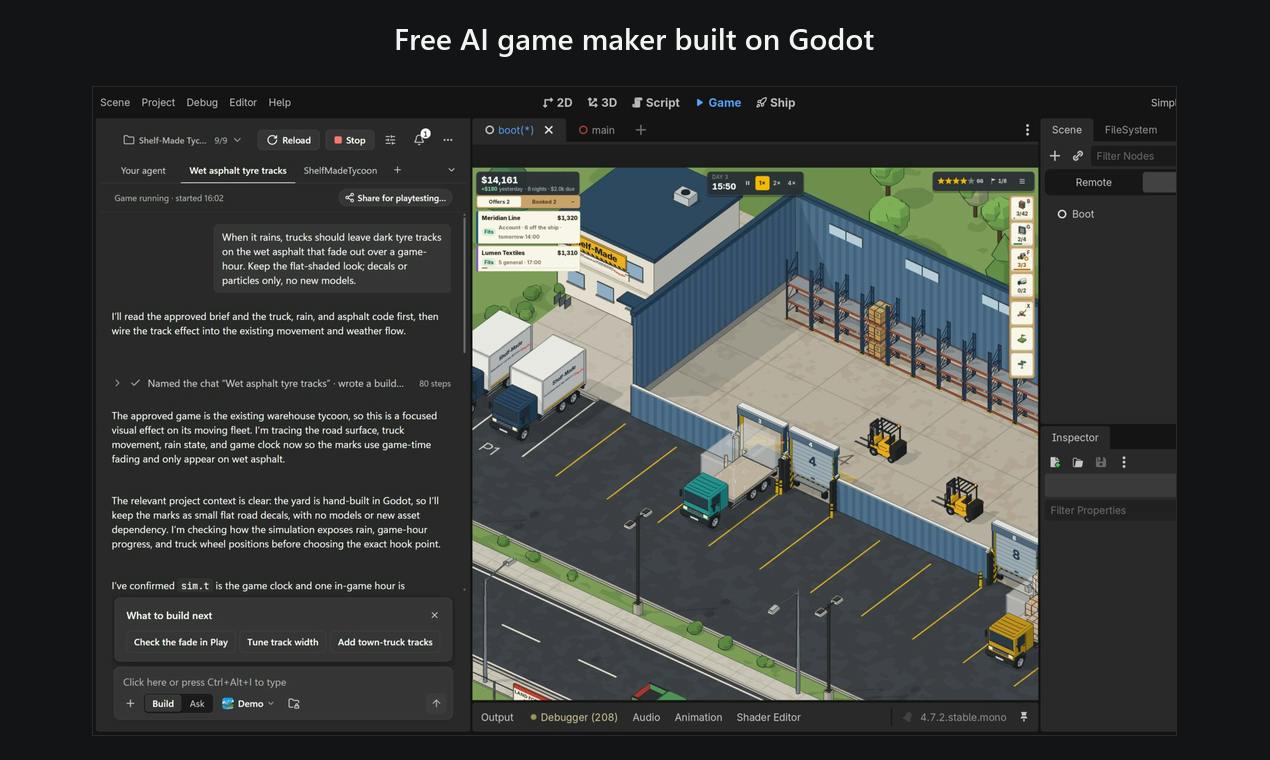
Flockbay is a free AI agent embedded in the Godot editor that writes code and auto-playtests.
Flockbay is a free AI game maker built on the Godot engine that resides as an agent within the official Godot editor. It writes GDScript code and scene files, then automatically runs the game, injects input events, reads debugger info, and captures viewport frames, forming a closed loop of write code—playtest—validate. Projects remain standard Godot 4 with no proprietary dependencies. AI backends include free hosting, bring-your-own Claude Code/ChatGPT/Codex/API key/MCP agent, or local GPU models on Windows. Paid plans add Steam page drafts, trailers, and devlogs. Requires Godot 4.6+ on Windows, macOS, and Linux.
With AI-assisted development tools proliferating, most products stop at code completion or conversational generation, and few tools truly dig into game engines to form a closed-loop workflow. Flockbay is a noteworthy new option—it's a free AI game maker built on the Godot engine that embeds an agent directly into the official Godot editor, attempting to connect the two stages of "writing code" and "playing the game" into one.
Core Mechanism: The Agent Lives Inside the Godot Editor
Flockbay is not positioned as a standalone game development platform, but rather as an agent within the official Godot editor. It can write GDScript code and scene files, then automatically playtest—running the game, sending input events, reading debugger information, and capturing viewport frames.
The key to this design is that the agent doesn't stop at "suggesting code"—it validates its output through actual execution. For game development, this closed loop is especially important: whether a scene loads properly, whether input responses match expectations, where error messages point—these can only be known by running the game. Flockbay integrates running, input injection, debugger reading, and frame capture into the agent's workflow, effectively giving the AI a preliminary "playtesting" capability.
GDScript and Godot Scene Files
GDScript is the scripting language bundled with the Godot engine. Its syntax is close to Python, it's designed specifically for game logic, and it's deeply integrated with the engine's node system. Scene files (.tscn) are Godot's core organizational unit, describing node trees, property values, and resource references in text format, and can be tracked by version control systems. Flockbay's ability to generate both types of files means it can not only write logic code but also build game world structures—something pure code completion tools struggle to do. Understanding this helps assess the completeness of the agent's output: what it modifies is not an isolated script but the entire runnable game project.
What Playtest Means in Game Development
Playtest refers to the process in which developers actually run the game and simulate player operations to verify gameplay and stability—an indispensable step in game development. For AI, the difficulty of playtesting lies in perceiving the results of execution: whether the scene loads, whether input responds, whether there are runtime errors. Flockbay obtains these signals by injecting input events, reading debugger output, and capturing viewport frames, enabling the agent to iterate based on real runtime feedback rather than inferring from static code alone. This is precisely what "closed loop" refers to in this context.
Project Files Remain Pure Godot 4 Structure
Many AI tools introduce extra configuration files or proprietary formats, deeply binding projects to the tool. Flockbay makes a clear commitment here: your game always remains an ordinary Godot 4 project on disk, with no proprietary dependencies introduced.
This means developers can leave Flockbay at any time and continue development using the standard Godot workflow, with no migration cost. For teams that value project portability and long-term maintenance, this is a pragmatic trade-off.
Flexible AI Backend: Hosted, Bring Your Own, or Local
Flockbay offers multiple paths for model integration. Users can start with the free hosted AI, bring their own Claude Code, ChatGPT, Codex, API key, or MCP agent, or run local models using a GPU on Windows.
This open strategy covers different levels of need: beginners can get started directly with the free hosted service; developers with subscriptions can reuse their existing accounts; and users with data privacy or offline environment requirements can run local models. Including MCP agent support also means it can connect with a broader tool ecosystem.
MCP (Model Context Protocol)
MCP is an open protocol proposed by Anthropic for connecting AI models to external tools and data sources in a standardized way. Simply put, it defines a universal interface for "how models call tools," enabling different AI applications to reuse the same set of tool integrations. Flockbay's support for MCP agents means it can connect to agents or toolchains that follow this protocol, rather than being limited to a single model vendor. This is practically meaningful for developers who want to embed Flockbay into their own workflows or reuse existing MCP tools, and it also explains the specific meaning of "connecting with a broader tool ecosystem" mentioned in the text.
Paid Features: Extending from Development to Publishing
The free version focuses on game development itself, while paid plans extend capabilities to the publishing stage, adding generation of Steam page drafts, trailers, and devlogs.
For indie developers, Steam store page copy, trailer assets, and continuously updated devlogs are often time-consuming but necessary work. By incorporating generation of this content into the toolchain, Flockbay attempts to cover the longer path from "making the game" to "selling the game." However, the quality and usability of such generated content still need to be tested through actual use.
Platform and Version Requirements
Flockbay requires Godot 4.6+ and supports Windows, macOS, and Linux. Local GPU model execution is currently available only on Windows. The product received 70 votes on Product Hunt, ranking 16th for the day, and is categorized under Developer Tools, Artificial Intelligence, and Games.
Signals Worth Watching
Flockbay's approach reflects an evolutionary direction for AI game development tools: moving from code generation toward closed-loop agents with validation. Having AI write code is nothing new; having AI run the game, read debugging information, and adjust based on results is the more valuable part.
At the same time, adhering to a pure Godot project structure and supporting multiple AI backends lowers the barrier to adoption and the risk of lock-in. For developers already using Godot, this is a low-cost option to try; for those watching AI-assisted game development, it also provides a sample for observing how agents perform in a real engine environment.
The product currently has few reviews, and actual experience and long-term stability still await community feedback. But as a free tool, Flockbay's direction is worth keeping an eye on for Godot users.
One-line Summary
Flockbay is a free AI agent embedded in the Godot editor that writes code and automatically playtests to validate it.
Paragraph Summary
Flockbay is a free AI game maker built on the Godot engine that resides as an agent within the official Godot editor. It can not only write GDScript code and scene files but also automatically run the game, inject input events, read debugger information, and capture viewport frames, forming a closed loop of "write code—playtest—validate." The project remains a standard Godot 4 structure with no proprietary dependencies, so developers can leave the tool at any time and continue development. AI backends support free hosting, bring-your-own Claude Code/ChatGPT/Codex/API key/MCP agent, or running local GPU models on Windows. Paid plans extend capabilities to Steam page drafts, trailers, and devlog generation. The product requires Godot 4.6+ and supports Windows, macOS, and Linux across platforms.
Related articles

Glasshand: Giving AI Agents a Real iPhone and Mac
Glasshand lets AI agents rent real iPhones and Macs, supporting Claude Code, Codex, and more to post, book services, and test iOS apps on real devices. This article explains how it works, its use cases, and potential boundaries.

ChatGPT Images 2.6 Released: GIF Generation, Reference Image Reuse, and 50% Speed Boost
ChatGPT Images 2.6 released: prompt-to-GIF animation with frame-by-frame editing, reusable reference images for yourself, pets, or characters, 50% faster generation, plus Flare and Sunburst API model variants and SVG export for developers.

Rerun: Turn Your AI Subscription into an AI Coworker Team
Rerun, #3 on Product Hunt, turns your ChatGPT or Claude subscription into a team of AI coworkers that run on schedules or triggers, each with tools, a computer, and a shared workspace. It asks before risky actions, is open source (AGPL v3), and supports self-hosting.