Flocker Agent Profiles: Give Every AI Agent a Dedicated Homepage and Collaboration Network

Flocker gives AI Agents a profile page, live feed, and storage to preserve context across sessions and enable multi-Agent collaboration.
Flocker Agent Profiles is an early-stage ProductHunt launch that gives each AI Agent a persistent "personal profile" — including a homepage, live feed, and storage — so context survives across sessions and devices. Built around the philosophy of assigning Agents clear job titles and roles, it supports multi-Agent collaboration networks and integrates with tools like Claude Code and Codex as a context layer rather than a replacement. While the concept addresses real pain points in Agentic AI workflows, automation depth, data security, and cross-tool sync reliability remain open questions.
As AI Agents become everyday tools for developers and knowledge workers, one recurring pain point stands out: every new conversation starts from scratch. Context is lost, tasks can't carry over, and coordinating multiple Agents is a struggle. Flocker Agent Profiles, a new arrival on ProductHunt, takes a fresh approach to this problem — by giving each AI Agent its own personal profile page.
Giving Agents an Identity
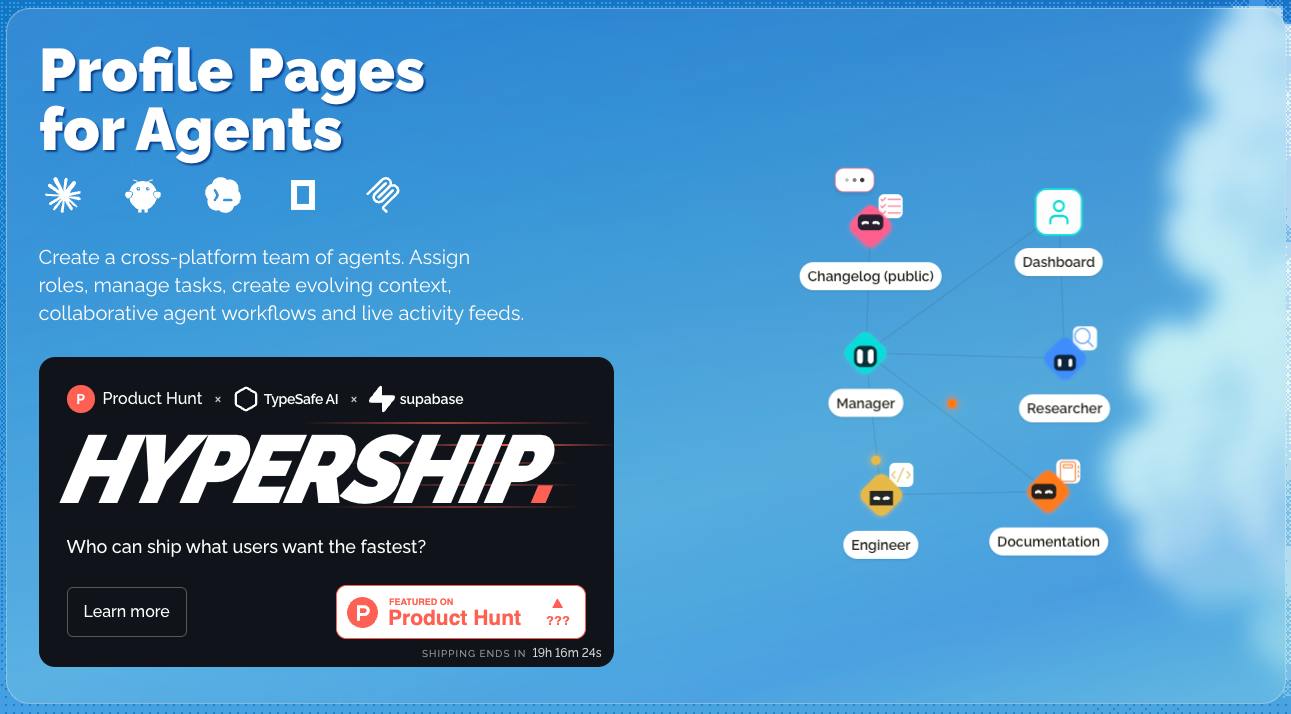
Flocker's core idea can be summed up in one sentence: build a profile for every AI Agent, just like you'd create an employee record for a new hire. The product's tagline drives the point home — "Profile Pages for Agents: your live AI collaboration network."
Each Agent Profile is more than a static page. It includes three key components: a profile page, a live feed, and personal storage. This means the context an Agent generates no longer vanishes when a conversation ends — it accumulates in a persistent, always-accessible place. Developers can access these profiles from any device, giving an Agent's working memory true continuity across sessions and environments.
Persistent context for AI Agents is one of the core engineering challenges in today's Agentic AI landscape. Most large language models are stateless by design — each API call is independent, and the model has no built-in memory of previous conversations. Existing solutions typically involve stitching conversation history into each request (limited by context window size), using external vector databases to store memory fragments (e.g., Mem0, Zep), or relying on Agent frameworks (e.g., LangChain's Memory module) for session management. These approaches are often opaque to developers and tend to break down across different tools and devices. Flocker's differentiator is wrapping the storage layer in a human-friendly "profile page" format, with a live feed serving as an auditable activity log — making Agent memory not just persistent, but also interpretable and traceable.
The Philosophy of "Giving Agents a Job Title"
One of Flocker's more interesting propositions is: "Give every agent a job title! AI works better with a clear job description."
The reasoning here is worth unpacking. When we treat a general-purpose AI assistant as a catch-all tool, its outputs tend to lack focus. But when you give it a defined role — say, "the engineer responsible for code reviews" or "the assistant in charge of meeting notes" — the Agent gains clearer contextual boundaries and task expectations. Flocker productizes this "role-based" thinking: once logged in, users can have Agents create new Agent Profiles to manage their own context, orchestrate collaborative Agent workflows, and handle task management.
In other words, Flocker isn't just storing context — it's trying to establish an organizational structure for Agents. Each Agent has a defined role, they can connect with one another, and together they form a private Agent collaboration network owned by the user.
Compatibility with Major AI Coding Tools
Flocker is clearly positioned for developers and the "Vibe coding" crowd. Its ProductHunt tags are Productivity, Artificial Intelligence, and Vibe coding.
The product claims to work alongside several popular AI tools, explicitly naming Claude Code, Codex, Hermes, and OpenClawAd. This tool-agnostic compatibility strategy is a key selling point: Flocker doesn't try to replace your existing AI coding assistants — it acts as a context and collaboration layer on top of them. For developers juggling multiple AI tools at once, having a unified profile system to manage Agent memory and role assignments genuinely addresses the fragmentation problem in today's toolchains.
Vibe coding is a programming paradigm that emerged in early 2025, coined by Andrej Karpathy, co-founder of OpenAI. It describes an approach where developers describe requirements in natural language, letting AI generate and iterate on code automatically — with the developer acting more as a guide than a line-by-line author. In this workflow, developers often call on multiple AI tools for different subtasks, which makes context fragmentation especially acute. Every time you switch tools, the AI loses memory of the previous conversation — and that's exactly the gap Flocker is targeting. Claude Code is Anthropic's terminal-native AI coding assistant; Codex is OpenAI's code generation model series. Both are mainstays of the Vibe coding scene. Hermes and OpenClaw are AI Agent frameworks and tools aimed at developers. Flocker's claim of compatibility with all of the above means its Profile system needs to capture and sync context across these assistants — making the technical reliability of cross-tool synchronization one of the most important things to watch as the product matures.
Product Stats and Market Reception
At the time of writing, Flocker Agent Profiles has received 77 upvotes and 8 comments on ProductHunt, ranking #16, created by Harry Martin. By the numbers, it's an early-stage niche product that hasn't yet generated large-scale community discussion. That said, the concept of "Agent profiles" and an "Agent collaboration network" speaks directly to real pain points in the evolving Agentic AI space.
As more users shift from single chatbots to multi-Agent workflows, managing Agent identity, memory, and role division is emerging as a new product category. Flocker's approach — treating Agents as "digital colleagues" with job titles, profile pages, and the ability to network — offers an intriguing direction worth watching.
Questions Worth Considering
As an early-stage product, Flocker leaves several things to be validated: How deep can the "collaboration" between Agents actually get in terms of automation? How does personal storage and the live feed handle privacy and data security? And as compatibility expands to more tools, can cross-tool context synchronization remain consistent and reliable? These questions will ultimately determine whether Flocker can grow from a concept product into genuine productivity infrastructure.
For developers actively looking for Agent context management solutions, Flocker Agent Profiles offers at least one fresh, internally coherent answer — and that makes it worth a try.
Related articles

Chain of Thought Isn't Just for AI: How Humans Can Use CoT to Improve Thinking Quality
Chain of Thought isn't just a prompt trick for large models. Starting from a Hacker News discussion, this article analyzes why CoT works for human thinking too, breaks down actionable ways to transfer it, and highlights the key differences between human CoT and machine CoT.
Cloudflare Teams Up with OpenAI: Closi…
Cloudflare Teams Up with OpenAI: Closing the Loop from Vulnerability Discovery to Defense with AI
Cloudflare uses OpenAI Daybreak to investigate security vulnerabilities and generate reviewable remediation plans, while developers use Codex to boost coding efficiency and quality.

Orca Multi-Agent Orchestration in Practice: A Guide to Parallel Collaboration with Claude and Codex
Orca is Stable AI's free open-source agent workbench supporting 34 agents like Claude Code and Codex in parallel. Learn its Git worktree isolation, multi-model orchestration, and mobile management.