FLORE: A Humanoid Robot Manipulation Framework That Teaches Robots to "Apply Force"

FLORE makes force an explicit policy output, boosting contact-intensive task success from 26.7% to 80%.
FLORE is a learning framework for humanoid mobile manipulation that elevates contact force from implicit controller compensation to explicit policy output. It combines robot-free demonstration collection with force-sensing handheld grippers, a force-reactive diffusion policy, and a hybrid compliant whole-body controller. On three contact-intensive real-robot tasks, it achieved 80% success versus 26.7% for position policies.
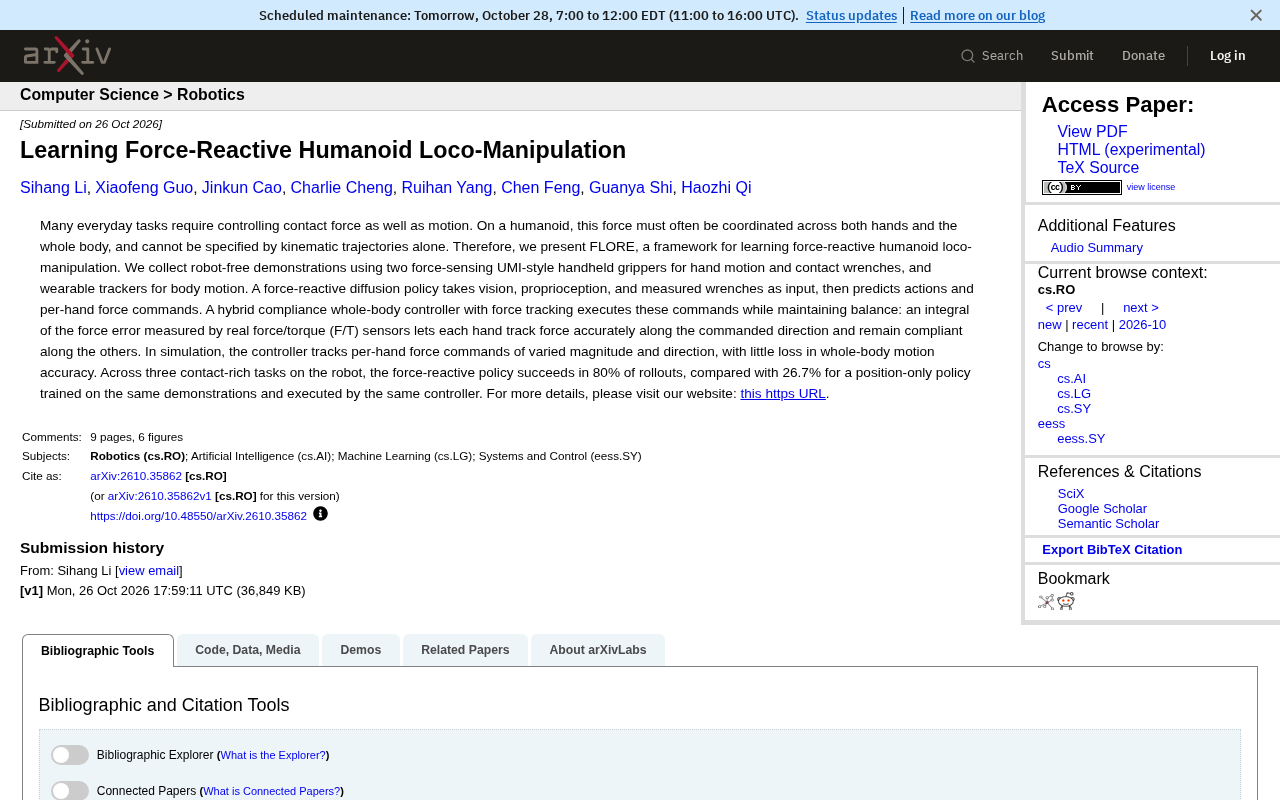
Many everyday tasks require not only motion control but also precise control of contact forces. For humanoid robots, these forces often require coordination between both hands and the whole body, and kinematic trajectories alone cannot fully describe them. To address this, researchers propose FLORE—a framework for learning force-reactive humanoid mobile manipulation.
Why "Force" Is Harder to Learn Than "Position"
Traditional robot manipulation mostly focuses on position control: given a target pose, plan a trajectory, and execute it. But real-world contact-intensive tasks—such as wiping a table, pushing or pulling a door handle, or two-handed cooperative carrying—require the robot to sense and regulate contact forces. A slight deviation in magnitude or direction of force can cause task failure, or even damage the object or the robot itself.
Humanoid robots are especially tricky: forces must be transmitted through coordinated motion of both arms and the whole body, while balance is always a concern. FLORE's core idea is to make force part of the policy output, rather than passively compensating for it afterward with a controller.
Wrench is the standard mathematical tool in robotics for describing contact forces; it combines a 3D force vector and a 3D torque vector into a 6-dimensional vector. A single force value alone cannot fully characterize the contact state—the same magnitude of force applied at different contact points produces different rotational tendencies, so the wrench encodes both "how hard to push" and "where to rotate about." FLORE collects and outputs exactly this 6-dimensional wrench, which allows the policy to express whole-body coordination intentions such as "when lifting with both hands, raise one hand more upward and squeeze the other more inward." Understanding the wrench is a prerequisite for understanding this article's core design of "force as policy output."
FLORE's Three Key Components
Robot-Free Demonstration Collection
The research team used two UMI-style handheld grippers with force sensing to record hand motion and contact wrenches, while wearable trackers captured body motion. This approach bypasses the high cost and risk of collecting data with real robots, directly acquiring force information from human manipulation.
Force-Reactive Diffusion Policy
The policy network takes vision, proprioception, and measured wrenches as input, and outputs actions as well as per-hand force commands. The generative capability of diffusion policies is well-suited to handling multimodal contact force distributions, enabling the robot to respond appropriately under different contact states.
Diffusion Policy is a class of imitation learning methods that model robot action generation as a denoising process: starting from Gaussian noise, it gradually "purifies" an action sequence through multiple iterations, rather than directly outputting a single deterministic action like a regression network. The key advantage of this generative modeling is its ability to express multimodal distributions—given the same visual scene, contact forces may have multiple plausible values (light touch or heavy press), and a diffusion policy can cover these modes instead of averaging them into an infeasible intermediate value. FLORE incorporates force commands into the diffusion policy's output space, precisely leveraging this property to handle the uncertainty and multiple solutions of contact states.
Hybrid Compliant Whole-Body Controller
The execution layer uses a hybrid compliant controller with force tracking, executing force commands while maintaining whole-body balance. The key design: using the integral of force error measured by real force/torque (F/T) sensors, each hand precisely tracks force along the commanded direction while remaining compliant in other directions. This "direction-selective" compliance is fundamental to safety in human-robot interaction and contact-rich tasks.
Hybrid compliant control originates from classical impedance/admittance control ideas: the robot does not rigidly lock its end-effector position but behaves like a spring-damper system, yielding to external forces. "Hybrid" means adopting different strategies in different directions—force control (closed-loop regulation of contact force) in directions requiring precise force tracking, and compliant position control (allowing passive deviation to absorb impacts) in other directions. This direction selectivity is crucial for contact-intensive tasks: for example, when wiping a table, force must be applied steadily perpendicular to the table surface, while sliding compliantly along the table surface to avoid jamming. FLORE drives this mechanism with F/T sensor error integrals, enabling "force commands" to be physically realized.
Experimental Results: Force Feedback Brings Significant Improvements
In simulation, the controller can track per-hand force commands of different magnitudes and directions while incurring only minimal loss in whole-body motion accuracy. More critically, real-robot experiments: across three contact-intensive tasks, the force-reactive policy achieved an 80% success rate, while a position policy trained on the same demonstration data and executed by the same controller achieved only 26.7%.
This comparison clearly shows that position trajectories alone cannot handle contact-rich tasks. The introduction of force commands enables the policy to learn "how much force to apply and in which direction to push," while the controller is responsible for executing this intention stably.
Industry Implications
FLORE demonstrates a replicable path: first use handheld devices to collect demonstrations with force information at low cost, then train a policy that outputs force commands, and finally close the loop on real robots with a compliant controller. It elevates "force" from an implicit controller compensation to an explicit policy output, offering new ideas for deploying humanoid robots in home service, precision assembly, and other scenarios.
Of course, the current method still relies on specific handheld collection devices, and cross-task generalization remains to be validated. But the gap between 80% and 26.7% is enough to show that force feedback is not a nice-to-have but a necessary condition for contact-intensive manipulation. For more details, visit the project website: https://louis-leee.github.io/FLoRe/.
One-line Summary
FLORE makes force an explicit output of humanoid robot policies, raising success rates on contact-intensive tasks from 26.7% to 80%.
Paragraph Summary
FLORE is a learning framework for humanoid mobile manipulation whose core claim is elevating contact force from implicit controller compensation to explicit policy output. It consists of three parts: robot-free demonstration collection using force-sensing UMI-style handheld grippers and wearable trackers; a force-reactive diffusion policy that takes vision, proprioception, and wrenches as input and outputs both actions and per-hand force commands; and a hybrid compliant whole-body controller that uses F/T sensor error integrals for direction-selective force tracking. Across three contact-intensive real-robot tasks, the force-reactive policy achieved an 80% success rate, versus only 26.7% for the position policy under identical conditions, clearly demonstrating that force feedback is a necessary condition for contact-rich manipulation.
Related articles

Private Key Set to 4? CA's Elementary Mistake Leaves TLS Exposed
CA eMudra set private keys to tiny values like 4, making TLS certificates brute-forceable. A Computerphile video demonstrates the full process from extracting public keys to forging certificates, and explores the fragility of the PKI trust chain.

How Gen Turns Data into Decisions with ChatGPT Work
In an OpenAI user case, business leader Gen shares how ChatGPT Work turns data into decisions: within hours of launch, teams can judge whether integrations and onboarding flows work, shifting decision iteration from hundreds of trial-and-error attempts to a fast feedback loop.

ChatGPT vs. Claude In-Depth Comparison: Strong at Coding but Weak at Research — How to Bridge the Gap?
A user considers switching from ChatGPT to Claude, finding Claude stronger at coding but shallower at research. We analyze the differences and share tips to make Claude's research deeper.