Florilegium: A Geeky Experiment in Procedurally Generating Flowers with LaTeX

Florilegium procedurally generates flowers with LaTeX code, expanding the generative art boundaries of typesetting tools.
The GitHub project Florilegium drew attention on Hacker News by using LaTeX (likely based on TikZ/PGF) to procedurally generate flower patterns, turning an academic typesetting tool into a canvas for generative art. The article analyzes its technical path: parameterized control of petal count, rotation angles, color gradients, etc., to compile vector graphics, with advantages of infinite variations, precise reproducibility, and seamless document integration. It explains its significance from three perspectives: the minimalist route of generative art, document as medium, and open-source reproducibility. It also notes that the project is currently closer to a proof of concept, with limitations in LaTeX drawing performance and naturalness, suitable for LaTeX users, generative art enthusiasts, and educators to try.
When LaTeX Stops Typesetting Papers and Starts "Growing Flowers"
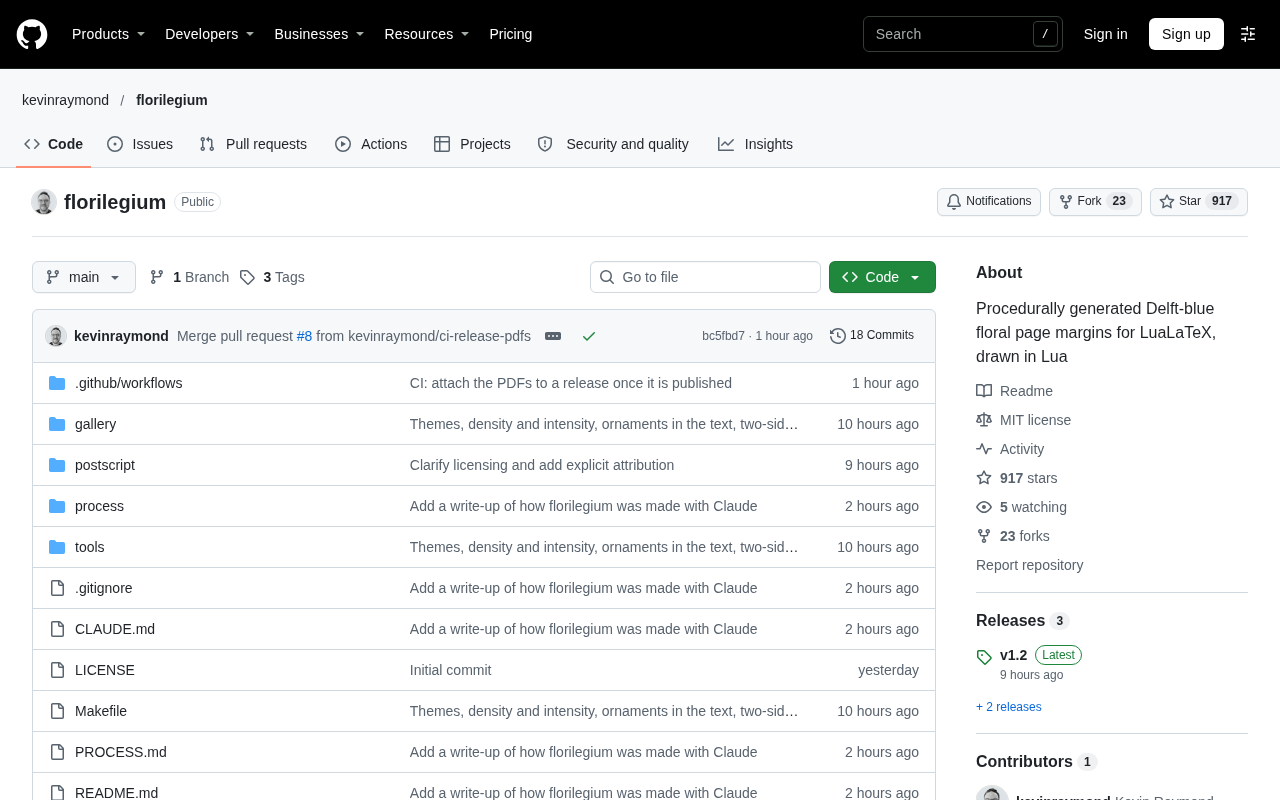
Most people see LaTeX as a tool for academic typesetting—equations, references, three-line tables. But a GitHub project called Florilegium (recommended on Hacker News, with 288 points and 47 comments) takes it in an unexpected direction: procedurally generating flower patterns with LaTeX code. The project name "Florilegium" comes from Latin, meaning "flower collection" or "anthology," which neatly echoes its dual identity—both a code repository and a botanical atlas drawn by algorithms.
The fact that this project sparked discussion on Hacker News itself speaks to a sense of contrast: using the most "academic" tool to do the most "natural" thing. It attracts not only LaTeX enthusiasts but also technical people interested in generative art and procedural design.
Procedural Flowers: How Algorithms "Bloom"
Procedural generation is not a new concept—from game terrain to building facades, algorithms have long been able to mimic nature. But what makes Florilegium special is its constraints: it runs within LaTeX's drawing ecosystem (most likely TikZ or PGF), meaning every petal and every stem is defined by mathematical expressions and coordinate transformations rather than hand-drawn or bitmap images.
It can be inferred that the project parameterizes flower morphology—petal count, rotation angles, color gradients, fractal levels, etc.—and ultimately compiles vector graphics. The advantages of this approach are: infinite variations, precise reproducibility, and seamless integration with documents. You can insert a "computed flower" into a paper without worrying about resolution or copyright issues.
The specific implementation details (such as the packages used and parameter interfaces) require consulting its GitHub repository, but the discussion heat on HN indicates that the community has genuine interest in this intersection of "LaTeX generative art."
TikZ is the most mainstream drawing package in LaTeX, built on the PGF low-level engine. It allows users to draw vector graphics with imperative syntax (e.g., \draw (0,0) -- (1,1);) and supports loops, variables, coordinate transformations, and custom functions. Unlike inserted images, TikZ graphics are parsed directly by the LaTeX engine into PDF drawing instructions at compile time, so they scale perfectly with the document, stay crisp, and keep file sizes extremely small. If Florilegium is based on TikZ/PGF, it can leverage its mathematical expression evaluation capabilities (such as \pgfmathparse) to parameterize petal curves and use \foreach to batch-generate symmetric structures—this is precisely the technical foundation of "code as pattern."
Why It's Worth Noticing: Three Technical Perspectives
1. The "Minimalist" Route of Generative Art
Compared with creative coding tools like Processing and p5.js, LaTeX's drawing capabilities seem clunky and limited. But it is precisely this limitation that gives rise to a unique aesthetic: code as pattern, compilation as creation. Florilegium continues the tradition of "algorithmic aesthetics"—from early computer art to today's generative AI, generating complex forms from rules has always been a fascinating proposition for technical people.
Processing and p5.js are representative tools in the creative coding field: the former is based on Java, the latter is a JavaScript library. Both provide instant rendering windows, rich graphics APIs, and active community examples, making them suitable for rapid prototyping and interactive works. In contrast, LaTeX drawing has no real-time preview, requires recompilation after every change, and its graphics capabilities are limited by the abstraction level of the PGF engine. But it is precisely this "inconvenience" that constitutes a different creative paradigm: Processing leans toward exploration and iteration, while LaTeX leans toward precision and embedding—each occupying one end of the generative art spectrum.
2. Document as Medium
LaTeX's strength is structured documents. Embedding procedural flowers into a PDF means graphics can scale with the document, remain vector-crisp, and even adjust automatically to page layout. For technical documents requiring illustrations, educational materials, or poetry layout, this is an elegant solution.
3. Open Source and Reproducibility
The project is hosted on GitHub with publicly available code. Anyone can clone it, modify parameters, and generate their own "flower collection." This reproducibility is exactly the value championed by the open-source community—the 47 comments on HN likely include discussions about code structure, compilation performance, or extensibility.
Limitations and Reflections
Florilegium is currently more of a proof of concept than a mature tool. LaTeX's drawing performance is limited, and complex flowers may cause slow compilation; whether the parameter interface is friendly and the documentation is complete also determines whether it can be adopted by a broader user base. Additionally, procedurally generated flowers still have a ceiling in terms of "naturalness"—algorithms can mimic forms but struggle to capture the random imperfections and growth logic of real plants.
However, the significance of such projects often lies not in practicality but in expanding the boundaries of what tools can do. It reminds us: LaTeX is not just a typesetting tool—it can also be a canvas; code is not just logic—it can also be aesthetic expression.
Proof of Concept (PoC) refers to a minimal implementation used to verify whether a technical idea or design is feasible. It typically does not pursue feature completeness, performance optimization, or user experience, but focuses on demonstrating the core mechanism. In the open-source community, many projects are released as PoCs to quickly gather feedback, attract contributors, or record inspiration. Describing Florilegium as a proof of concept means its current value lies more in showing "what LaTeX can do" rather than providing a production-ready, out-of-the-box tool—readers should adjust their expectations accordingly and focus on its inspirational significance rather than applying it directly.
Who Should Try It
- Heavy LaTeX users: Those who want to add unique vector illustrations to their documents.
- Generative art enthusiasts: Those interested in algorithmic aesthetics and procedural design who are willing to try non-mainstream tools.
- Educators: Those who can use it to demonstrate the combination of "mathematics and art" and spark student interest.
If you're curious about how code can "bloom," check out the GitHub repository—perhaps the next flower will bloom in your PDF.
Related articles

Running Audio and Vision Locally with a 2B Model: LFM3 Hands-On Revealed
A blogger tests Liquid AI's LFM3 Audio 2B and Omni 2B on a MacBook Air: 2B parameters run speech and vision offline, tool calling exceeds expectations, but noise transcription and hallucination issues are evident.

Bilibili AI Infinite Arena: Local Deployment Extreme PK of Three MOE Models
Bilibili AI Infinite Arena test: locally deploying Gemma 4, GLM 4.7 Flash, and Qwen 3.6 35B A3B MOE models on an RTX 3060 for a 3D modeling PK. Qwen 3.6 wins with one-shot success; GLM has rich detail but poor stability; Gemma 4 ranks last. Includes test setup and process analysis.

Prompt Engineering for Beginners: From Writing Instructions to Systematic Design
A beginner's guide to prompt engineering: the difference between prompts and prompt engineering, the four roles of prompts, the six-step process and four goals, plus key limitations around capability ceilings, stability, hallucinations, context length, and cost.