Prompt Engineering for Beginners: From Writing Instructions to Systematic Design

A prompt is a one-off instruction; prompt engineering is a reusable process—the gap is huge and each has its limits.
Based on lesson one of a Bilibili prompt engineering tutorial, this article systematically covers the core framework of prompts and prompt engineering. Prompts are the most direct means of controlling AI, serving four roles: communication bridge, task navigation, style control, and boundary constraints. Prompt engineering is a systematic, method-driven process with six steps—requirement decomposition, solution design, execution testing, evaluation, strategy iteration, and crystallization for reuse—pursuing four goals: accuracy, low hallucination, stability, and low cost. The article also stresses that prompts aren't a master key: there are hard limits around capability ceilings, unstable output, hallucinations, context length, and lack of long-term memory. Enterprise deployment requires combining prompts with code, and token cost traps must be avoided.
Many people assume that prompting just means sending a message to an AI. In reality, it's far more than that. A prompt engineering tutorial on Bilibili—described by viewers as "all substance, no fluff"—starts from the most basic concepts, clearly explaining prompts, prompt engineering, and the gap between them. This article is based on the first lesson of that tutorial, organizing its core framework and adding some personal interpretation.
What Exactly Is a Prompt
A prompt is any instruction we give to an AI—whether it's a question, a description, or a complete task specification. The tutorial uses a vivid metaphor: a prompt is like the neural signal you send to the AI—whatever signal you send, the AI thinks in that direction. It's the most direct means we have of controlling AI.
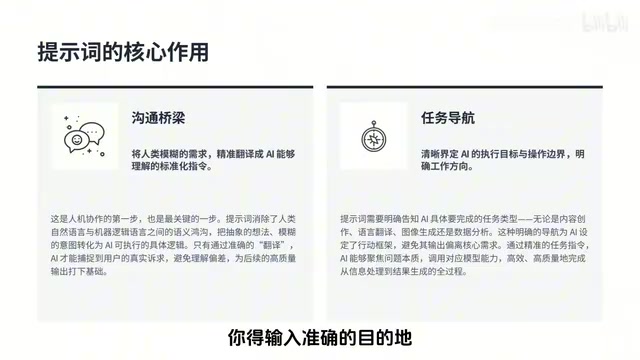
With the same model, some people can only produce elementary-school essays, while others can write professional industry reports. The difference isn't in the AI itself—it's in the input. The specific roles of a prompt can be broken down into four layers:
- Communication bridge: Translating vague needs in your head into clear instructions the AI can understand. It's like ordering takeout—you can't just say "bring me some food"; you need to specify the dish, spice level, and whether to add rice.
- Task navigation: Telling the AI a clear goal and boundaries. "Help me process this file" is an invalid instruction—the AI doesn't know whether you want statistical analysis, visualization, or a summary, so it just picks one at random. A good prompt is like entering an accurate destination into navigation; otherwise, the AI will drive all over the place.
- Style control: This is the most easily overlooked layer. Business emails and social media posts have vastly different styles. By default, AI outputs a neutral "generic style." Through prompts, you can switch it to a Lu Xun style, an elementary-school tone, or rigorous academic language—saving a lot of post-editing.
- Boundary constraints: One of the most effective ways to deal with AI "nonsense." An unrestricted AI can ramble from one point to a million miles away and fabricate things that don't exist. Clearly stating what can and cannot be said keeps the output focused.
The tutorial gives an intuitive comparison: asking AI to write about spring. The basic prompt only says "write an article about spring" without specifying region, genre, word count, or style—so the AI can only guess, resulting in generic output. The optimized prompt first assigns a role (you are an essay writer), then specifies word count (800 words), setting (spring in Jiangnan), and style (beautiful language, lyrical, focusing on the misty rain atmosphere of a water town). Turning vague requirements into executable rules immediately changes the output quality.
What Prompt Engineering Really Means
These two concepts are often conflated, but the tutorial emphasizes that the difference is enormous. Prompt engineering isn't "being able to write a few good prompts"—it's a complete methodology: without modifying the AI's code or parameters, designing input instructions to make the AI reliably produce desired results. It's the key to getting general-purpose models to solve specific business problems, and a core skill for efficient collaboration with AI.
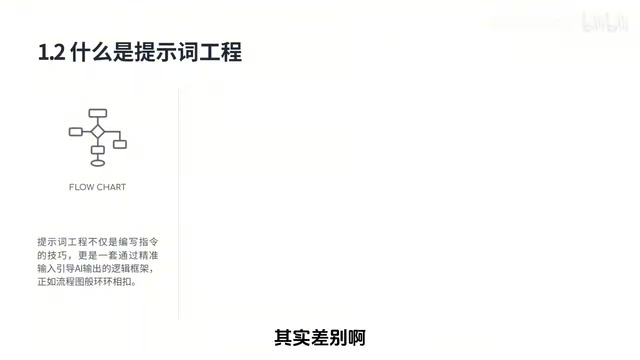
The contrast is clear: a prompt is one-off, like writing a line of code that executes once to solve one problem—it works this time, but may fail with a different problem next time. So-called "universal prompts" don't exist; only prompts suited to specific scenarios do. Prompt engineering, on the other hand, is a process—relying on method rather than inspiration, from analyzing problems to designing solutions, testing results, and continuously optimizing, ultimately crystallizing into reusable assets. It solves not one problem but a class of problems.
Execution can be broken into six steps: requirement decomposition (breaking complex problems into small problems AI can solve), solution design (designing prompts and roles for each sub-problem), execution testing (actually running it to see results), evaluation (using specific criteria to judge quality), strategy iteration (continuously improving weak points), and crystallization for reuse (saving good solutions for direct use in similar scenarios). This process closely resembles software development—except you're writing in natural language.
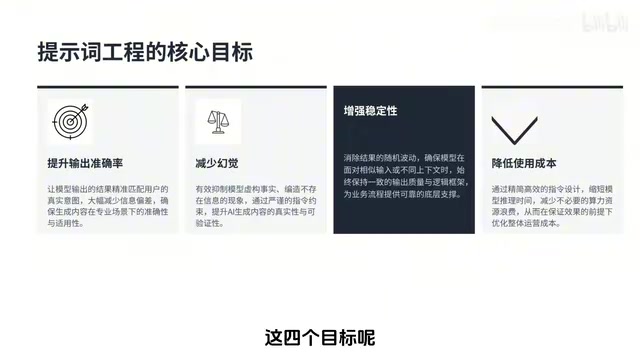
Prompt engineering ultimately pursues four goals, which also serve as criteria for evaluating solutions: improving accuracy, reducing hallucinations, enhancing stability (same results regardless of who uses it or when), and lowering cost (getting the best results with the fewest tokens). If all four are achieved, the solution is successful.
Token is the basic unit of text processing for large models, roughly understood as a "word piece"—a Chinese character, an English word, or a punctuation mark often corresponds to one or more tokens. Models charge based on total input and output tokens, and the context window (the maximum number of tokens the model can "remember" at once) is measured this way too. This is why longer prompts cost more and why models "forget" during long conversations: early content beyond the window gets truncated or compressed. Understanding tokens helps you proactively simplify when writing prompts—using more concise expression to gain lower costs and more stable context retention.
Why It's Worth Learning Now
The tutorial cites a statistic: over 90% of users only use AI for basic Q&A. It's like buying a sports car but only driving in first gear. Current model capabilities are already strong—the bottleneck is on the user side: not knowing how to unleash them.
Prompt engineering has an extremely low barrier to entry: no programming required, no need to understand algorithms—just the ability to speak and express things clearly. Yet the returns are direct. In terms of efficiency, what used to take a day might be done in an hour, and you can tackle tasks AI previously couldn't handle, like writing professional reports or doing complex data analysis. Commercial value is equally significant: helping businesses and content creators optimize prompts or generate content can be done in spare time; when starting a business, one person can do the work of an entire team with low trial-and-error costs, allowing ideas to be validated quickly; content creators can use AI to rapidly produce content and build followers. The tutorial's framing: this isn't just a skill—it's an opportunity in the AI era.
Context Window is the maximum number of tokens a model can process in a single conversation, analogous to working memory capacity. The larger the window, the more material the model can reference simultaneously—suitable for long document analysis and multi-turn complex tasks. But the window isn't infinite, and as conversation progresses, early content may be pushed out or diluted, causing the model to "forget" initially set roles and requirements. Common practical workarounds include periodically restating key constraints during long tasks, placing important information at the beginning or end, or splitting tasks into multiple short sessions to avoid information decay caused by window limits.
The Limits of Prompts: Not a Master Key
The course spends considerable time on limitations at the end—and this part is actually most worth taking seriously.
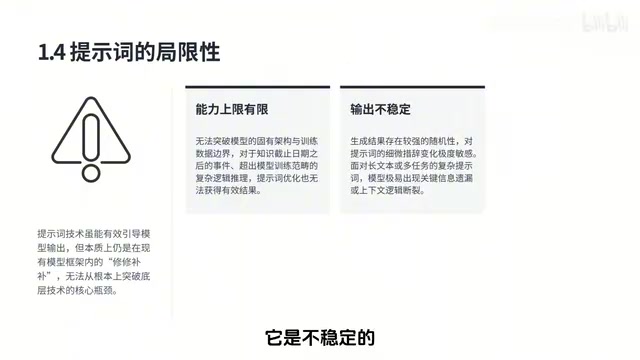
The capability ceiling cannot be broken. AI training data has a cutoff date—ask about events after that and it won't know; complex math problems it can't solve, no matter how you optimize the prompt.
Output is unstable. Sometimes changing one word produces completely different results; overly long prompts cause the AI to "forget"—what was said earlier is lost later.
Hallucinations can only be reduced, not eliminated. Any large model will inevitably fabricate—important matters must be verified yourself.
At the technical level, there are three hard constraints: limited context length, like phone RAM—open too many apps and the system kills background processes; chat too long and the AI forgets initial requirements. Complex multi-step tasks are unstable—prone to skipping steps and breaking logic—so they must be broken into smaller tasks first. And there's no true long-term memory—each conversation is brand new, unable to remember preferences and background, solvable only through external databases. These three problems are determined by the technical foundation and cannot be fixed by prompts.
At the implementation level, there are three pitfalls. First, safety and alignment restrictions: illegal content absolutely cannot be generated, but completely legitimate requests may also be falsely blocked—a common problem across all large models. Second, pure prompting can't be engineered: fine for personal use, but not for a product serving hundreds or thousands of users—version management, issue tracing, and large-scale batch tasks can't hold up. Enterprise applications must combine prompts with code. Third, the cost trap: AI charges by token—longer prompts cost more, and costs don't grow linearly; hidden costs become terrifying with high-frequency calls. Prompts must be concise.
Building these four understandings is more valuable than memorizing any "god-tier prompt." Prompts are a great tool, but not a master key—what should be done by humans still needs humans.
Hallucination refers to large models generating content that appears plausible but is factually incorrect or fabricated. The root cause is that models fundamentally predict the next token based on probability rather than retrieving from a factual database—so when training data is missing or the question exceeds their knowledge, they "smoothly fabricate" rather than admit not knowing. Common mitigation methods include: asking the model to flag uncertain areas, providing reference materials for it to answer based on given content (retrieval augmentation), and using external tools to verify key data. But these only reduce probability—they cannot be eliminated mechanistically. So for high-risk information like numbers, regulations, and citations, human review remains essential.
Related articles

AI Tools Quietly Altering Settings: Postman Silently Installs Plugin, Codex Sharing Option Auto-Resets
AI Daily reports: Postman silently installs a Mac plugin and self-approves startup hooks, logged as auto-existing upgrade; Hacker News developers say Codex data-sharing opt-out flips back. Plus Simon Willison's raw float weight experiment with QEN 3.8-27B.

AI Learns to Rewrite AI: MIT's "Weightspace Programming" Redraws the Path to Recursive Self-Improvement
MIT team proposes weightspace programming: GPT-6 Astra reads and edits AI model weights directly. Math scores jump several-fold, hand-written networks beat trained models. Eight experiments analyzed, plus Anthropic's same-day warning and the real boundaries of recursive self-improvement.

Running Qwen 3.8 on a Laptop to Read Raw Weights: 46 Minutes Per Answer
Simon Willison reproduced weight space programming with Qwen 3.8 27B on a laptop: a 17GB model file, 46 minutes per answer, 43,506 reasoning tokens, Pong over an hour, Freeway failed. Suited for interpretability researchers.