Flova All-in-One Agent: A Systematic Solution to Character Consistency in AI Short Drama Production
Flova is an AI-native Agent that solves character drift in serialized AI short drama production.
Flova is an all-in-one AI-native Agent designed for full-pipeline video creation. It addresses the biggest pain point in AI short drama production — characters changing appearance across episodes — through a persistent document system, a reusable asset library, and an integrated workflow covering script generation, storyboarding, and final output.
The Rise of AI Short Dramas — and Their Core Pain Point
A recent AI-generated short drama called Zui Qi Yang Zhan Shen ("Drunk Bizarre Raises a War God") went viral, surpassing 100 million views and running for eight seasons. With similar hit productions emerging regularly, AI video creation is clearly transitioning from concept to mature commercial application — featuring natural character movement, coherent storylines, and consistent visual style that demonstrate AI's enormous potential for long-form content creation.
The rise of AI short dramas is closely tied to the traffic dynamics of short-video platforms. China's short drama market, led by Douyin and Kuaishou, experienced explosive growth between 2023 and 2024, with annual paid short drama revenue exceeding tens of billions of yuan. AI's involvement has further compressed content production cycles — while traditional short dramas require days or even weeks of filming and editing, AI-generated content can theoretically reduce single-episode production time to just a few hours. This efficiency leap has attracted a large number of independent creators and MCN agencies, giving rise to a wave of AI content studios built around the competitive advantage of "low cost, high output."
Yet anyone who has produced a serialized AI short drama knows the feeling all too well: the most maddening problems show up when making the sequel. The first episode looks great, but by the second, the lead character's appearance has inexplicably changed and the entire world falls apart. This inconsistency in character appearance and visual style remains the single biggest obstacle to scaling AI short drama production.

The root cause lies in the fact that mainstream image/video generation models — such as Stable Diffusion, Midjourney, and Sora — lack persistent "memory" mechanisms. These models, built on diffusion or Transformer architectures, rely on the current input prompt and a random noise seed at each generation call and do not natively maintain state across sessions. Even with identical prompts, the stochastic sampling process introduces variation in outputs. Common workarounds in the industry include ControlNet reference image constraints, IP-Adapter character feature injection, and LoRA fine-tuning for dedicated character models — but these approaches carry a high technical barrier for everyday creators and are difficult to integrate seamlessly into a continuous narrative workflow. This is precisely the key pain point that Flova, the subject of this article, is built to solve.
Flova: An AI-Native All-in-One Agent for the Complete Creative Workflow
Unlike the single-function video generation tools on the market, Flova is positioned as an AI-native all-in-one Agent covering the full video creation pipeline. The "AI-Native Agent" paradigm is a product concept that has risen to prominence over the past two years alongside the leap in large language model (LLM) capabilities. Unlike the linear "user action → tool execution" model of traditional software, the Agent paradigm emphasizes the AI system's ability to understand user intent, autonomously plan multi-step tasks, invoke multiple tools, and dynamically adjust its strategy based on feedback during execution. In video creation, this means the system can respond not just to single instructions (like "generate a character image") but to compound instructions like "produce the third scene of episode two based on the existing settings" — automatically coordinating subtasks such as script retrieval, style constraints, and shot generation. Flova doesn't just generate a single clip; it covers the entire chain from scriptwriting to final output.
Full Script Generation from a Single Sentence
In practice, users simply enter a one-sentence idea and Flova generates a complete short drama script. Take the example of Capture Wind Pet Short Drama: within minutes of entering the prompt, the system produced a complete storyline for the first three episodes — including character profiles and storyboard breakdowns for each episode — dramatically lowering the barrier to scriptwriting and allowing creators to rapidly scaffold a story structure.
Seamless Bridge from Script to Visuals
Once the storyline is confirmed, users can guide Flova to the next step: generating character design visuals, then producing storyboards and scene reference images. The storyboard is a standard pre-production tool that the film and television industry has relied on for decades, originating from early Disney animation workflows. It translates the written narrative of a script into a visualized shot sequence through frame-by-frame sketches. In traditional film production, professional storyboard artists command high day rates, and storyboarding a short film can take several days. AI-assisted storyboard generation dramatically reduces the cost of this stage and, more importantly, closes the loop between "written intent" and "visual representation" rapidly — allowing creators to validate narrative pacing in a very short time. The entire workflow is tightly integrated, so creators never need to switch between multiple tools.
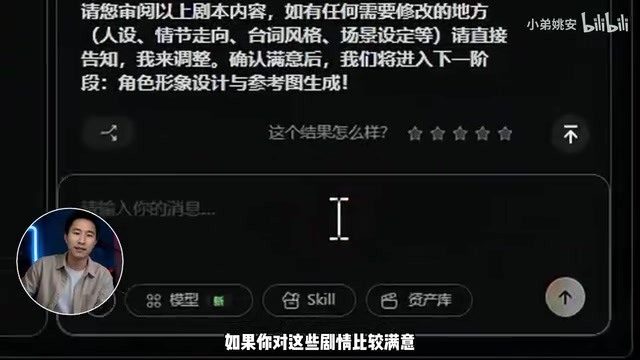
This all-in-one workflow design is the core value that sets Flova apart from traditional AI video tools — consolidating fragmented creative steps into a single coherent, Agent-driven process.
Dual-View Mode and Fine-Grained Control
Flova's left panel provides a clear view of storyboard settings and all creative elements. The upper-left area supports free switching between List Mode and Canvas Mode:
- List Mode: Review shots in storyboard order, one by one. Clear and logical, ideal for ironing out narrative structure in the early script phase.
- Canvas Mode: Freely drag and reorganize material relationships — better suited for managing complex assets as a project grows in scale.
Shot-Level Precision Editing
After the storyboard is generated, if certain shots are unsatisfactory, users can submit revision requests directly in the comment area for individual shots. The system also supports parallel processing of multiple localized tasks. This fine-grained, controllable editing capability avoids the "change one thing, break everything" problem of full regeneration — enabling true local optimization without disrupting the overall project.
The Document System: The Core Mechanism Behind Consistent Characters
The key to Flova's solution for character appearance drift and world-building collapse lies in the combined design of its document system and asset library.
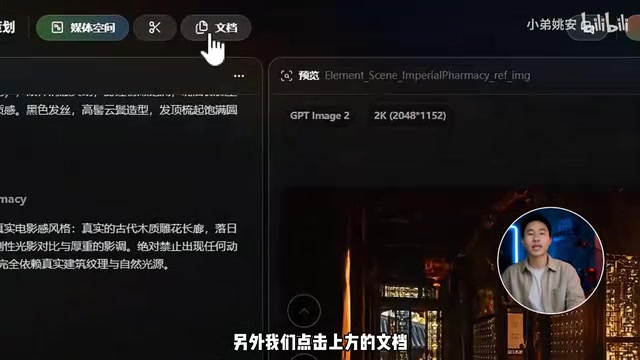
Through the document entry in the interface, users can view files such as style requirements and production rules, and update them manually at any time. After an update, the AI continues working based on the latest context in subsequent creative tasks, ensuring the overall style remains controllable. Creators can also save scripts and story backgrounds as documents to reference across episodes, ensuring narrative continuity — for example, instructing the system to produce episode two strictly in accordance with the style document and story outline, thereby maintaining the established settings.
Asset Library: One-Click Access to Reusable Materials
Beyond project documents, Flova also supports saving reusable content — characters, visual styles, music, materials — to an asset library.
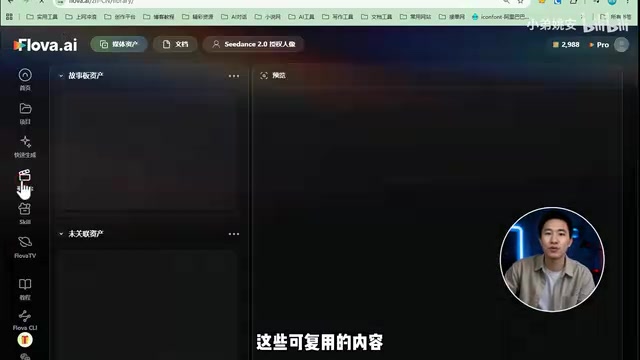
The asset library concept draws from the mature Digital Asset Management (DAM) systems used in the game and film industries. In professional film production pipelines, assets such as 3D character models, texture maps, and voice recordings are typically stored on centralized asset servers for cross-department, cross-project reuse. Flova transplants this concept into the AI-generated content space. The core technical challenge here is: how to persistently store a character's "visual identity" in a structured way, and inject it as a hard constraint when invoking a generation model each time — achieving deterministic appearance reproduction within diffusion models that are inherently probabilistic. This typically involves a multi-layer combination of techniques including reference image embedding, character feature vector extraction, and conditional control signal injection, and represents one of the core technical moats in today's competitive AI content creation tool landscape.
Whether producing episode two, three, or four, creators can invoke existing character and style assets with a single click. This is the technical foundation that solves the "character drift" problem — through persistent asset management, the AI truly "remembers" the creative intent, achieving a high degree of character and style consistency across episodes.
An Open Strategy of Continuous Integration with Top-Tier Models
Flova has committed to integrating the best available models on the market as quickly as possible. According to the team, Flova is about to integrate Kling CD2.5 (the Kling series). Kling is a video generation foundation model developed by Kuaishou's Kling AI team. Since its release in mid-2024, it has attracted widespread attention both domestically and internationally for its high motion fluency and extended generation duration (supporting videos up to 3 minutes), and is considered one of the most representative domestic Chinese video generation models — competing with international products such as Runway Gen series, Pika, and Sora. Flova leverages its SKILL mechanism to accumulate a large body of optimized workflows and official operational best practices, maximizing the generation quality and capability of each integrated model.
The strategy of "platform-level integration of top models + accumulation of best practices" means creators don't need to master complex parameter tuning themselves — they simply benefit directly from polished, optimal generation results. This competitive strategy represents the direction of AI applications evolving from single-point tools toward systematic workflows, and is a prime example of the current trend toward AI tool platformization.
Conclusion: From "Making One Episode" to "Making an Entire Season"
Flova delivers a systematic solution to the core pain points of AI short drama production — character appearance drift and visual style collapse. Through the coordinated combination of script generation, storyboard design, dual-view editing, the document system, and the asset library, it builds an AI-native creative Agent that can genuinely "remember" a project.
For creators looking to produce serialized AI short dramas at scale, consistency and continuity are the lifeblood of commercial operations. The emergence of full-pipeline Agent tools like Flova is pushing AI short drama production from "being able to make one episode" to the practical stage of "being able to make an entire season." As more top-tier models continue to be integrated, the capability boundaries of these tools will keep expanding — making them well worth following for content creators.
Key Takeaways
Related articles

Workbuddy for Absolute Beginners: How a Desktop AI Agent Fits Into Real Workflows
A beginner's guide to the Workbuddy desktop AI agent: installation, claiming credits, file management, and building automated workflows—compared with CodeX for fit and cost, helping professionals shift from AI question-askers to AI managers.

OpenAI's New Agent Stack: Computer Use, Decisions API, and Ultra-Fast Workflows
OpenAI Dev Day unveiled a new agent stack: Computer Use outperforms humans, Decisions API delivers ultra-low-latency classification via Luna, Agents API opens the same Computer Use capabilities, and GPT-6.1 Sol costs only one-seventh of Astra. Core updates, benchmark data, and developer insights.

Liang Wenfeng Open-Sources DeepInfo Inference Framework, Takes On U.S. Ban
DeepSeek open-sources its DeepInfo inference framework after its models, featuring GPU/CPU cross-pipelining, small-model prediction with large-model verification, and full Huawei Ascend and NVIDIA chip support—facing the U.S. federal ban head-on. This article analyzes its significance for AI deployment and open-source strategy.