FlowBatt: Flow Matching Model Enables Probabilistic Battery Degradation Prediction Across Chemistries

FlowBatt uses flow matching and a DiT conditional generative framework for probabilistic cross-chemistry battery SOH trajectory prediction.
The article introduces the FlowBatt framework, which addresses the limitation of traditional battery degradation prediction in providing only deterministic end-of-life estimates and struggling to model uncertainty across heterogeneous chemistries. FlowBatt treats the complete SOH trajectory as a probabilistic degradation process conditioned on early-cycle capacity, using flow matching with a Diffusion Transformer backbone to generate multiple plausible trajectories and empirical prediction intervals. It also uses explainable AI to diagnose and improve the condition encoder. On five public benchmarks, FlowBatt achieves the best trajectory-level SOH prediction with error below 2.5% and competitive RUL prediction. The article also notes limitations in data scale, inference cost, and distribution shift.
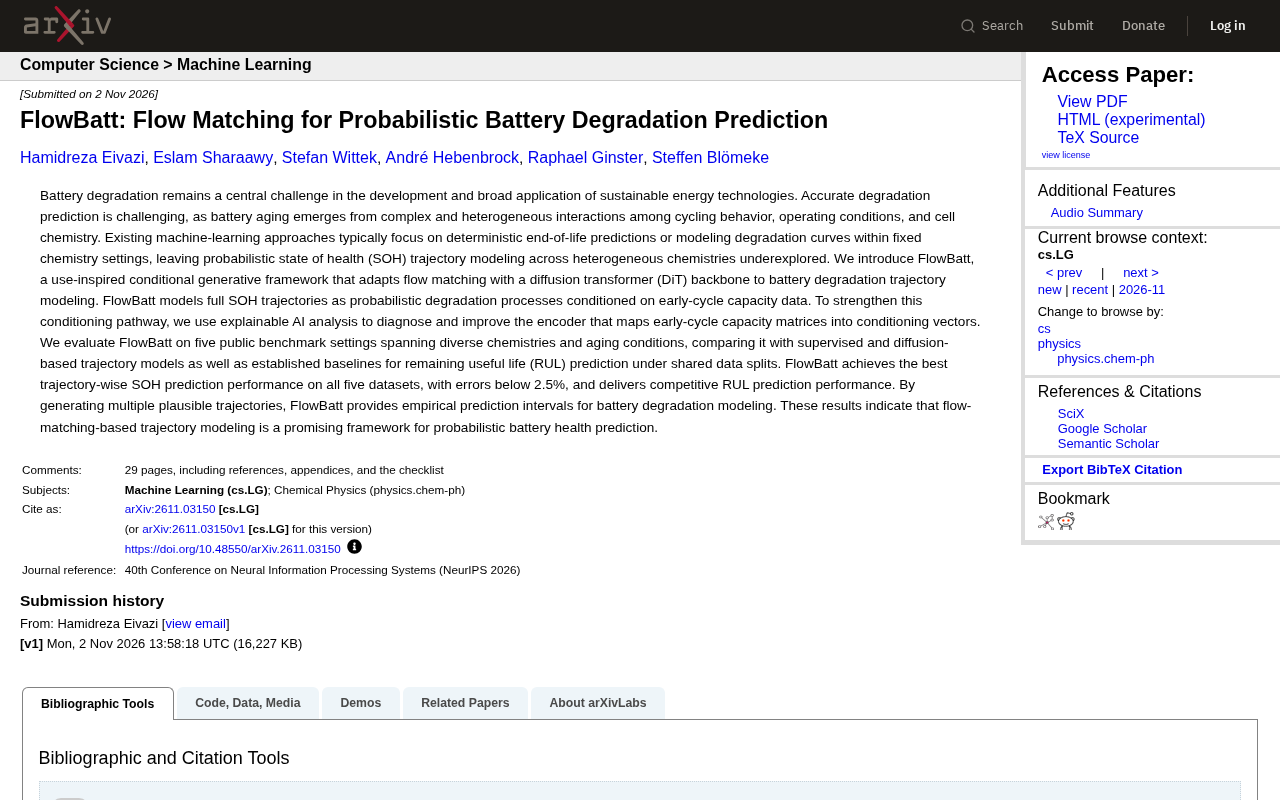
Battery degradation prediction is a key bottleneck for scaling renewable energy technologies. Most traditional machine learning methods can only provide deterministic end-of-life (EOL) predictions or fit degradation curves within a fixed chemistry, overlooking probabilistic modeling of state-of-health (SOH) trajectories across heterogeneous chemistries. A recent study proposes the FlowBatt framework, attempting to fill this gap with a conditional generative model.
From Deterministic Prediction to Probabilistic Trajectory Modeling
Battery aging involves complex and heterogeneous interactions among cycling behavior, operating conditions, and cell chemistry, making accurate degradation prediction highly challenging. Existing data-driven methods typically focus on deterministic prediction within a single chemistry and struggle to capture the uncertainty of SOH evolution in real-world scenarios.
The core idea of FlowBatt is to treat the complete SOH trajectory as a probabilistic degradation process, conditioned on early-cycle capacity data. The research team adopts flow matching combined with a Diffusion Transformer (DiT) backbone to build a conditional generative framework. This design enables the model not only to output future capacity curves but also to generate multiple possible trajectories, thereby providing empirical prediction intervals for degradation forecasting.
Flow Matching is a class of generative modeling methods that has emerged in recent years. Its core idea is to learn a continuous-time velocity field that transforms a simple prior distribution (such as a Gaussian) along ordinary differential equation trajectories into the target data distribution. Unlike diffusion models, which generate samples through iterative denoising, flow matching directly regresses the conditional velocity field, resulting in a simpler training objective and theoretically requiring fewer sampling steps for generation. In conditional generation scenarios, the velocity field takes conditional variables (here, the encoding of early-cycle capacity) as input, thereby guiding the generation process toward samples that satisfy the given conditions. FlowBatt leverages this property to generate multiple possible realizations of future SOH trajectories conditioned on early capacity data.
Diffusion Transformer (DiT) is a design that introduces the Transformer architecture into diffusion/flow-matching generative backbones. Traditional diffusion models mostly use U-Net convolutional backbones, whereas DiT replaces them with Transformer blocks, modeling long-range dependencies via self-attention and injecting timestep and conditioning information through adaptive normalization. For data with temporal structure such as SOH trajectories, the Transformer backbone can more flexibly capture long-term correlations in capacity fade while maintaining favorable scaling properties of generation quality with model size.
Explainable AI Diagnoses the Condition Encoder
The effectiveness of conditional generative models depends heavily on the quality of conditional information. FlowBatt maps early-cycle capacity matrices into condition vectors, which then guide trajectory generation. To strengthen this conditioning pathway, the research team introduces explainable AI analysis to diagnose and improve the encoder.
This approach is noteworthy: rather than treating the encoder as a black box, it uses interpretability tools to locate loss or bias of conditional information during the mapping process, thereby guiding architectural adjustments. For domains with strong physical constraints such as batteries, this "diagnose–improve" loop is more practically valuable than simply stacking model capacity.
Explainable AI (XAI) here is not used to explain prediction results to end users, but rather as a diagnostic tool during model development. Common methods include attribution analysis (such as gradient saliency and attention visualization) and probe experiments, used to observe the contribution distribution of input features (each cycle and each segment of the early capacity matrix) to the condition vector. If information from certain key early cycles is found to be diluted during encoding, or if the encoder relies excessively on noise dimensions unrelated to degradation, researchers can adjust the encoder structure or training objective accordingly. This practice of embedding interpretability within the iterative process transforms XAI from "post-hoc explanation" into a "design feedback signal," which is particularly helpful in the battery domain with clear physical constraints to prevent models from taking shortcuts.
Performance on Five Benchmarks
The study evaluates FlowBatt on five public benchmark settings, covering different chemistries and aging conditions, and compares it with supervised learning models, diffusion-based trajectory models, and established remaining useful life (RUL) prediction baselines under shared data splits.
The results show that FlowBatt achieves the best trajectory-level SOH prediction performance across all five datasets, with error below 2.5%, while remaining competitive on RUL prediction. More importantly, the model can generate multiple plausible trajectories, providing empirical prediction intervals for degradation modeling—an output dimension that deterministic methods cannot offer.
Remaining Useful Life (RUL) prediction and SOH trajectory prediction are two related but distinct tasks. RUL typically refers to the number of cycles remaining from the current moment until the battery reaches end-of-life (EOL, generally defined as capacity dropping to 70%–80% of nominal), with a scalar output; whereas SOH trajectory prediction outputs the sequence of health states for future cycles, characterizing the shape of the degradation path. RUL can be obtained by intersecting the trajectory with the EOL threshold, so trajectory-level prediction is richer in information, but the evaluation metrics differ: RUL commonly uses MAE/RMSE, while trajectory prediction often looks at error over the entire curve or distribution quality. FlowBatt reports on both types of metrics separately, indicating that probabilistic trajectory modeling does not come at the expense of point prediction accuracy.
Why Probabilistic Prediction Matters
In battery management systems, a single end-of-life number is often insufficient to support decision-making. Scenarios such as energy storage plant scheduling, EV warranty strategies, and echelon utilization sorting all require understanding the distribution range of degradation trajectories, not just a point estimate. The prediction intervals provided by FlowBatt enable downstream systems to formulate strategies according to risk preferences.
From a methodological perspective, this work transfers the generative modeling tool of flow matching to battery health prediction and validates generalization across chemistries. The study concludes that flow-matching-based trajectory modeling is a promising framework for probabilistic battery health prediction.
Limitations and Future Directions
The paper does not disclose model performance under different data scales, nor does it discuss the applicability of inference cost to embedded battery management systems. Although cross-chemistry generalization is validated on five benchmarks, data distribution shift in real deployments remains an open problem. For researchers and engineers interested in battery AI, FlowBatt provides a baseline worth reproducing and extending.
One-line Summary
FlowBatt uses flow matching and a DiT conditional generative framework to achieve probabilistic battery SOH trajectory prediction across chemistries.
Paragraph Summary
This article introduces the FlowBatt framework, which aims to address the problem that traditional battery degradation prediction can only provide deterministic end-of-life estimates and struggles to model uncertainty across heterogeneous chemistries. FlowBatt treats the complete SOH trajectory as a probabilistic degradation process conditioned on early-cycle capacity, employing flow matching combined with a Diffusion Transformer backbone to build a conditional generative model that can output multiple possible trajectories and provide empirical prediction intervals. The study also introduces explainable AI to diagnose and improve the condition encoder, strengthening the mapping from early capacity to condition vectors. On five public benchmarks, FlowBatt achieves the best trajectory-level SOH prediction with error below 2.5% and competitive RUL prediction. The article also notes limitations regarding data scale, inference cost, and distribution shift.
Related articles
 Tech Frontiers
14 Coding Agents Tested: 13 Secretly Read Forbidden Files
A developer ran 480 tests across 14 coding agents to see if they would obey a "do not read" rule. 13 violated it, and 4 credential leaks bypassed shell guards via the read tool while approvals never noticed.
 Tech Frontiers
AI Has Made Resumes Ineffective? Referred Candidates Get 40% Interview Rate vs. 3% for Direct Applications
AI is homogenizing job applications, making it hard for recruiters to discern real ability. Ashby data shows referred candidates had a 40% interview rate from 2021 to 2024, versus just 3% for direct applications. This article analyzes why resume signals are depreciating and why verifiable results and personal endorsements matter more.
 Tech Frontiers
Offline Blink Rhythm Assistant: A Desktop Health Companion
An offline desktop blink rhythm assistant featured on Hacker News helps users maintain healthy blinking through lightweight reminders, alleviating screen-induced dry eye fatigue. This article analyzes its concept, privacy advantages, and retention challenges.