Flutter Deep Dive: Why This Cross-Platform UI Framework Has Earned 179K GitHub Stars

Flutter's self-rendering engine and Dart dual-compilation have made it the go-to cross-platform UI framework with 179K GitHub Stars.
Flutter is Google's open-source cross-platform UI framework with over 179K GitHub Stars and 32K Forks. Unlike traditional solutions, it uses the Skia/Impeller engine to render every pixel directly, ensuring consistent UI across iOS, Android, web, and desktop. Dart's JIT/AOT dual-compilation enables millisecond Hot Reload during development and native performance in production. Backed by a rich pub.dev ecosystem of 40,000+ packages, Flutter is ideal for startups, brand-driven products, and fast-iterating teams — solidifying its status as a mainstream cross-platform choice.
Flutter Deep Dive: Why This Cross-Platform UI Framework Has Earned 179K GitHub Stars
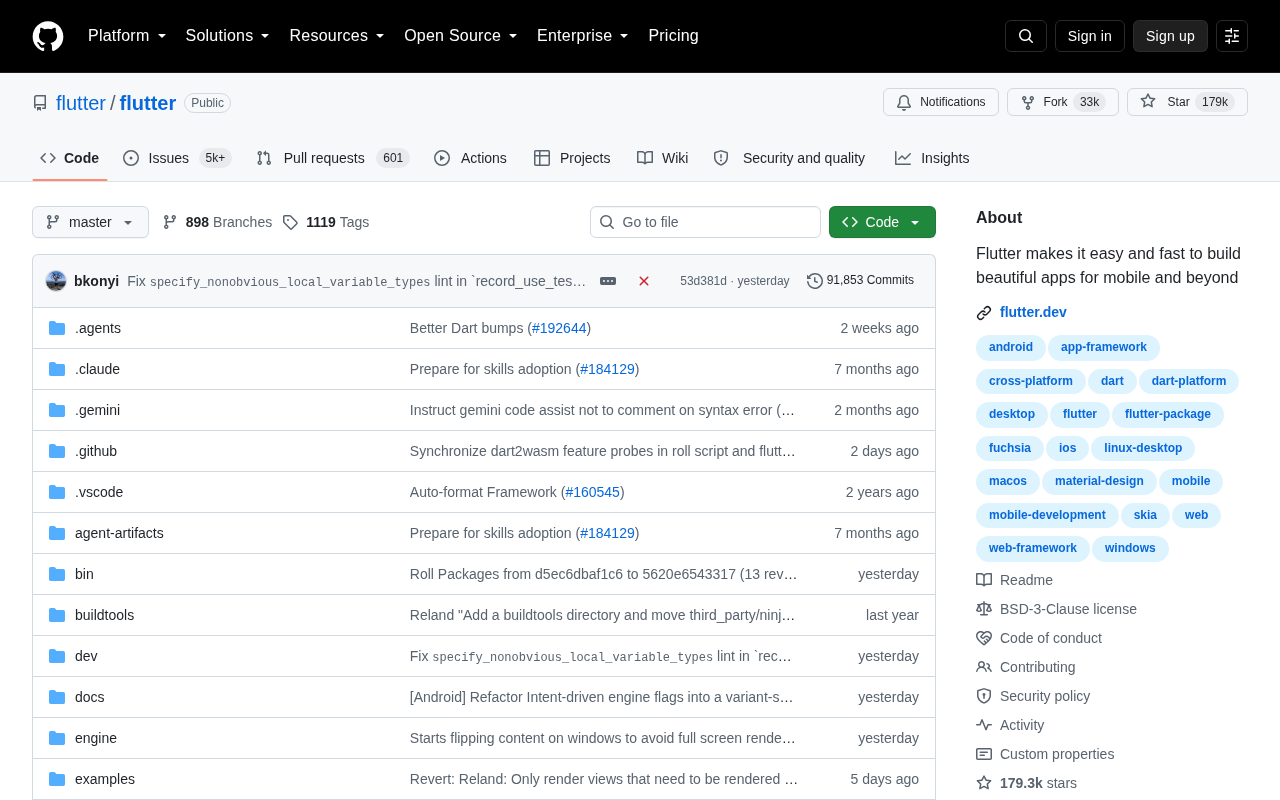
In the world of cross-platform app development, Flutter — the open-source framework led by Google — has become impossible to ignore. To date, its GitHub repository has accumulated over 179,310 Stars and 32,946 Forks, with a steady weekly gain of 266 new Stars. Behind these numbers lies something more meaningful: a sustained vote of confidence from the global developer community in the "write once, run everywhere" philosophy.
What Problem Does Flutter Actually Solve?
Flutter's official positioning is to make it "easy and fast to build beautiful apps for mobile and beyond." Two keywords in that statement are worth unpacking: beautiful and beyond.
Traditional cross-platform solutions typically compromise between performance and native-like experience. Flutter takes a fundamentally different technical approach — instead of relying on platform-native controls, it uses its own rendering engine (Skia/Impeller) to draw every single pixel directly. This means UI behavior remains highly consistent across iOS, Android, desktop, and web, giving developers far greater control over the interface.
"Beyond" signals Flutter's ambition: it is no longer just a mobile development framework. From its initial focus on iOS and Android, Flutter now targets Web, Windows, macOS, Linux, and even embedded devices — positioning itself as a truly universal UI solution.
Flutter's decision to use a self-rendering engine rather than reusing platform-native controls is one of the more radical choices in the cross-platform framework landscape. Traditional solutions like React Native use a "bridge layer" to map JavaScript calls to native platform components. The upside is that the UI naturally aligns with system styles; the downside is that bridge communication introduces performance bottlenecks, and inconsistencies in component behavior across platforms lead to a fragmented user experience. Flutter sidesteps this entirely: it relies on Skia (in older versions) or the next-generation Impeller rendering engine to rasterize all Widgets directly onto a Canvas, exchanging only the final pixel frames with the operating system. This gives developers near-total control over visual and interaction behavior across platforms. The trade-offs are a larger app bundle size (since the rendering engine must be embedded) and the need to communicate with the host platform via Platform Channels when accessing deep native capabilities like Bluetooth or camera.
Dart: An Underrated Language Choice
Flutter uses Dart as its development language — a choice that sparked controversy early on, but in hindsight proves to be quite forward-thinking. Dart supports both JIT (Just-In-Time) and AOT (Ahead-Of-Time) compilation: during development, JIT powers Hot Reload, reflecting code changes in running apps within milliseconds; at release time, AOT compiles the code to native machine code, ensuring runtime performance.
This dual-compilation model is the technical foundation behind Flutter's promise of "fast to develop, fast to run." For developers accustomed to the lengthy cycle of code → compile → wait → check, Hot Reload is a genuine productivity leap.
The JIT/AOT switch has a profound impact on the development experience and deserves a closer look. JIT dynamically compiles code into machine instructions at runtime, which is precisely why Hot Reload can take effect in milliseconds — Flutter only needs to recompile and swap in the changed code segments without restarting the app or losing the current UI state. AOT, on the other hand, fully compiles Dart code into native machine code for the target platform during the build phase, eliminating runtime compilation overhead for faster startup and higher execution efficiency — ideal for production releases. Dart also features built-in Null Safety, catching a wide range of potential null pointer errors at compile time, further improving code robustness. This is a meaningful differentiator compared to similar dynamic languages.
Community Momentum and Ecosystem Maturity

With 179K+ Stars, Flutter firmly ranks among the most popular open-source projects on GitHub. What's more telling is the sustainability of its growth — 266 new Stars per week indicates the project is still attracting new users, not just coasting on historical numbers.
Over 32,000 Forks tell yet another story: a large number of developers aren't just using Flutter — they're building on top of it, contributing plugins, and creating custom solutions. The pub.dev package registry that surrounds Flutter has accumulated a vast library of third-party packages covering networking, state management, UI components, and more, significantly lowering the barrier to entry.
Which Teams and Use Cases Is It Best For?
From a practical standpoint, Flutter is especially well-suited for:
- Startups and small-to-medium businesses: Limited engineering headcount, needing a single codebase to cover multiple platforms and validate products quickly.
- Products that prioritize UI consistency: Apps with strong branding and complex interactions can fully leverage Flutter's self-rendering engine.
- Rapidly iterating projects: Hot Reload dramatically shortens the development feedback loop.
That said, Flutter is not a silver bullet. Applications that are heavily dependent on platform-specific native features, or that are extremely sensitive to bundle size, will still require careful consideration of the trade-offs.
pub.dev is the official package registry for Dart and Flutter — the equivalent of npm for JavaScript or PyPI for Python. Developers can publish, discover, and depend on third-party libraries (called "packages") here. The platform automatically scores each package based on documentation quality, test coverage, platform compatibility, and maintenance activity, helping developers quickly assess quality. pub.dev currently hosts over 40,000 public packages, including popular state management solutions like Provider, Riverpod, and Bloc, as well as widely used utility libraries such as Dio (HTTP networking), Hive (local storage), and flutter_map (maps). This rich ecosystem means Flutter projects rarely need to build common functionality from scratch, which is a key reason new teams continue to adopt it.
Final Thoughts
Flutter's success is no accident. Its combination of a self-rendering engine and Dart's dual-compilation model offers a compelling answer to the longstanding challenges of cross-platform development. Nearly 180,000 Stars represent a global developer community voting with their feet. For teams evaluating cross-platform technology stacks, Flutter has evolved from "worth a try" to an unmissable mainstream option.
Related articles

Felix Rieseberg Personal Homepage
Felix Rieseberg's personal homepage sparks attention on Hacker News. This article covers the Slack engineer's technical background, the rise and fall of nativefier, and the value of a developer homepage as a tech calling card.

@ai-sdk/vue 3.0.306 Patch Release Syncs with [email protected] Update
@ai-sdk/vue 3.0.306 released, synced with [email protected]. A routine patch release for the Vercel AI SDK ecosystem with no public API changes; the Vue adapter layer stays version-aligned with the core package.

Gemini 4 Argon API Launches: The Era of Million-Token Output Begins
Google launches Gemini 4 Argon with sparse MoE architecture, up to 1M output tokens, and a 68.90% Vals Index score, available across API, AI Studio, and the Gemini app.