FLUX 3 Image Klein Released: 5.6B Image Model Runs on 8GB VRAM

AI capabilities are moving from the chat box to VRAM, browsers, payment networks, and steering wheels—execution and verification are the new battlegrounds.
This article rounds up key recent AI developments: FLUX 3 Image Klein achieves 8GB VRAM operation with 5.6B parameters and supports 4K and pixel-level editing; Anthropic's Claude Duet agent has its own VM and browser and can run for months after the user's device is off; OpenAI and Perturbate's multi-agent research system earned 75% expert preference in blind evaluations; Tencent opens internally validated search infrastructure via Tencent Cloud; Visa pilots AI agent payments, emphasizing independent verification of identity and behavior. It also covers insurance data corroborating NIO's assisted driving, NVIDIA's humanoid robot platform, and energy data. The article argues that three threads—model compression, agents' independent operation and payment identity, and physical-world feedback—are advancing together as AI shifts from 'can answer' to 'can execute,' with verification, authorization, and cost as the core challenges ahead.
AI model release cadence keeps accelerating, but what's truly worth noting this round isn't how much parameter counts have grown—it's that capabilities are moving out of the chat box and onto VRAM, browsers, payment networks, and steering wheels.
According to a roundup from Bilibili's AI Briefing, FLUX 3 Image Klein achieves 8GB VRAM operation with 5.6B parameters, Anthropic launches the Claude Duet agent that can run independently for months, and Visa kicks off an AI agent payment pilot. Viewed together, these stories point to a structural shift in how AI is being deployed.
FLUX 3 Image Klein: Squeezing a 5.6B Model into 8GB VRAM
Image generation models have long faced a trade-off: quality tends to scale with VRAM usage. FLUX 3 Image Klein's approach keeps parameters at 5.6B while supporting text-to-image, image editing, multi-reference generation, and native 4K resolution.
The more critical metric is its claim of pixel-level precise editing and stable pattern/line dimensional performance. For real workflows, this means the model doesn't just "draw convincingly"—it can modify local regions on command and maintain structural consistency. These two points are precisely the barriers to deploying generative models in design, e-commerce, and content production scenarios.
The 8GB VRAM threshold also deserves a separate mention. It extends the runnable range from high-end professional cards to mainstream consumer GPUs—a more direct benefit for independent creators and small teams than any benchmark improvement.
The relationship between diffusion models and parameter count: FLUX 3 Image Klein belongs to the diffusion model family, which generates images by progressively denoising from random noise. During inference, multiple copies of network weights must reside in memory simultaneously, so VRAM usage is typically far higher than a language model with the same parameter count. Compressing 5.6B parameters to run on 8GB VRAM usually implies parameter-efficient architectures (such as MoE-ified MMDiT variants), quantized inference (FP8/INT8), and chunked computation—engineering optimizations whose cost is often a slight loss in speed or extreme detail rather than capability. Understanding this is essential to judging whether "runs on 8GB" is a marketing line or genuinely usable in real workflows.
Claude Duet: Agents Begin Running Outside Your Device
Anthropic's Claude Duet is positioned as an AI agent rather than a chatbot. According to the briefing, it has its own dedicated VM and browser, and can continue running for up to 3 months even when the user's device is turned off.
This design points in a clear direction: the value of an agent lies not in conversation turns but in whether it can autonomously execute tasks over extended periods. The dedicated VM solves the execution environment problem, while the browser lets it interact with real web scenarios. Running continuously after the device is off essentially transforms AI from "you ask, it answers" to "you instruct, it handles."
The fundamental difference between agents and chatbots: Chatbots are stateless request-response systems—each conversation is independent and depends on the user being present. Agents, by contrast, have goal decomposition, tool invocation, environment interaction, and state persistence capabilities, enabling them to execute multi-step tasks continuously without human intervention. Claude Duet's dedicated VM provides an isolated execution sandbox, the browser serves as its tool interface to the real web, and "running for months after device shutdown" relies on server-side session persistence and checkpoint recovery. The engineering challenge of such designs isn't the model itself but long-horizon task interruption recovery, resource billing, and security boundary control.
Research and Security: Multi-Agent Collaboration and Vulnerability Discovery
OpenAI's collaboration with Perturbate has nearly 2,000 AI agents working together on scientific research, accelerating drug discovery. In blind evaluations comparing against reports generated by a single AI agent, experts preferred the explanations from the multi-agent system 75% of the time.
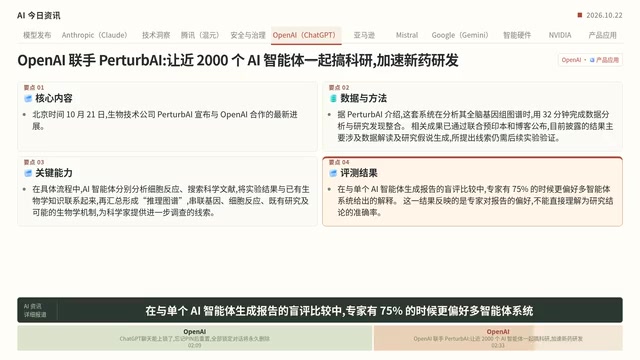
The significance of this figure is that multi-agent systems aren't simply multiple copies of a single agent—they improve output credibility through division of labor and cross-validation. For low-error-tolerance scenarios like scientific research, explanation quality often matters more than the conclusion itself.
There's progress on the security side too: OpenAI confirmed that two epic-level PHP security vulnerabilities were discovered with GPT assistance, and urgently released a Skill to help users detect whether their sites are affected. AI-assisted vulnerability hunting is moving from demo to real-world practice, and defenders' response methods are changing accordingly.
Enterprise Deployment: Search Infrastructure and Cloud Models
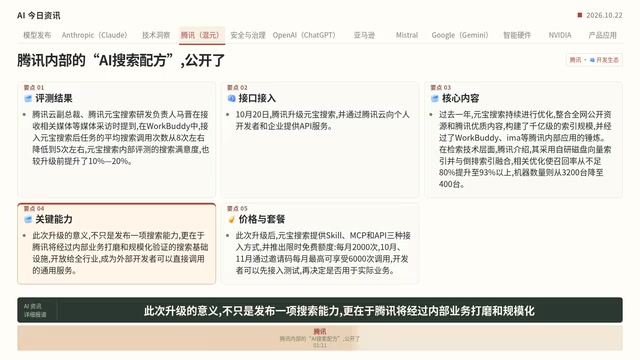
On October 20, Tencent unveiled its internal AI search solution, upgraded Yuanbao Search, and began offering API services to individual developers and enterprises through Tencent Cloud. The focus of this upgrade isn't a single search capability but opening up search infrastructure that has been refined and validated at scale through internal business as a general-purpose service.
At the model level, Mistral launched the Mistral Large 4 public preview, calling it its largest and most capable frontier model to date, and is partnering with NVIDIA to advance AI applications in engineering; Google Cloud launched Gemini for U.S. government agencies, supporting access to Oracle ERP and Microsoft 365 services, emphasizing compliance with the highest tier of U.S. government cloud procurement certification, with data remaining in private clouds on U.S. soil and not used for training without permission.
The Physical World: Autonomous Driving and Robots' Real-World Data
William Li disclosed that NIO's assisted driving system, built on a world model architecture plus closed-loop reinforcement learning, has been deployed on over 950,000 smart electric vehicles. Data from four insurance companies corroborates that accident-related safety losses for vehicles equipped with the system have decreased year over year, by more than 30%.

He also offered a blunt assessment: if users aren't willing to pay, autonomous driving—no matter how well marketed—hasn't truly created user value. Safety gains backed by insurance data are more convincing than marketing claims.
On the robotics front, NVIDIA partnered with Slinn to launch the Agile One SN humanoid robot reference platform, planned for market in early 2027. The robot stands 1.4 meters tall, weighs 40 kg, has 31 degrees of freedom, and supports 3 kg per arm.
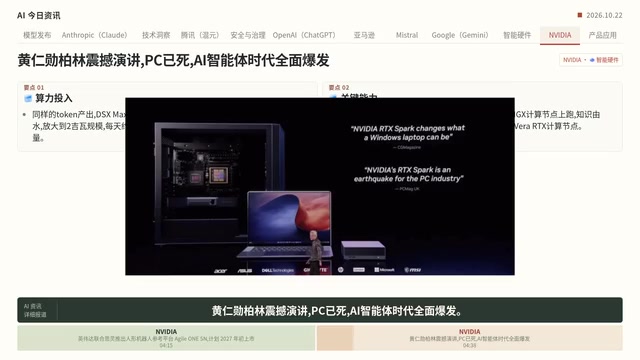
In a Berlin speech, Jensen Huang declared that "the PC is dead, and the AI agent era has fully erupted." The accompanying energy data is also worth recording: for the same token output, DSX Max LPS can use up to 30% less electricity; closed-loop night cooling plus dry cooling without evaporating water saves approximately 20% electricity and 54 million liters of water per day at megawatt scale—equivalent to one day's water consumption for 180,000 households.
World models and closed-loop reinforcement learning: A world model refers to teaching a system the dynamic rules of an environment so it can internally simulate "if this action is taken, how would the world change," used for prediction and planning. Closed-loop reinforcement learning continuously feeds driving data generated by the real fleet back into the training loop, allowing the model to keep iterating after deployment. The value of combining the two lies in reducing dependence on real-world test mileage and using independent third-party data such as insurance claims to verify safety gains—this is harder to manipulate than self-reported disengagement rates and constitutes the key evidence chain for judging whether autonomous driving truly creates user value.
Payments and Identity: Agents Are About to Spend Your Money
Visa announced three commercial payment capabilities and launched an AI agent payment pilot, predicting that B2B virtual card value will reach $14.6 trillion by 2029. Visa made clear that the key to the pilot isn't whether AI can initiate payments, but whether an AI agent's identity and behavior can be independently verified.
This statement highlights the core challenge of scaling agent commercialization: when the executor isn't a human, the authorization, liability, and audit chains must be rebuilt. Identity verification capability may become the bottleneck of the agent economy even before model capability does.
The identity verification challenge in agent payments: Traditional payment network authorization chains are built on "the cardholder themselves or an explicitly authorized agent," relying on passwords, biometrics, and merchant risk controls. When the party initiating payment is an autonomously operating AI agent, three new problems must be solved: verifiability of agent identity (proving it's the authorized one, not a forged copy), auditability of behavioral boundaries (how much it spent, on what categories), and liability attribution (who bears responsibility when something goes wrong—the developer, the deployer, or the user). The "independent verification" emphasized in Visa's pilot points to Verifiable Credentials and fine-grained authorization tokens; the maturity of such infrastructure will likely determine the pace of agent commercialization.
Other Signals Worth Noting
EarthSight proposed M-AMPT 1.0, supplementing memory capability at the model layer—training around internal states and capacity expansion yield further capability gains, though this isn't yet enough to prove that native memory's long-term ceiling exceeds external memory.
ChatGPT launched a locked chat feature: after setting a four-digit account PIN, specified conversations can be hidden. The official description notes that this only adds a viewing verification step—it does not provide end-to-end encryption and does not change data retention or model improvement settings.
A counterexample is also worth recording: influencer research institute C-Train.me used 3 months, 5 laypeople, and a $200,000 budget to design an anti-scorpion-venom protein with Cloud's help—17 of 211 designs printed met the preset binding criteria, covering 4 of 5 toxins. It's still far from a genuinely usable therapeutic, but it demonstrates how AI-assisted design is changing the cost side.
Conclusion
In this round of updates, what's most worth watching isn't any single benchmark but three simultaneously advancing threads: model compression pushing capabilities down to consumer hardware, agents gaining independent runtime environments and payment identities, and the physical world providing feedback through insurance data and deployment scale. Together they point to the same question—AI is shifting from "can answer" to "can execute," and verification, authorization, and cost will be the real battlegrounds of the next phase.
One-line Summary
AI capabilities are moving from the chat box to VRAM, browsers, payment networks, and steering wheels—execution and verification are the new battlegrounds.
Paragraph Summary
This article rounds up a set of key recent developments in AI: FLUX 3 Image Klein achieves 8GB VRAM operation with 5.6B parameters and supports 4K and pixel-level editing; Anthropic's Claude Duet, as an agent, has its own VM and browser and can run for months after the user's device is off; OpenAI and Perturbate's multi-agent research system earned 75% expert preference in blind evaluations; Tencent opens up internally validated search infrastructure through Tencent Cloud; Visa launches an AI agent payment pilot, emphasizing that independent verification of identity and behavior is key. It also covers insurance data corroborating NIO's assisted driving, NVIDIA's humanoid robot platform, and energy consumption data. The article argues that what truly matters isn't any single benchmark but three threads advancing together—model compression, agents' independent operation and payment identity, and physical-world feedback—as AI shifts from "can answer" to "can execute," with verification, authorization, and cost becoming the core challenges of the next phase.
Related articles
Learn AI Agent Development for Free: Build a Minimal Conversational Agent from Scratch
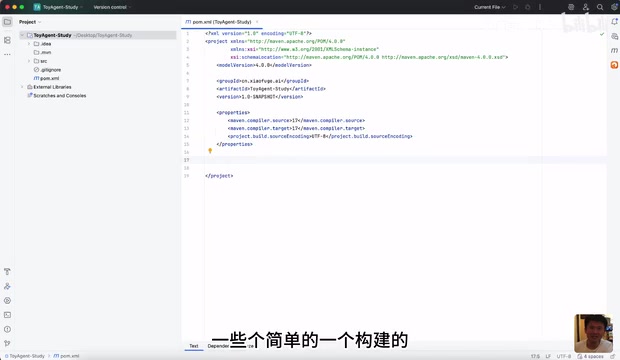
Based on Xiao Fu Ge's free Bilibili course, this lesson covers the five-stage AI Agent learning path, OpenAI protocol integration, a lightweight Java project, and building a minimal conversational agent.

Zero-Code AI God Sandbox: Is This Reddit User's Wild Idea Feasible?
A Reddit user wants 3-4 AI agents to play gods in a sandbox world for friends to interact with. Is this zero-code idea technically feasible? We break down the barriers.

Is Claude the AI That Refuses to Be a "Yes-Man"? A Reddit Discussion
Reddit discusses whether Claude is the least "yes-man" LLM. This article analyzes Claude's honesty design, comparisons with other models, and users' real attitudes toward AI people-pleasing.