FM4SAR-Bench 1.0: The First Benchmark Framework for Fairly Evaluating SAR Foundation Models

FM4SAR-Bench 1.0 proposes a five-level, six-dimension framework that fairly evaluates SAR foundation models and reveals data bottlenecks.
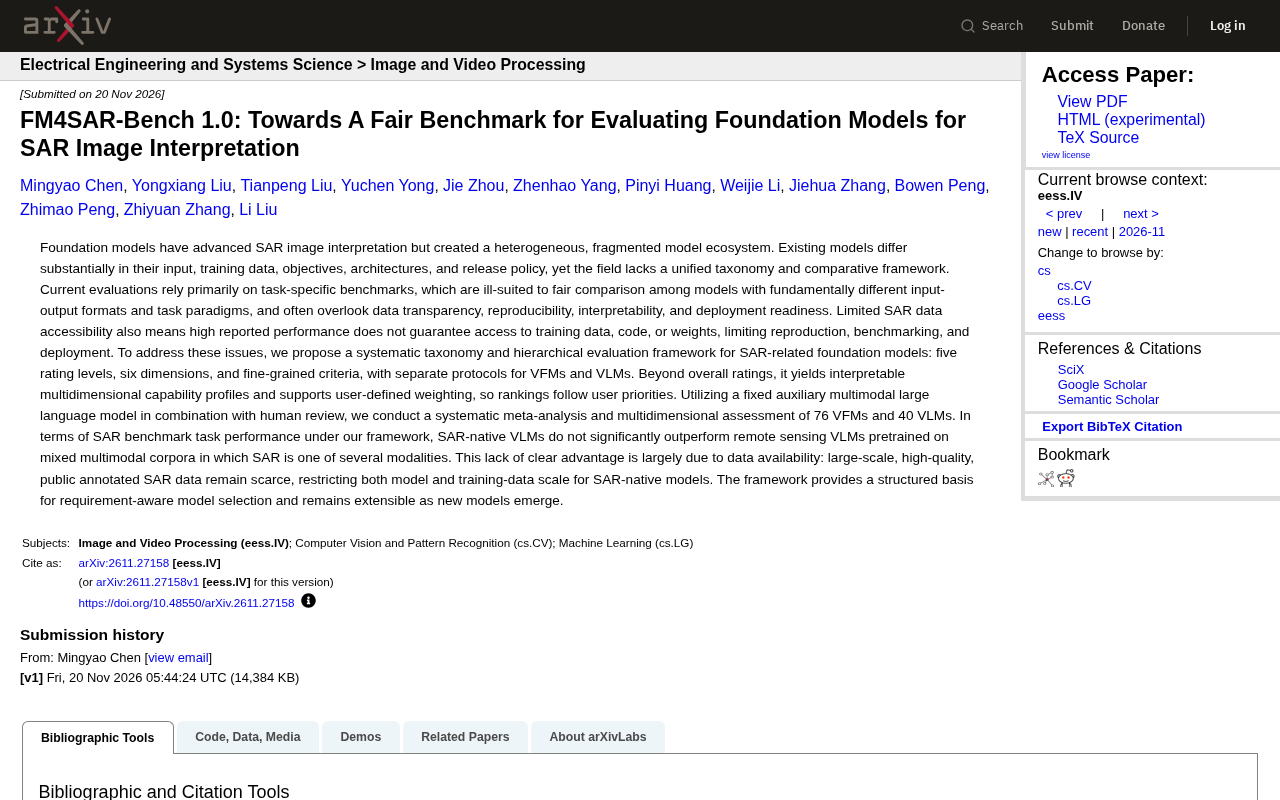
To address the fragmentation of the SAR foundation model ecosystem and the difficulty of fairly comparing heterogeneous models with existing task-specific benchmarks, researchers propose FM4SAR-Bench 1.0—a hierarchical evaluation framework with five rating levels and six evaluation dimensions, with separate protocols designed for visual foundation models (VFMs) and vision-language models (VLMs). The framework generates interpretable multi-dimensional capability profiles, supports user-defined weights for demand-aware model selection, and systematically examines data transparency, reproducibility, interpretability, and deployment readiness. Through meta-analysis and manual review of 76 VFMs and 40 VLMs, the framework finds that SAR-native VLMs do not significantly outperform remote sensing VLMs pretrained on mixed multimodal corpora on SAR benchmark tasks, mainly because large-scale, high-quality, publicly annotated SAR data is scarce, limiting the scale and potential of specialized models.
The field of Synthetic Aperture Radar (SAR) image interpretation is experiencing a surge of foundation models, but the fragmentation of the model ecosystem is far greater than one might imagine. Models differ dramatically in input formats, training data, target tasks, architectural design, and release strategies, while the field lacks a unified taxonomy and comparison framework. Existing evaluations rely mainly on task-specific benchmarks, making it difficult to fairly compare models whose input/output formats and task paradigms are fundamentally different, and they often overlook data transparency, reproducibility, interpretability, and deployment readiness. More critically, restricted SAR data access means that high reported performance does not guarantee access to training data, code, or weights—limiting reproduction, benchmarking, and real-world deployment.
To address these issues, researchers propose FM4SAR-Bench 1.0—a systematic taxonomy and hierarchical evaluation framework aimed at establishing fair comparison standards for SAR foundation models.
Why Are Existing SAR Model Evaluations Unfair?
The development of SAR foundation models has far outpaced the construction of evaluation systems. The current model ecosystem is highly heterogeneous: some models focus on SAR-native pretraining, while others are trained on multimodal mixed corpora that include SAR; input formats range from single-channel amplitude images to multi-polarization complex data; and task paradigms span object detection, land-cover classification, change detection, and more.
This heterogeneity leaves traditional task-specific benchmarks struggling. When one model takes complex SAR data as input and another receives pseudo-color images, even comparing them on the same downstream task makes it hard to determine whether performance differences stem from model capability or from the degree of adaptation to the input format. Moreover, existing evaluations rarely systematically examine dimensions critical to real-world application, such as data transparency, code reproducibility, model interpretability, and deployment readiness.
The accessibility of SAR data is another obstacle. Because SAR data involves sensitive domains, large-scale, high-quality, publicly annotated data has long been scarce. This means that a model's reported high performance may not be reproducible by third parties—training data, code, or weights may not be public—thereby hindering benchmarking and deployment.
SAR-native pretraining refers to a model whose backbone is pretrained directly on SAR images (single-channel amplitude, multi-polarization, or complex data) via self-supervised or supervised means, rather than transferring from optical remote sensing or natural image pretrained weights. The design assumption behind such models is that SAR imaging mechanisms (speckle noise, side-looking geometry, backscatter characteristics) differ significantly from optical images, so dedicated pretraining can learn more suitable feature representations. In contrast is mixed multimodal pretraining: treating SAR as one modality within a multimodal corpus and training jointly with optical, text, and other modalities. The performance difference between the two on few-shot downstream tasks is precisely one of the core questions FM4SAR-Bench aims to answer.
Pseudo-color images are visual representations obtained by mapping SAR amplitude or polarization information into RGB channels, with common approaches including false-color synthesis and log-stretched colorization. They facilitate reuse of pretrained models and visualization tools designed for natural images, but they discard phase, polarization phase differences, and original radiometric calibration information, and introduce nonlinear transformations at the display end. Consequently, models taking pseudo-color as input and those receiving complex or raw intensity data directly are not equivalent in terms of information visibility, and directly comparing downstream performance can easily misattribute gains from input preprocessing to differences in model capability.
How Does the Five-Level, Six-Dimension Evaluation Framework Work?
The core of FM4SAR-Bench 1.0 is a hierarchical evaluation framework: five rating levels, six evaluation dimensions, and fine-grained scoring criteria. The framework designs separate protocols for visual foundation models (VFMs) and vision-language models (VLMs), because these two model types differ fundamentally in input/output forms and task paradigms.
The framework's output is not just an overall rating. It generates interpretable multi-dimensional capability profiles, allowing users to see clearly how a model's strengths and weaknesses are distributed across dimensions. More flexibly, the framework supports user-defined weights—different application scenarios prioritize data transparency, performance, and deployment readiness differently, so rankings can be adjusted to user needs. This design allows the framework to serve both as an academic comparison tool and as a demand-aware basis for model selection in industry.
In terms of evaluation methodology, the researchers used a fixed auxiliary multimodal large language model combined with manual review to conduct a systematic meta-analysis and multi-dimensional evaluation of 76 VFMs and 40 VLMs. The choice of a fixed auxiliary model ensures consistency in the evaluation process, while manual review compensates for the shortcomings of automated evaluation in fine-grained judgments.
SAR-native VLMs Do Not Significantly Outperform Remote Sensing VLMs
Applying the framework yielded a noteworthy finding: on SAR benchmark task performance, SAR-native VLMs do not significantly outperform remote sensing VLMs pretrained on mixed multimodal corpora (where SAR is just one modality).
This result is counterintuitive—models specifically trained for SAR should have an advantage. The researchers attribute the cause to data accessibility: large-scale, high-quality, publicly annotated SAR data remains scarce, which simultaneously limits the model scale and training data scale of SAR-native models. In other words, SAR-native models do not suffer from architectural or methodological flaws; rather, they are constrained by a data supply bottleneck that prevents them from fully realizing their specialization potential.
This finding has direct implications for the field: under the realistic constraint of scarce public data, pretraining on mixed multimodal corpora may be the more pragmatic choice. At the same time, it highlights the urgency of promoting open sharing of SAR data—without public data of sufficient scale, the specialization advantages of SAR-native models cannot be realized.
VFM (visual foundation model) and VLM (vision-language model) evaluation protocols must be designed separately because their output spaces and task interfaces differ. VFMs typically output dense feature maps, with evaluation focusing on linear probing, fine-tuned segmentation/detection accuracy, and feature transferability; VLMs output natural language, with evaluation involving image-text retrieval, visual question answering, caption generation, etc., requiring examination of language-side alignment quality and hallucination rates. If the same set of metrics were used to measure both, the VLM's language generation capability could not be captured by VFM metrics, and conversely the VFM's dense prediction accuracy would not apply to the VLM's generative outputs—hence the framework sets separate scoring dimensions and weights for the two model types.
Positioning and Scalability of the Framework
FM4SAR-Bench 1.0 is not a static leaderboard but a structured foundation for demand-aware model selection. As new models continue to emerge, the framework remains extensible, and new models can be incorporated into the existing dimension system for evaluation.
For researchers and engineers in the SAR field, the value of this framework lies in breaking down the vague question of "which model is better" into "better on which dimensions, and better for what needs." Including data transparency, reproducibility, interpretability, and deployment readiness in the evaluation means that model selection no longer looks only at performance numbers but comprehensively considers the feasibility of real-world deployment. As SAR foundation models move from research to application, this multi-dimensional evaluation perspective may be more meaningful than a single performance ranking.
Related articles

Michael Nielsen Takes Down His Classic Neural Network Textbook, Sparking Community Discussion
Michael Nielsen's classic free textbook Neural Networks and Deep Learning has been taken offline, sparking discussion on Hacker News about the reasons and impact.

Inside the AI Training Data Market: The Trade-off Between Exclusivity and Discounts
G2i founder Gabe Greenberg reveals the dual-track pricing of the AI training data market: labs pay a premium for exclusive data or accept discounts that allow others to buy it.

SessionGraph: Unifying All Coding Agent Sessions in One Interactive Graph
SessionGraph aggregates coding agent sessions into an interactive graph, helping developers review, debug, and manage AI coding workflows across sessions. This article examines its positioning, value, and open questions.