Foglio: A Privacy-First, Minimalist AI Document Editor

Foglio is a minimalist, privacy-first AI document editor with smart templates and zero bloat.
Foglio is a minimalist document editor by indie developer Fabio Bernardi, ranked #20 on Product Hunt. Its core proposition: return to pure writing in a market full of bloated tools, differentiating on privacy, distraction-free experience, and zero redundancy. Built-in AI templates for contracts, invoices, and meeting notes lower the barrier to creating formal documents — ideal for freelancers and small teams. Privacy is another key selling point, naturally aligned with sensitive document use cases. The product is free forever, but its monetization path remains unclear, and feature depth and AI quality still await real-world validation.
In an era of increasingly bloated document tools, a product called Foglio has taken the opposite approach — using minimalist design and smart templates to bring the focus back to the act of writing itself. This editor, which landed at #20 on Product Hunt, earned 72 upvotes with its positioning around "privacy, distraction-free writing, and zero bloat."
What Problem Does Foglio Solve?
Today's mainstream document collaboration tools keep piling on features: sidebars, plugin marketplaces, AI assistants, comment systems, and version history all layered on top of each other. Feature richness is a selling point, but for users who simply want to quickly draft a contract, generate an invoice, or organize meeting notes, all of that functionality becomes noise.
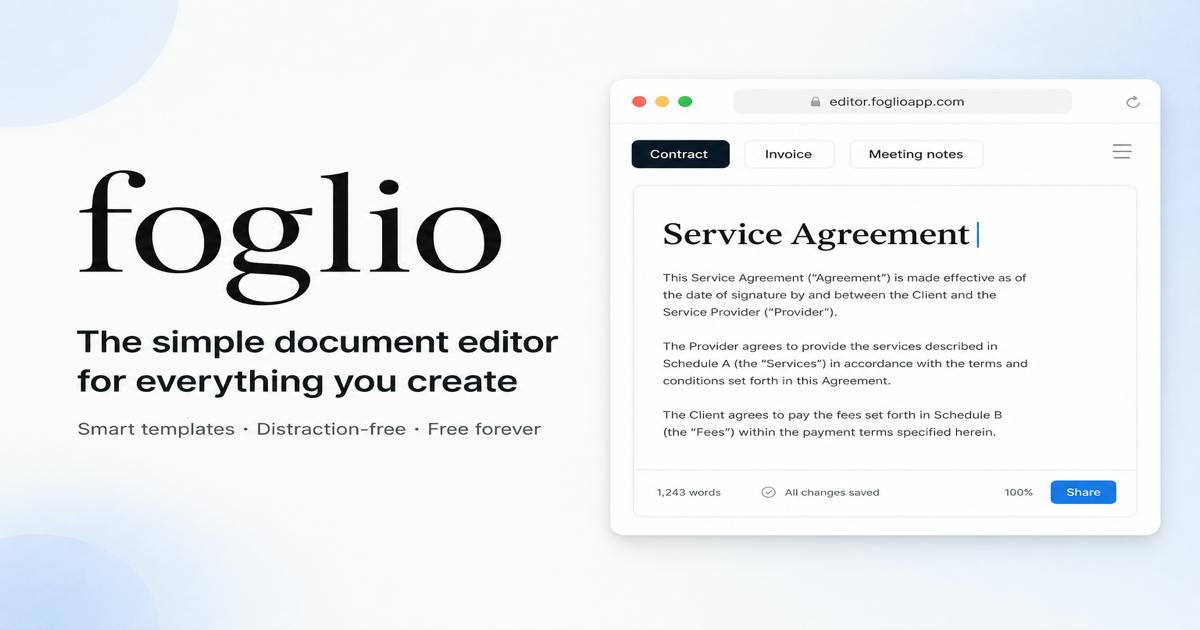
Foglio's developer, Fabio Bernardi, distills the product philosophy into a single line — "Simple, private docs with smart AI templates, zero bloat." It positions itself as "a simple document editor for all kinds of writing," championing a clean, clutter-free editing experience.
Smart Templates as the Core Value Proposition
What sets Foglio apart from ordinary minimalist editors is its built-in smart AI templates, covering common document types like contracts, invoices, and meeting notes.
The value of these templates lies in lowering the psychological barrier of starting from scratch. When writing formal documents, the most time-consuming part is often not the writing itself — it's agonizing over formatting, structure, and required clauses. Pre-built templates handle that structural scaffolding upfront, so users only need to fill in the content, with AI assisting in generation or refinement from there.
For freelancers, small teams, and independent creators, being able to handle contracts, invoices, and notes all within a single tool means no more context-switching between multiple SaaS products. This "just enough" integration philosophy is precisely what differentiates it from heavyweight office suites.
Privacy as a Differentiating Positioning
In a landscape where most AI document tools require uploading content to the cloud for processing, Foglio explicitly emphasizes privacy. While the product page doesn't detail the specific technical implementation, the fact that "private" appears as a core tagline signals that it's targeting users who are sensitive about data security.
Documents like contracts and invoices often contain business terms and financial information, so users naturally have higher privacy concerns around them. Positioning privacy as a selling point creates a logical loop with the smart template use cases — the more sensitive the document you're working on, the more you care about whether it's secure.
From a technical standpoint, there are several approaches AI document tools can take to implement privacy: local model inference (the model runs on the user's device so data never leaves it), end-to-end encryption before cloud processing, and server-side processing with a commitment not to retain data. Each approach involves different trade-offs between privacy protection strength and functional capability — local inference is the most secure but demands more device computing power, while pure cloud processing offers the most functionality but relies on the provider's privacy promises. Foglio hasn't publicly disclosed its specific technical implementation, which isn't uncommon for early-stage indie developer products. However, for business users who treat privacy as a hard requirement — such as law firms or finance teams — technical transparency is typically an important factor in procurement decisions.
The Ambition Behind "Free Forever"
Foglio has raised the Free forever flag. A free strategy helps accumulate users quickly, but it naturally raises questions about the long-term business model: will it monetize through premium feature subscriptions, a template marketplace, or a team collaboration tier? The product page hasn't answered that yet.
As a new product from an indie developer, Foglio currently has only 1 comment, indicating it's still in very early stages. Feature depth, AI generation quality, and template coverage all await validation through real-world usage feedback.
"Free forever" is a common cold-start strategy in the SaaS world, closely tied to the freemium model. The core logic of freemium is: accumulate a large user base with a free tier, then convert through paid layers offering advanced features, more storage, team collaboration, or API access. For indie developers, this model can effectively lower the barrier to trying the product — but conversion rates and willingness to pay depend heavily on how the feature gap between free and paid tiers is designed. If the free tier already satisfies the vast majority of use cases, users' motivation to upgrade diminishes significantly. Whether Foglio's free commitment is sustainable ultimately depends on how quickly it finds a viable monetization path.
Conclusion
Foglio represents a product philosophy of subtraction: rather than chasing breadth, it focuses on doing three things well — privacy, minimalism, and practical templates. For users tired of bloated tools who just want to write in peace, it offers a lightweight option worth watching. Whether it can hold its ground in the fiercely competitive document space, however, still depends on continued refinement of its features and the path it takes toward monetization.
Related articles

Chain of Thought Isn't Just for AI: How Humans Can Use CoT to Improve Thinking Quality
Chain of Thought isn't just a prompt trick for large models. Starting from a Hacker News discussion, this article analyzes why CoT works for human thinking too, breaks down actionable ways to transfer it, and highlights the key differences between human CoT and machine CoT.
Cloudflare Teams Up with OpenAI: Closi…
Cloudflare Teams Up with OpenAI: Closing the Loop from Vulnerability Discovery to Defense with AI
Cloudflare uses OpenAI Daybreak to investigate security vulnerabilities and generate reviewable remediation plans, while developers use Codex to boost coding efficiency and quality.

Orca Multi-Agent Orchestration in Practice: A Guide to Parallel Collaboration with Claude and Codex
Orca is Stable AI's free open-source agent workbench supporting 34 agents like Claude Code and Codex in parallel. Learn its Git worktree isolation, multi-model orchestration, and mobile management.