Ford Releases Privacy Pledge: A Detailed Look at Vehicle Data Use and Protection

Ford releases a privacy pledge in response to the data trust crisis facing intelligent connected vehicles.
Ford has issued a "privacy pledge," affirming the security of customer vehicle data and explaining the logic of data collection and use, emphasizing that data serves function optimization, safety improvement, and personalized experiences. The article notes that intelligent connected vehicles generate data at a scale far beyond traditional cars, and consumers' concerns about data abuse are spreading to the automotive industry, requiring automakers to proactively build trust. Ford's statement is a microcosm of traditional automakers' intelligent transformation, attempting to draw a line between data-driven innovation and privacy protection. But the effectiveness of the pledge depends on execution, and data management entry points and permission controls on the product side will be the key test of sincerity.
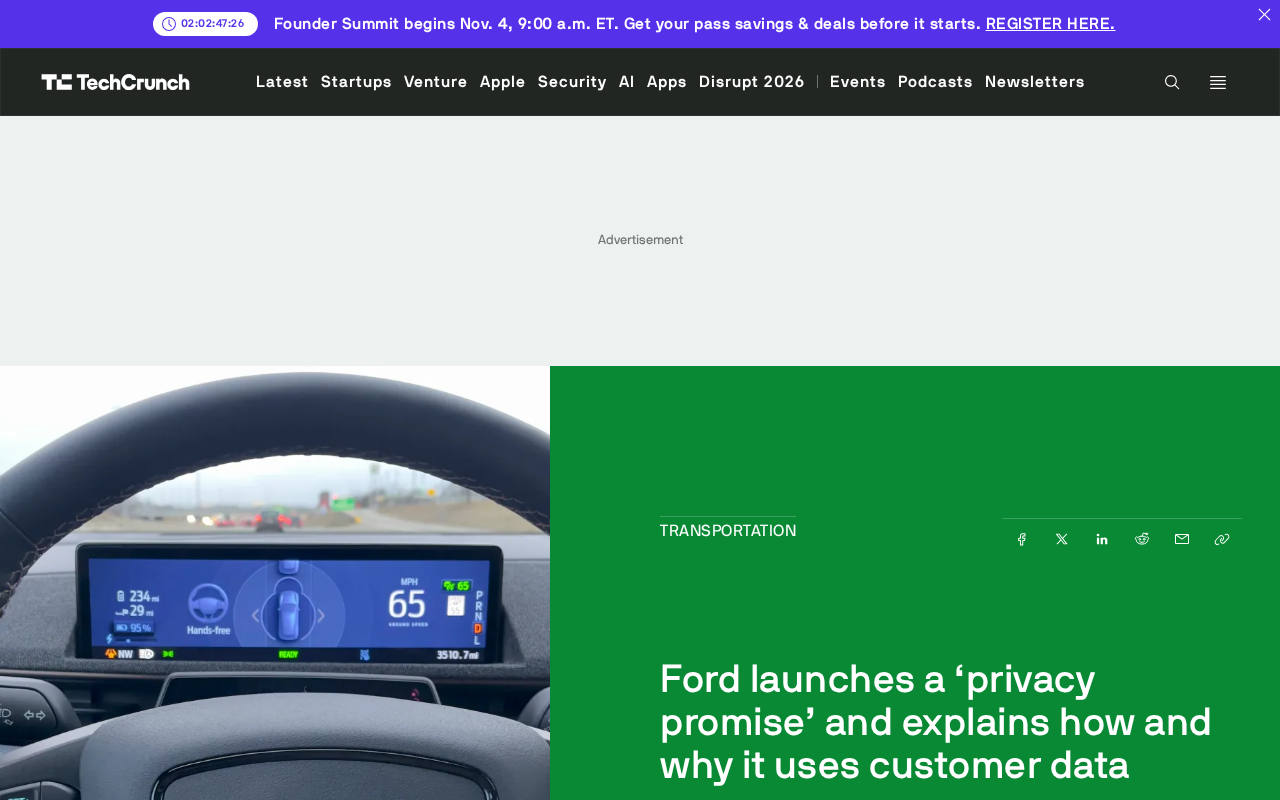
Automaker Ford recently issued a "privacy pledge," explicitly assuring customers that their vehicle data is safe and explaining in detail the logic behind how data is collected and used. This is not a simple PR statement, but a systematic response from a traditional automaker facing an increasingly severe data trust crisis amid the wave of intelligentization.
Why Emphasize Privacy Now?
Intelligent connected vehicles generate data at a scale far beyond that of traditional cars—from driving behavior and location trajectories to in-cabin voice and camera footage, each item touches on users' core privacy. Ford says the company is making a "clear commitment" to ensure the security of customers' "vehicle data." The backdrop to this statement is that consumers' concerns about data abuse by tech companies are spreading to the automotive industry; if automakers fail to proactively build trust, it will directly affect the market acceptance of their intelligent products.
Intelligent connected vehicles refer to vehicles that, through onboard sensors, controllers, actuators and other devices, integrate modern communications and networking technology to enable information exchange between vehicle and cloud, vehicle and vehicle, vehicle and road, and vehicle and people. Compared with traditional cars, their data collection capability grows exponentially: an intelligent connected vehicle can generate several GB of data per second, covering sensitive information such as location trajectories, driving behavior, in-cabin audio and video, and biometric features. This data is not only the fuel for optimizing algorithms and training autonomous driving models, but also constitutes a potential threat to user privacy. Precisely because of the leap in data scale and sensitivity, intelligent connected vehicles have become a key area of data protection regulation—and this is the deeper reason Ford is proactively taking a stand at this time.
The Boundaries and Logic of Data Use
The focus of Ford's explanation is to clarify "how and why" it uses data. Its core logic is that data collection serves vehicle function optimization, safety performance improvement, and personalized service experiences. For example, analyzing driving data can improve the performance of driver assistance systems. The key point is that Ford emphasizes this use takes place within the framework of the pledge, meaning data collection and processing must follow the principle of transparency. Although Ford did not disclose specific technical details or a data classification list in this statement, its framing that directly links data use to user benefit is intended to build a narrative of "data used for service, not for profit."
The principle of transparency is one of the core principles in personal information protection, requiring data controllers to inform users, in a clear and understandable way, of the scope of data collection, purpose of use, storage period, and sharing recipients when collecting and processing personal data, and to obtain users' informed consent. In the automotive context, implementing the transparency principle is particularly complex: vehicles involve multiple types of sensors and multiple data flows (automakers, dealers, third-party service providers), and users often find it difficult to perceive who collects data, when, and in what manner. Ford's emphasis in its statement on using data "within the framework of the pledge" is essentially an attempt to base itself on the transparency principle, binding data use to user-perceivable benefits, thereby alleviating users' concerns about hidden data abuse.
Industry Trends Behind the Pledge
Ford's "privacy pledge" is a microcosm of traditional automakers' transformation into tech companies. As the concept of software-defined vehicles takes hold, data becomes a core asset, but it also becomes a liability. Unlike some emerging automakers' aggressive data collection strategies, traditional giants tend to be more cautious on privacy issues because they need to maintain long-established brand reputation. Ford's move is essentially an attempt to draw a clear line between using data to drive innovation and adhering to privacy protection red lines, using this as a point of differentiated competition.
However, the effectiveness of a pledge ultimately depends on execution and verification. For consumers, the value of a "privacy pledge" lies not only in rigorous wording, but also in whether it provides convenient data management entry points and clear permission control options. Ford's statement this time is the first step in building trust, but how these principles are implemented on the product side will be the key test of its sincerity.
Software-Defined Vehicle (SDV) refers to an automotive architecture concept centered on software, continuously updating vehicle functions and experiences through OTA (over-the-air) updates. Under this paradigm, a vehicle's value increasingly depends on software and data services rather than purely mechanical performance. Data therefore becomes a core asset for automakers: it drives innovative functions such as autonomous driving algorithm iteration, personalized service recommendations, and predictive maintenance. But the assetization of data also means liability—automakers must establish a full-lifecycle governance system from collection, storage, and processing to destruction. When traditional automakers transform toward SDVs, they must both unlock data value and maintain long-term brand reputation; this tension is the fundamental reason why giants such as Ford adopt a cautious stance on privacy.
One-line Summary
Ford releases a privacy pledge in response to the data trust crisis facing intelligent connected vehicles.
Paragraph Summary
Ford has issued a "privacy pledge," affirming the security of customer vehicle data and explaining the logic of data collection and use, emphasizing that data serves function optimization, safety improvement, and personalized experiences. The article notes that intelligent connected vehicles generate data at a scale far beyond traditional cars, and consumers' concerns about data abuse are spreading to the automotive industry, requiring automakers to proactively build trust. Ford's statement is a microcosm of traditional automakers' intelligent transformation, attempting to draw a line between data-driven innovation and privacy protection. But the effectiveness of the pledge depends on execution, and data management entry points and permission controls on the product side will be the key test of sincerity.
Related articles

Glasshand: Giving AI Agents a Real iPhone and Mac
Glasshand lets AI agents rent real iPhones and Macs, supporting Claude Code, Codex, and more to post, book services, and test iOS apps on real devices. This article explains how it works, its use cases, and potential boundaries.

ChatGPT Images 2.6 Released: GIF Generation, Reference Image Reuse, and 50% Speed Boost
ChatGPT Images 2.6 released: prompt-to-GIF animation with frame-by-frame editing, reusable reference images for yourself, pets, or characters, 50% faster generation, plus Flare and Sunburst API model variants and SVG export for developers.

Rerun: Turn Your AI Subscription into an AI Coworker Team
Rerun, #3 on Product Hunt, turns your ChatGPT or Claude subscription into a team of AI coworkers that run on schedules or triggers, each with tools, a computer, and a shared workspace. It asks before risky actions, is open source (AGPL v3), and supports self-hosting.