ForeSCITE: Using Temporal Trajectories to Predict Future Biomedical Discoveries

ForeSCITE uses semantic temporal direction to guide LLMs in generating novel and plausible scientific hypotheses.
The ForeSCITE framework captures temporal evolution patterns from the semantic representations of published biomedical conclusions to guide future hypothesis generation. It estimates early-to-recent semantic drift directions across 407 topic clusters derived from ~3M conclusions, projects embeddings onto that direction, and decodes them into natural-language hypotheses. It outperforms five prompt-based and retrieval-augmented baselines on semantic coverage, entity-pair novelty, and post-cutoff re-observation, with 37 CAR-T hypotheses judged novel and biologically plausible by experts.
When LLMs Start "Reading" the History of Science: How the Temporal Dimension Guides Hypothesis Generation
The concept of an AI co-scientist is moving from science fiction to reality. Large language models are already widely used to generate scientific hypotheses and guide experiments, but most approaches focus on semantic similarity within a "knowledge space" rather than evolutionary direction along a "timeline." A recent study proposes a different approach: can temporal patterns be captured from the semantic representations of complete biomedical conclusions and used to steer the generation of future hypotheses?
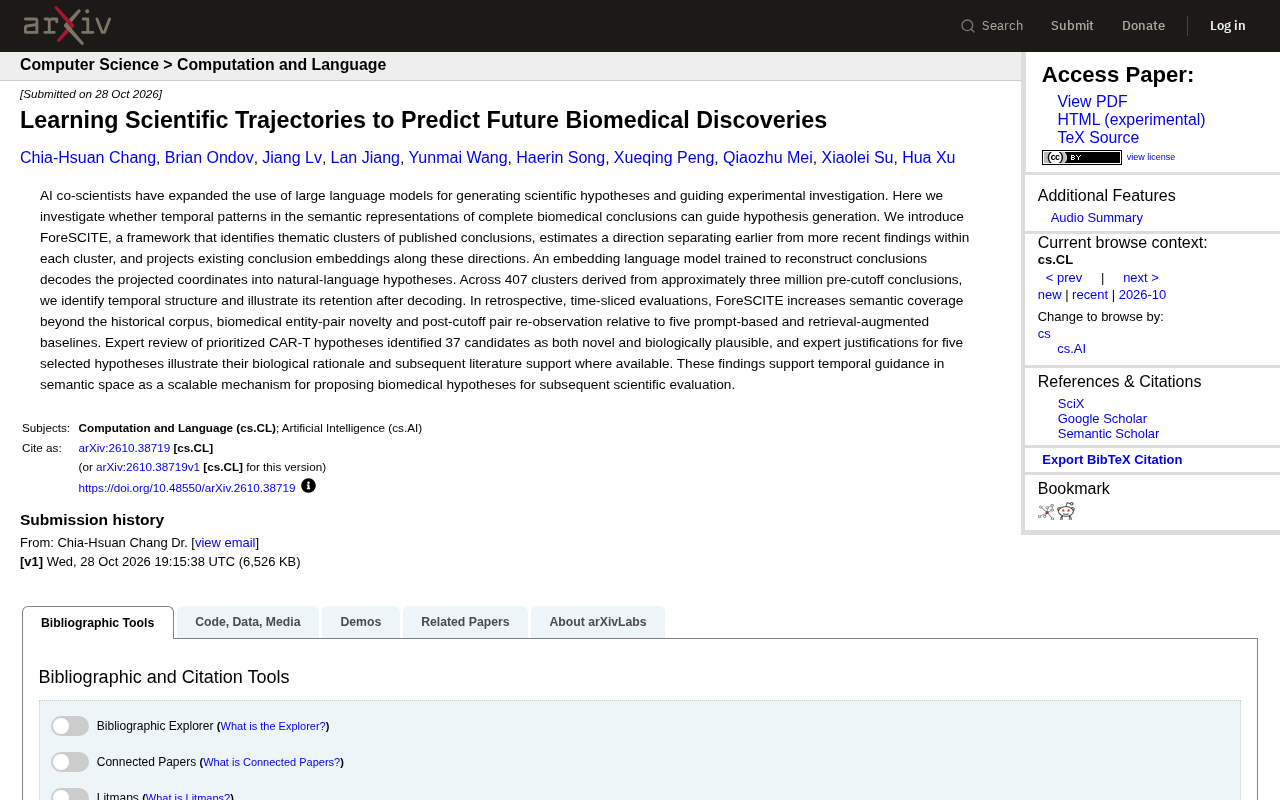
The research team's answer is yes. Their proposed ForeSCITE framework is motivated by the fact that scientific discovery is inherently directional—conclusions on the same topic drift semantically over time. If this drift can be explicitly modeled, a model can extrapolate "what might come next" from the "past-to-present trajectory" instead of merely restating existing knowledge.
Temporal Structure Within Three Million Conclusions
The ForeSCITE pipeline can be broken down into three stages. The team first identifies topic clusters of published conclusions, estimates within each cluster a direction that separates early from recent findings, and then projects the embeddings of existing conclusions onto that direction. Next, an embedding language model trained to reconstruct conclusions decodes these projected coordinates back into natural-language hypotheses.
This pipeline runs on 407 topic clusters derived from roughly three million conclusions published before the cutoff date. The results show that identifiable temporal structure does exist in semantic space and is preserved after decoding—meaning the generated hypotheses are not random combinations detached from historical context, but rather advance along interpretable directions of topic evolution.
Embedding Language Model is a type of language model that maps text into continuous vector representations, typically implemented via encoder-decoder or decoder-only architectures. In ForeSCITE, this model is trained to "reconstruct conclusions": given a low-dimensional projected coordinate (i.e., the scalar projection of a conclusion embedding onto the temporal direction), the model must generate natural-language text that reproduces the semantics of the original conclusion. This training objective forces the embedding space to retain enough information to support semantic reconstruction, so that the projected coordinates are not only discriminative but also decodable into readable hypothesis statements. Unlike conventional contrastive-learning embeddings, reconstruction-based training prioritizes information fidelity and is well suited to scenarios that require tracing from abstract coordinates back to concrete scientific statements.
Retrospective Evaluation: Outperforming Five Types of Baselines
In time-sliced retrospective evaluations, ForeSCITE outperforms five prompt-based and retrieval-augmented baselines across multiple dimensions. Specifically: its semantic coverage exceeds that of the historical corpus itself, the novelty of biomedical entity pairs is higher, and a larger proportion of post-cutoff entity pairs are subsequently re-observed.
The combination of these three metrics is telling. Semantic coverage shows that the model does not simply replicate the training data distribution; entity-pair novelty shows that it proposes concept combinations not linked in the original literature; and post-cutoff re-observation is the strongest signal—if the entity pairs the model proposes are indeed touched upon by subsequent research in "future" literature, then temporal guidance has produced genuine predictive value rather than merely clever text-level arrangements.
Retrospective evaluation is an evaluation paradigm commonly used in time-series forecasting and scientific discovery prediction: data are split by time into a training set (before the cutoff date) and a test set (after the cutoff date), and the model generates predictions using only training-set information, which are then compared against real discoveries in the test set. Its advantage is that published literature can serve as an objective reference for the "future," but an inherent risk is hindsight bias—evaluators may inadvertently exploit knowledge of later literature when designing or interpreting metrics. In ForeSCITE, the proportion of post-cutoff entity pairs re-observed is calculated precisely on this paradigm: if entity pairs the model generates before the cutoff frequently appear in post-cutoff literature, its predictions are forward-looking.
Entity-pair novelty is a common metric for assessing the innovativeness of generated hypotheses, usually defined as the proportion of generated biomedical entity pairs (e.g., gene-drug, disease-target) that never co-occur in the training corpus. High novelty means the model proposes concept combinations not linked in the original literature, but novelty alone does not guarantee plausibility—random combinations can also achieve high novelty. ForeSCITE therefore combines entity-pair novelty with the post-cutoff re-observation rate: the former measures "newness," the latter measures "likely true," and together they provide a more comprehensive characterization of hypothesis quality. In expert review, 37 CAR-T hypotheses were judged to be both novel and biologically plausible, a qualitative validation of this metric combination.
Expert Review: 37 Novel and Plausible CAR-T Hypotheses
Beyond automated metrics, the study also introduced domain expert review. For the prioritized CAR-T hypotheses, experts judged 37 candidates to be both novel and biologically plausible. For five selected hypotheses, the experts provided arguments explaining their biological rationale and, where available, pointed to supporting subsequent literature.
This point is especially critical: the hard part of generating hypotheses has never been "generation" itself, but generating candidates that are both new and plausible. In the context of expert review, 37 is not a small number, indicating that direction filtering guided by temporal trajectories genuinely improves candidate quality rather than overwhelming reviewers with noise.
Temporal Guidance: A Scalable Hypothesis Generation Mechanism
From a broader perspective, the contribution of this work is introducing "time" as a first-order signal into scientific hypothesis generation, rather than merely as a retrieval filter. Temporal guidance in semantic space is a scalable mechanism—it does not rely on handcrafted rules from domain-specific knowledge bases but learns direction from the overall distribution of published conclusions, and in principle can be transferred to disciplines beyond biomedicine.
Of course, the inherent limitations of retrospective evaluation remain: hindsight may overestimate the model's predictive ability, and the sample size of expert review is limited. But the framework itself offers a clear path: letting an AI co-scientist know not only "what is relevant" but also "what is heading where." For teams hoping to use LLMs to assist scientific discovery, this is a paradigm shift worth watching.
One-line Summary
ForeSCITE uses semantic temporal direction to guide LLMs in generating novel and plausible scientific hypotheses.
Paragraph Summary
The ForeSCITE framework captures temporal evolution patterns from the semantic representations of published biomedical conclusions and uses them to guide future hypothesis generation. The team estimates early-to-recent semantic drift directions across 407 topic clusters derived from roughly three million conclusions, projects conclusion embeddings onto that direction, and decodes them into natural-language hypotheses with an embedding language model. In retrospective time-sliced evaluations, ForeSCITE outperforms five prompt-based and retrieval-augmented baselines on semantic coverage, entity-pair novelty, and post-cutoff re-observation rate. Expert review further judged 37 CAR-T hypotheses to be both novel and biologically plausible. This work introduces time as a first-order signal into the AI co-scientist, offering a transferable hypothesis generation mechanism.
Related articles
Fable 5.2's Self-Improvement Loop Accelerates as Gemini 4 Carbon Closes In
Anthropic Fable 5.2 and Google Gemini 4 Carbon launch together, Remote Labor Index doubles, self-improvement loop accelerates, but benchmark flaws and evaluation awareness persist.
Meta FAIR Releases e-means: A New k-means Alternative That Converges 10x Faster
Meta FAIR releases e-means in FAISS 1.16.0, replacing mini-batch k-means with ~10x fewer epochs, 10-45x GPU speedup, and no new hyperparameters.
AI Is Great at Writing Code, So Why Are Codebases Becoming More Fragile?
AI coding tools boost efficiency but may make codebases fragile. Based on a developer blog and Hacker News discussion, this article analyzes the hidden costs of AI-generated code, community divisions, and practical suggestions for reducing risks.