Former Google Researcher Shares: My AI Conversation Record from Inside Google

A former Google researcher shares a conversation video from his tenure, reflecting a new trend of big tech AI talent going public.
The article discusses a conversation video shared by a former Google researcher on X. The tweet itself is limited in information, not revealing topics or participants, but it reflects two notable industry phenomena: the scarcity of internal discussions at large AI labs, with departing researchers filling the information vacuum beyond official disclosures; and AI knowledge dissemination expanding from academic conferences and podcasts to fragmented social media sharing. The author suggests watching for the full conversation's release while cautioning against over-interpreting a single tweet.
A Conversation Record from Inside Google
Recently, a former Google researcher shared a conversation video he recorded while still working at Google on the social platform X (formerly Twitter). In his tweet, he wrote: "This was recorded a few months ago, when I was still at Google. It was a very interesting conversation."
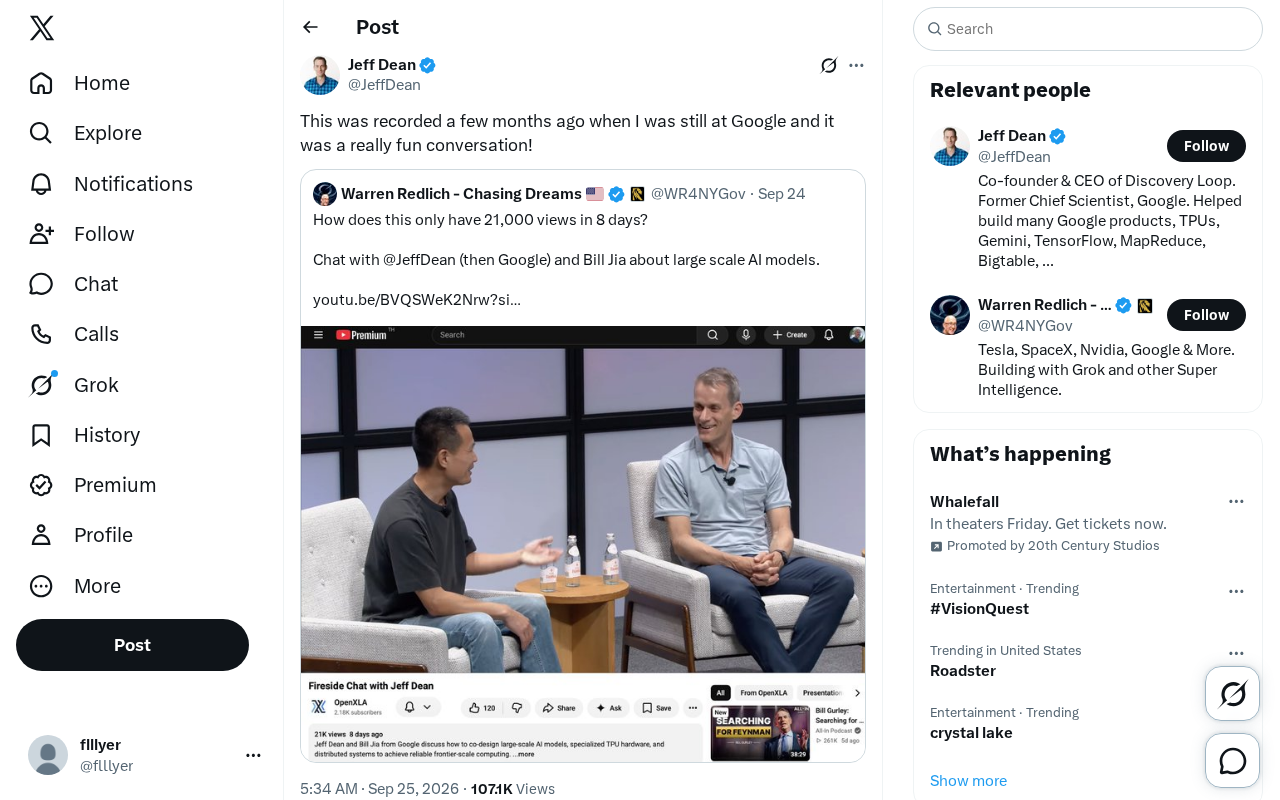
The brief tweet itself reveals limited information, but its implications are worth noting: public statements from frontline researchers at major AI labs often give outsiders a glimpse into the thinking patterns and discussion atmosphere within top-tier AI teams.
Google DeepMind is a British AI company acquired by Google in 2014. After merging with Google Brain in 2023, it became Google's unified AI research organization. DeepMind is known for breakthrough achievements such as AlphaGo and AlphaFold, and is one of the world's leading AI labs. Alongside institutions like OpenAI and Anthropic, it stands as a core player in large model and artificial general intelligence research. Talent flows frequently between these institutions, and researchers' career choices are often seen as industry bellwethers, giving their public statements significance beyond the individual.
Why Big Tech Researchers' "Departure Shares" Deserve Attention
In recent years, researchers from top AI institutions like Google DeepMind, OpenAI, and Anthropic have been moving frequently, with many choosing to share their experiences and insights through podcasts, interviews, or social media after leaving. This type of content attracts attention for several reasons.
The Scarcity of Insider Perspectives
Information disclosed by large AI labs is typically subject to strict review. Genuine technical roadmap discussions, team collaboration details, and the logic behind research direction trade-offs rarely appear in official blogs. Departing researchers' shares fill this information vacuum to some extent.
Non-compete agreements and confidentiality culture are important context for understanding AI researchers' departure shares. In Silicon Valley, virtually all employees at top AI labs must sign non-disclosure agreements (NDAs) and non-compete clauses — the former prohibits leaking company confidential information, while the latter restricts employees from joining competitors within a certain period. This means departing researchers must carefully avoid unpublished research details, internal data, and technical roadmaps when sharing publicly. Precisely because of this, the "insider perspectives" outsiders hear are often personally filtered and delayed — typically appearing as podcasts or interviews months or even a year after departure. This time lag itself constitutes a structural feature of information dissemination.
Conversation Content May Involve Cutting-Edge Directions
Judging from the tweet's wording, this was a "very interesting conversation." Although the specific topics haven't been disclosed, given the timing when the sharer was still at Google, the discussion likely involved cutting-edge research projects or industry trend assessments underway at the time.
What Can Be Read from a Single Tweet
Frankly speaking, this tweet doesn't carry much information density. It doesn't disclose the conversation's specific topics, participants' identities, or technical details. But it conveys at least two signals:
First, AI researchers' attitudes toward public communication are becoming more open. Despite the constraints of non-compete agreements and confidentiality culture, some are still willing to participate in conversations and share in a personal capacity after leaving.
Second, the way such content spreads is changing. From formal academic conference presentations to podcast interviews to fragmented social media shares, knowledge dissemination channels in the AI field are becoming increasingly diverse.
What It Means for Those Following the AI Industry
For practitioners and enthusiasts tracking AI industry developments, it's worth following whether this former Google researcher will release the full conversation content. If the conversation involves technical roadmap discussions or industry assessments, its reference value would far exceed this tweet itself.
At the same time, one should remain rational: a single social media tweet does not constitute any substantive technical information or industry conclusion. Before more details are made public, over-interpretation is not advisable.
One-line Summary
A former Google researcher shares a conversation video recorded during his tenure, reflecting a new trend of big tech AI talent sharing publicly.
Paragraph Summary
The article centers on a conversation video shared by a former Google researcher on X. The tweet itself contains limited information, without revealing the conversation's topics or participants, but it reflects two noteworthy industry phenomena: first, the scarcity of internal discussions at large AI labs, with departing researchers' shares filling the information vacuum beyond official disclosures; second, AI knowledge dissemination channels are expanding from academic conferences and podcasts to fragmented social media sharing. The author suggests following whether the full conversation will be released later, while cautioning that a single tweet does not constitute substantive technical information and over-interpretation should be avoided.
Related articles

JobRunner MCP Server: AI Agents Can Now Fix Failed Java Jobs
JobRunner launches an open-source MCP server enabling AI agents to view cluster status, diagnose failures, and recover Java jobs—incident response from any cloud coding environment or existing agent.

MLAI Digital Launches 9 Security Agents: MCP Server Safeguards the Full Lifecycle of Agentic AI
MLAI Digital launches Security MCP Server with nine built-in specialized security agents covering vulnerability discovery, attack simulation, prompt injection detection, API and infrastructure assessment, and accelerated remediation—embedding security validation across the full Agentic AI lifecycle from development to production.

Running Isaac Lab on H100 GPUs: Exploring Better Approaches
Exploring optimization methods for running Isaac Lab on NVIDIA H100 GPUs, including MIG configuration, mixed precision, TensorRT acceleration, and community experience to improve robotics simulation and reinforcement learning efficiency.