Former OpenAI Researcher Finds Hidden Blackwell Signature in Open-Source Model

Former OpenAI researcher finds Blackwell signature in an open-weight model, raising concerns about hardware coupling and transparency.
A former OpenAI researcher discovered a "signature" related to NVIDIA's Blackwell architecture in an open-weight model, drawing attention on Hacker News. Details are limited, and it is unclear whether the signature was deliberately implanted or is metadata/operator characteristics left by the training toolchain. The article analyzes two key questions: whether the model has undisclosed optimizations or restrictions for specific hardware, and whether portability on other hardware is affected. The open-source community has low tolerance for implicit hardware binding, and this finding may increase model audit costs. Future focus should be on reproducibility, publisher response, and toolchain-level explanations.
An Unusual Discovery
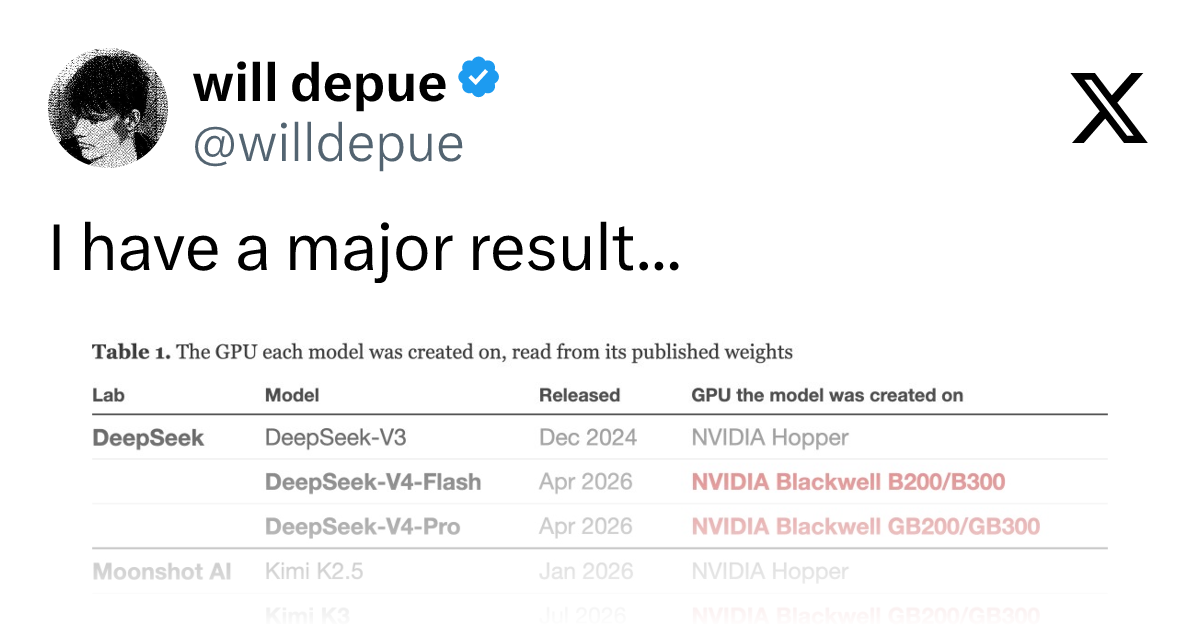
A former OpenAI researcher has discovered what is being called a "Blackwell signature" in an open-weight model. This finding is noteworthy not only because it involves Blackwell, NVIDIA's current-generation GPU architecture, but also because it suggests that open-source models may have deeper connections to specific hardware than publicly disclosed.
According to discussion on Hacker News, the news quickly attracted attention after the researcher posted it. Although available details are limited—the original post only provided key points and a few comments—the term "Blackwell signature" itself is enough to alert practitioners: why would a marker related to a hardware architecture appear in an open-source model?
What Is a "Signature" and Why It Matters
The presence of a hardware name in a model file does not necessarily indicate a backdoor or hidden functionality. More commonly, the signature may be a trace of the training infrastructure: the model was trained or fine-tuned on a GPU cluster with Blackwell architecture, and the toolchain left identifiable metadata, compilation markers, or operator characteristics in the weight files.
But the problem is that open-weight models are generally expected to be "clean"—users can freely inspect, reproduce, and deploy them. If the weights carry a signature tied to specific hardware, this raises at least two questions: first, whether the model has undisclosed optimizations or restrictions for specific hardware; second, whether such a signature affects the model's behavior and portability on other hardware.
Based on the available information, it is not yet possible to determine whether this is a deliberate implantation or a natural byproduct of the toolchain. The single comment on Hacker News also provided no clear direction, which precisely indicates that the discovery is still in an early stage of discussion.
Open-weight models refer to models whose architecture and trained parameters (weights) are publicly released in a way that allows free use, modification, and redistribution—typical examples include the Llama series, Mistral, and some Qwen models. This contrasts with closed-source models that only provide APIs. The key promise of open weights is transparency: researchers can download the weights, inspect the file structure, reproduce inference locally or on private clouds, and even continue fine-tuning. However, "open weights" does not equate to "open training data" or "open training code." Weight files often contain a large amount of metadata automatically written by the training framework, which ordinary users rarely review item by item, providing cover for traces such as hardware signatures.
Blackwell is the GPU architecture released by NVIDIA in 2024, succeeding the Hopper architecture, and is designed for large-model training and inference scenarios. Different GPU architectures differ in instruction sets, tensor core features, and memory hierarchies, so training frameworks and operator libraries (such as CUDA, cuBLAS, TensorRT-LLM) typically compile or optimize operators for specific architectures. When a model is trained or fine-tuned on a Blackwell cluster, the toolchain may leave architecture-related compilation markers, operator version numbers, or serialization metadata in the weight files—such traces are one possible source of the "signature."
Potential Impact on the Open-Source Ecosystem
The core value of open-weight models lies in transparency and reproducibility. Once "hardware signatures" become a common phenomenon, the audit cost for the open-source community will rise: users will need not only to examine model behavior but also to understand the origin of each type of metadata in the weight files.
Another dimension worth noting is the relationship between hardware vendors and model developers. If the signature indeed points to Blackwell, it may reflect a deep coupling between the model and a specific GPU architecture during the training phase. Such coupling is common in commercial closed-source models, but it will be amplified in discussions about open-source models because the open-source community has a lower tolerance for "implicit binding."
At present, this event still lacks verifiable technical details, including which models contain the signature, in what form it exists, and whether it can be removed. Before more information is disclosed, the rational approach is to treat it as a signal that requires ongoing observation rather than jumping to conclusions.
Portability in the machine learning context refers to whether the same model weights can run on different hardware (such as NVIDIA, AMD, Apple chips, or domestic accelerators) with similar performance and accuracy. Ideally, weights are hardware-agnostic numerical tensors, and the inference framework is responsible for mapping them to the target hardware. However, if the weights embed operator characteristics or compiled artifacts for a specific architecture, the model may trigger fallback paths, accuracy differences, or even loading failures on other hardware. For teams that need cross-platform deployment, this implicit coupling increases adaptation costs and is an important reason why the open-source community is sensitive to hardware signatures.
What to Watch Next
First, see whether anyone reproduces the finding. The advantage of open-source models is that they can be independently verified; if multiple researchers observe similar signatures in different models, the nature of the event will change. Second, see whether the model publisher responds. Silence or vague responses could both heighten community concerns. Third, see whether there is an explanation at the toolchain level—if the signature comes from the default behavior of the training framework, then the issue shifts from "hidden functionality" to "metadata specification."
For teams using open-source models, there is no need to overreact in the short term, but metadata inspection of weight files can be incorporated into routine processes. Such checks are low-cost yet can provide first-hand evidence for judgment in similar events.
Related articles

English Version of 'Thank You for Your Love' Gains Traction on Bilibili: A Cross-Cultural Rendition of a Classic Love Song
The English version of 'Thank You for Your Love,' titled 'I'll give you all my love,' trends on Bilibili with rewritten lyrics about giving all your love. This article analyzes its emotional expression, cross-cultural adaptation strategy, and differences from the Chinese original.

Claude Code vs Cursor vs GitHub Copilot: How to Choose Among the Three Major AI Coding Tools
A clear explanation of Claude Code, Cursor, and GitHub Copilot through the lens of 'degree of delegation': Copilot embeds in your editor for autocomplete, Cursor is an AI-first full editor with multi-file batch editing, and Claude Code executes tasks end-to-end in the terminal. Includes selection advice.

Behind the Viral Dynamic Comic Commentary: Deconstructing the Narrative of Family Finance and Emotional Conflict
Deconstructing a Bilibili dynamic comic episode on family financial conflict: how dense dialogue and emotional hooks retain viewers, and where AI script generation falls short in narrative coherence.