Former PlayStation Boss: True Innovation Is Building a $300 Console Again

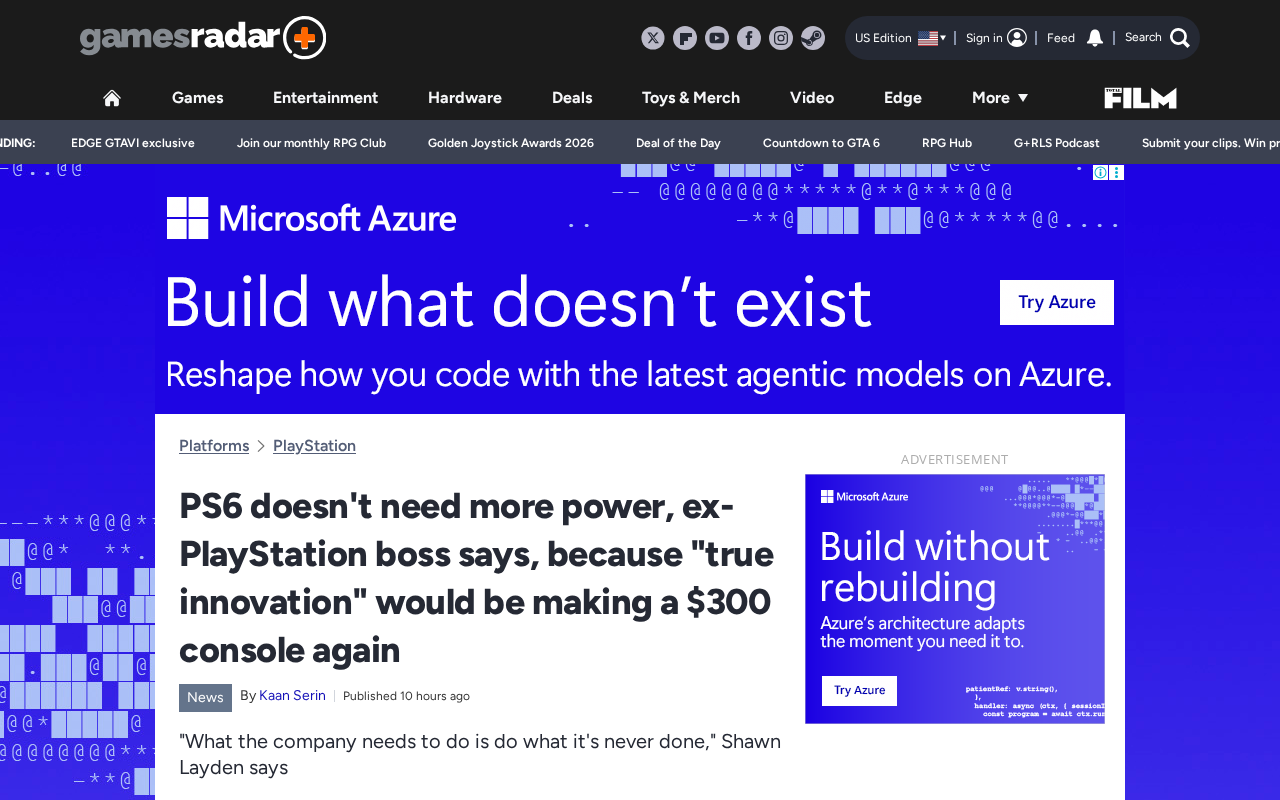
A former PlayStation executive says true innovation is building a $300 console again, not stacking performance.
The article discusses a former PlayStation head's claim that "a $300 console is true innovation," challenging the industry's default "more expensive, more powerful" upgrade logic and bringing price accessibility back into the standard for innovation. Building a $300 console tests engineering trade-offs and is a kind of "subtraction" reverse innovation. Expensive consoles raise the purchase barrier and deepen reliance on subscriptions, though low-cost plans face rising chip costs, inflated expectations, and ecosystem adaptation hurdles.
Why Console Pricing Became the Yardstick for "Innovation"
A former PlayStation executive's viewpoint sparked discussion on Hacker News: he argues that what the game industry today calls "innovation" mostly amounts to piling on performance and expanding ecosystems, whereas "true innovation" would be building a $300 game console again. The remark hits hard because it takes aim at the entire industry's default upgrade logic—each console generation is more expensive, more powerful, and more complex, yet few stop to ask: can the average player still afford one?
This executive's statement isn't nostalgic sentiment but a declaration of product philosophy. $300 was once a sweet-spot price in console history, meaning hardware didn't need top-tier specs but had to balance cost, experience, and adoption rate. Bringing this price point up again is essentially asking: is today's console design building products for players, or building products for spec sheets?
The so-called "sweet spot price" refers to the price point that achieves the optimal balance between what consumers can psychologically bear and how broadly a product can be adopted. In console history, Sony's PlayStation launched at $299 in 1995 and the PlayStation 2 arrived at the same $299 in 2001—both seen as classic examples of this strategy: the hardware itself carried thin margins or even sold at a loss, but costs were recouped through software licensing and game sales. This "razor-and-blades" business model is the key premise for understanding console pricing logic—consoles don't make money by selling machines, but by selling games.
Behind "$300" Is Hard-Earned Cost Control
Squeezing a console down to $300 has never been about cutting specs—it's about delivering a complete experience within a limited budget. That involves trade-offs in chip selection, balancing thermals and power consumption, controlling storage costs, and a willingness to use mature processes instead of the latest ones. In other words, a cheap console tests engineering judgment, not the length of a procurement list.
From this angle, "building another $300 console" is reverse innovation: not asking "what more can we add," but "can we strip away the redundant and nail the core experience." This approach isn't mainstream in today's hardware industry, because flagship products make for better stories and higher margins. But it's precisely this non-mainstream choice that deserves the label of "true innovation."
According to the discussion on Hacker News, the attention this view received shows that players' fatigue with expensive consoles is real. When a console's price approaches or even exceeds that of an entry-level PC, the console's original differentiators—plug-and-play and affordability—are eroded.
The term "reverse innovation" was first coined by Dartmouth professor Vijay Govindarajan, originally referring to the strategy of developing low-cost products for emerging markets and then pushing them back into developed markets. Its core isn't simple downgrading but achieving cost targets by redesigning architecture and removing redundant features. In consumer electronics, this approach gave rise to categories like netbooks and low-cost smartphones. Applying it to consoles means working backward from a "target price" to hardware specs, rather than forward from "maximum performance" to retail price—two entirely different orders of product definition.
The Hidden Costs of Expensive Consoles
Consoles getting more expensive triggers a chain reaction beyond the purchase barrier. Higher hardware costs often mean longer lifecycle planning, more conservative backward compatibility strategies, and greater reliance on software subscriptions and value-added services to recoup costs. On the surface, players buy a machine; in reality, they enter a carefully designed paid ecosystem.
This also explains why the "$300 console" framing is seen as criticism. It implies that current high-price strategies aren't a technical necessity but more of a business choice. If manufacturers were willing to hold back a little on performance and pass the savings to players, both console adoption and software sales could benefit—a virtuous cycle proven repeatedly, except it requires manufacturers to give up the short-term lure of high unit prices.
"Backward compatibility" refers to a new console generation's ability to run games from the previous generation. Under high-priced hardware strategies, manufacturers tend to extend the life of old platforms and delay compatibility solutions, because keeping players buying games on old platforms helps amortize the R&D costs of new hardware. Conversely, a low-cost console trying to establish itself in an ecosystem usually relies more on compatibility to inherit an existing game library. Thus there's a hidden linkage between pricing strategy and compatibility strategy—an often overlooked dimension when discussing low-cost consoles.
The Real-World Resistance to This Argument
Ideals aside, a $300 console would be hard to pull off today. Rising chip manufacturing costs, supply chain volatility, and player expectations for visuals and frame rates being constantly raised by flagship products all put low-priced products at risk of looking "not good enough." If a manufacturer launches a machine with clearly inferior specs, it's easily branded as "cut down" in public opinion.
Another obstacle comes from ecosystem inertia. When the entire content and service system is built around high-performance hardware, a low-cost console must answer one question: can it run the same games? If the answer is "it needs separate adaptation," the point of cost control gets diluted. That's why similar low-cost arguments often stay at the slogan level, and few manufacturers are genuinely willing to step in.
Still, the objections themselves show the topic has value. If an industry no longer even discusses "can it be cheaper," that's the real signal that innovation has stalled. This former PlayStation executive's words at least put the question back on the table.
Broader Lessons for the Hardware Industry
Stepping away from game consoles, this viewpoint holds just as well for consumer electronics more broadly. Whether PCs, phones, or various smart devices, "spec-stacking upgrades" and "affordable design" are two different paths. The former makes headlines more easily; the latter achieves scale more easily. The real challenge is balancing both on the same product line—or making a clear-eyed choice between them.
For entrepreneurs and product teams, "$300" can serve as a thinking tool: if your product had to be delivered at a price far below current mainstream levels, what would you cut and what would you keep? This exercise often exposes the parts of a product that are actually unnecessary. Innovation isn't always addition—sometimes it's a decisive subtraction.
Conclusion
The value of this former PlayStation executive's remark isn't in predicting any specific product, but in reminding the industry: the measure of innovation shouldn't be only performance and specs, but also price accessibility. As console prices keep climbing, reopening the discussion of the number 300 is itself a gentle yet forceful pushback against industry inertia.
One-line Summary
A former PlayStation executive says true innovation is building a $300 console again, not stacking performance.
Paragraph Summary
The article discusses a former PlayStation head's claim that "a $300 console is true innovation." The author notes its impact lies in challenging the industry's default "more expensive, more powerful" upgrade logic and bringing price accessibility back into the standard for innovation. $300 was once a sweet-spot price in console history; achieving it tests engineering trade-offs in chip selection, thermals, power, and storage—a kind of "subtraction" reverse innovation. Expensive consoles not only raise the purchase barrier but deepen reliance on subscriptions and value-added services, eroding the plug-and-play, affordable differentiators. However, the low-cost argument faces three obstacles: rising chip costs, inflated player expectations, and ecosystem adaptation difficulties. The article ultimately extends this thinking to consumer electronics at large, arguing that innovation is sometimes a decisive subtraction.
Related articles
 Tech Frontiers
MuJoCo: An Analysis of DeepMind's Open-Source General-Purpose Physics Simulator
An in-depth analysis of Google DeepMind's open-source physics simulator MuJoCo: high-performance C++ kernel, MJCF modeling format, contact solving principles, MJX GPU acceleration, and robot reinforcement learning use cases.
 Tech Frontiers
Claude API Quick Start: The Official Quickstarts Project Collection
Anthropic's official claude-quickstarts project collection helps developers quickly build deployable apps with the Claude API. Nearly 20k stars, Python-based, great for beginners and prototyping.
 Tech Frontiers
AI Agents Connecting Directly to APIs: Which Calls Can Be Safely Allowed?
AI agents can call any API, but the real challenge is deciding which calls can be safely allowed. This article analyzes allowance decisions from three dimensions—intent matching, least privilege, and controllable impact—and argues that the control layer should sit outside the agent, combined with audit traceability to build a trustworthy API call governance mechanism.