Four AI Image Models Tested: Which One Renders Dewdrops Most Realistically?

GPT Image 2.5 tops a four-model AI image showdown on macro dewdrop realism, scoring 78.2 points.
Four AI image models — GPT Image 2.5, Tongyi Image 3.0 Pro, Nano Banana 2, and Jimeng 5.0 Pro — were tested on the same macro close-up prompt and scored by AI judges. GPT Image 2.5 won with 78.2 points thanks to strong depth-of-field control; Tongyi placed second at 74.5 with a zen atmosphere but sacrificed shadow detail; Jimeng scored 68.2 with beautiful fog but a misplaced focal point; Nano Banana 2 came last at 52 due to physically implausible dewdrops. The test highlights physical realism and focal control as the key capability differentiators.
An Image Generation Showdown — Judged by AI
In this installment of a series called "AI Reality Check," the creator designed a clever evaluation framework: four mainstream AI image models are given the same prompt, and multiple AI models serve as judges to score them. The prompt, titled "Within an Inch," tests each model's ability to reproduce fine detail at extremely close range — specifically the subtle layering of dewdrops, fine hairs, and morning mist on a leaf surface.
This dual setup of "AI contestants + AI judges" is itself a fascinating observation window. It not only tests each model's output quality, but also indirectly exposes how different judge models understand "image quality." The four contestants are GPT Image 2.5, Tongyi Image 3.0 Pro, Nano Banana 2, and Jimeng (C Dream) 5.0 Pro.
Contestant A: GPT Image 2.5 Wins with Layered Detail
GPT Image 2.5 took first place this round with an overall score of 78.2 — the only entry to break 78 points. Judge GPT 6 commented: "Near and far blur, two pearls at the front are best," noting that the image achieved a near-sharp, far-soft depth-of-field effect, making the two foreground dewdrops the visual focal point — a sound approach that aligns with the core aesthetics of macro photography.
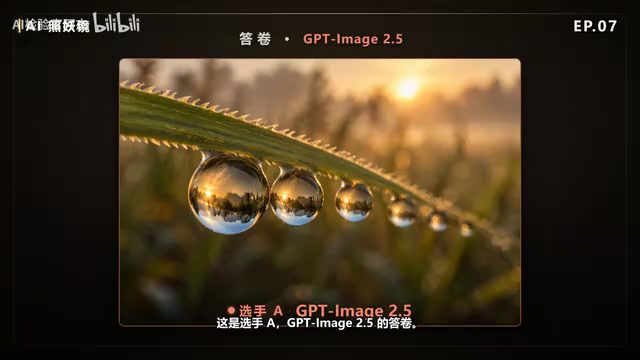
That said, the entry wasn't flawless. Judge Code flagged a compositional issue — "the sun appearing directly in frame goes off-topic" — pointing out that including the sun in a prompt emphasizing extreme close-up texture was a slight misfire. Even so, after weighing the pros and cons, GPT Image 2.5 still led the field on the strength of its depth-of-field control and focal clarity.
Contestant B: Tongyi Image 3.0 Pro — A Trade-off Between Zen Atmosphere and Shadow Detail
Tongyi Image 3.0 Pro scored 74.5 points, placing second. Interestingly, the judging panel included Tongyi's own model, which gave a notably positive review: "The highlight edges on the fine hairs and the gradual fog effect are the most zen." This praised the image's soft-light quality and atmospheric rendering.
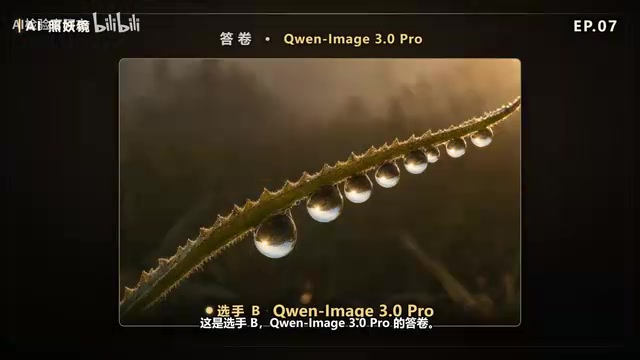
Judge Gemini, however, was more critical: "Shadows too heavy, missing hair strands and structural gaps." This suggests that while the overall mood was appealing, the image sacrificed shadow detail — some fine hairs and structural crevices that should have been visible were swallowed by overly dark shadows. The balance between atmosphere and information density proved to be this entry's main weakness.
Contestant C: Nano Banana 2 — Dewdrop Physics Go Wrong
Nano Banana 2 came in last with 52.0 points — more than 26 points behind the winner, the largest gap in this round. Judge Code's critique cut to the core: "Most dewdrops sit flat on the surface rather than hanging, and the leaf is covered in scattered water fragments."
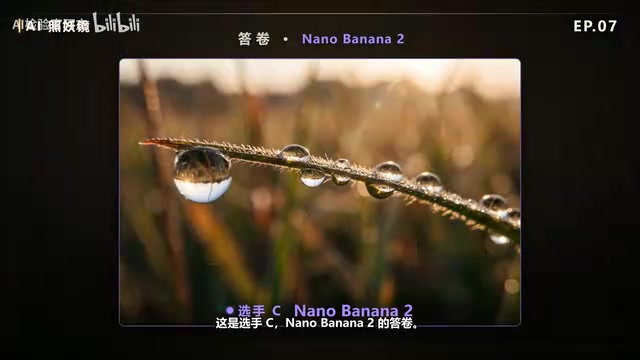
This critique highlights a frequently overlooked challenge in AI image generation — physical plausibility. In the real world, dewdrops hang along leaf edges under gravity, taking on specific shapes and optical refractions. The model's dewdrops, by contrast, looked more like flat water stickers pasted onto the surface — too numerous, randomly distributed, and lacking any physically intuitive arrangement. This type of error is often easier to spot than compositional issues, and much harder to fix.
The difficulty in rendering physically believable dewdrops stems from the need to simultaneously satisfy multiple physical laws: surface tension causes dewdrops to form near-spherical domes on smooth leaf surfaces; gravity pulls edge droplets downward into teardrop shapes; and optical refraction creates an inverted environmental reflection inside each drop. AI image models generate outputs based on statistical patterns rather than physical simulation. They can learn what dewdrops look like, but struggle to internalize the mechanics of why they look that way. Once the scene deviates from common viewpoints in training data — such as an extreme macro close-up — this surface-level imitation breaks down, producing a "decal" feel rather than genuine realism. This is precisely why physical plausibility often reveals more about a model's capability ceiling than color or composition does.
Contestant D: Jimeng 5.0 Pro — Strong Atmosphere, Misplaced Focus
Jimeng (C Dream) 5.0 Pro scored 68.2 points — a middling performance. Judge Code praised its atmosphere: "The foggy morning light is beautiful," acknowledging the model's strength in rendering dawn light and misty texture.
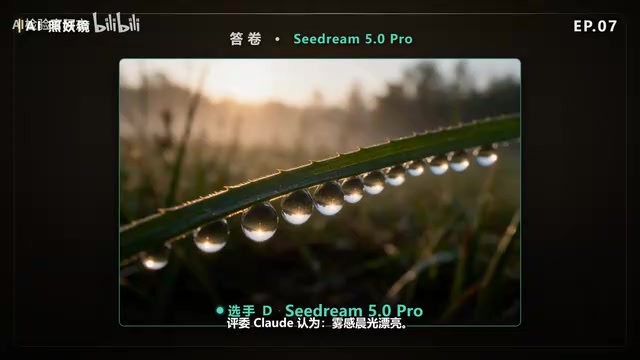
Points were lost on composition. Judge Gemini noted: "The focal point did not land on the nearest, largest dewdrop, causing the visual center of gravity to shift." In macro photography, the viewer's eye should be guided toward the closest, most prominent subject — yet this image's visual weight drifted off-center, weakening the narrative focus. An appealing mood undermined by unclear subject hierarchy is the defining trait of this entry.
Key Signals from This Evaluation
Comparing all four entries side by side, several noteworthy trends emerge.
First, physical realism is becoming a key differentiator. Nano Banana 2's last-place finish wasn't about aesthetics — it was about the physical logic of dewdrops. The "something's just off" category of errors is increasingly the dimension that separates models.
Second, depth-of-field and focal control determine the ceiling. GPT Image 2.5's advantage came precisely from its near-sharp, far-soft layering and clear visual focal point — a stark contrast to the "focal drift" seen in lower-ranked entries.
Third, a pleasing atmosphere alone doesn't translate to a high score. Both Tongyi and Jimeng received praise for their foggy, misty morning-light aesthetics, yet lost points for heavy shadows and focal drift, respectively. This shows that excelling on a single dimension rarely converts into strong overall scores.
It's worth noting that the "AI judge" mechanism has inherent limitations — scores depend on each judge model's aesthetic inclinations, and different judges diverged on the same image (e.g., Tongyi scoring its own work higher, Gemini being stricter on shadow detail). These scores are best treated as relative references rather than absolute standards. The ultimate judge may still have to be the human eye.
If you were on the judging panel, what scores would you give these four dewdrop entries?
Using AI as a judge is an emerging practice in image evaluation. The approach works by feeding candidate images into language-vision multimodal models, which then output textual commentary and quantified scores based on given criteria. The advantages are reproducibility, parallelism, and immunity to human evaluator mood swings. The limitations are that different models carry systematic differences in visual understanding and aesthetic preference — in this article, Tongyi's self-scoring bias and Gemini's heightened sensitivity to shadow detail are both classic examples of evaluator-side bias. Furthermore, multimodal models' "understanding" of images is fundamentally still feature matching, and their grasp of intuitive aesthetic dimensions — such as pictorial mood and emotional tension — remains noticeably behind that of human expert judges. AI judges are therefore best suited for scoring well-defined technical dimensions, rather than comprehensive artistic value assessments.
Related articles

How Big Can Stars Really Get? The Physical Limits of the Largest Stars
Red supergiants are the largest stars by volume, with radii up to 2,000 times the Sun, engulfing the inner solar system. But there is no precise upper limit on stellar size—models predict up to 15,000 solar radii. The most massive blue stars are far smaller than red supergiants—biggest and heaviest are two different things.

Apple HomeView Smart Display Full Feature Breakdown: Wall-Mount or Desktop, $299
Apple launches HomeView, a $299 smart display with wall-mount and desktop options, 12MP camera for facial recognition, smart home control, music playback, and recipe step-by-step cooking. Full breakdown of watch faces, apps, privacy, and cooking integration.

Where Did the Promised New Studio Go? Craft Computing Answers After Five Years
Craft Computing's host responds to viewer questions: the new studio promised five years ago was shelved as construction costs soared from $30,000 to $75,000, and was replaced by a 168-square-foot garage conversion.