Four Failure Modes of AI Acceptance Judges — and How an Evidence Health Gate Fixes Them

Four AI judge failure modes decoded, with an Evidence Health Gate to eliminate dangerous fake passes.
This article maps four classic failure modes of AI acceptance judges in development pipelines: fake red (environment blocks misreported as code errors), deformed fearful judgment (non-standard commands returning blanks), lost connection (intermittent null returns), and the most dangerous — fake pass, where a verdict is logged with zero actual verification. The author's Evidence Health Gate counters this with three mechanical checks: schema-validated verdicts, a minimum token floor, and mandatory diff citation. The piece also highlights the judge's unique strength — detecting cross-module regression bugs that point tests miss — while warning against handcrafted stubs and single-classifier overreliance.
In an AI-assisted development pipeline, the most dangerous point is often not a failing test — it's the judge responsible for making the call going wrong itself. A developer shared a cautionary tale: they once caught a "fake pass" where the checker executed a single token, took 3 milliseconds, and lit up green — all without performing any real verification. This kind of "marked as verified without actually verifying" behavior quietly poisons the entire trust chain.
This article draws on that developer's hands-on experience to map out four classic failure modes of AI acceptance judges (checker/judge), along with an "Evidence Health Gate" mechanism you can deploy the same day.
Four Failure Modes of the AI Judge
The author organizes AI acceptance judge failures into four categories, ranging from wasted resources to corrupted trust — in increasing order of severity.
Failure 1: Fake Red — Environment Blockages Misreported as Code Errors
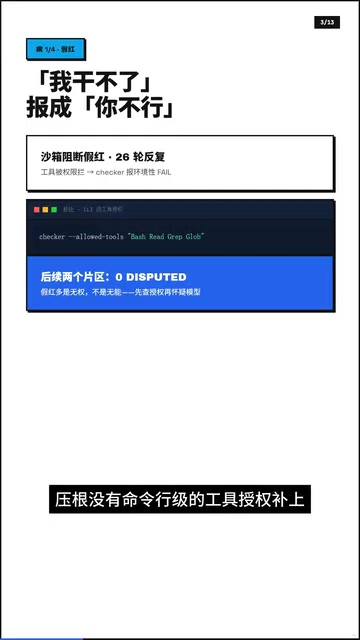
When a checker runs inside a sandbox with all tools blocked, it can't execute its verification steps — but instead of reporting "I can't do my job," it reports "your code is broken." The author mentions one project where this looped for 26 rounds. The root cause wasn't the model; the checker simply had no authorization to use command-line tools.
The fix is straightforward: add bash, read, grep, and glob to the tool whitelist. Once authorization was in place, disputed verdicts in subsequent batches dropped to zero.
Failure 2: Deformed Fearful Judgment — Non-standard Command Syntax Returns a Blank
When the checker is asked to run compound commands like cd && node, the whole thing gets blocked. The result is either an overly conservative fail or a malformed invalid. The author had to open three separate tickets before fully resolving this.
The fix: lock down the invocation spec so the checker only runs single commands, and pair it with a "truth probe" branching logic — 404 means a package issue, 403 is noise, double 429 means quota exhausted. Use error codes to distinguish failure types rather than blanket-flagging everything red.
Failure 3: Lost Connection — Channel Intermittently Returns Empty
The checker channel occasionally returns null, and acceptance results vanish into thin air. The author opened three tickets without a permanent fix, and ultimately turned the "license check" itself into a tool: a three-probe health check that verifies registration, write access to the ledger, and tty environment — three diagnostic lines from a single command. When a connection drops, you can pinpoint the problem on the spot.
The underlying insight here: when the judge is unreliable, build a diagnostic instrument for the judge first — don't keep blindly trusting its verdicts.
Failure 4: Fake Pass — Waving Through Without Evidence
This is the most dangerous mode. The author caught it early: one token, three milliseconds, zero evidence — and a pass gets logged to the books.
Fake red wastes a run window. Fake pass records "unverified" as "verified" — it contaminates every downstream consumer of that trust chain, and the cost is far higher than a single failure.

Fake passes are especially insidious in large pipelines, because downstream systems — CD/deployment systems, progress dashboards, version archives — treat a "pass" record as ground truth and trigger a cascade of irreversible actions. Once an acceptance node "quick-passes" at near-zero cost, the trust anchor for the entire chain has already snapped, but the failure typically doesn't surface until integration testing or production. This is the same nature as a silent failure — the system appears to run normally while its internal state has already drifted from expectation.
Token count works as a proxy metric because a language model performing genuine code review must read context, compare against the diff, and build a chain of reasoning — steps that produce observable computational consumption. "Judge without reading" behavior shows a statistically anomalous low token count, which makes it a valid signal for mechanical gating.
The Evidence Health Gate: Three Mechanical Checks
To address the most dangerous failure — fake pass — the author designed an "Evidence Health Gate" using three purely mechanical rules that require no trust in the model.
First: the verdict must conform to a schema. A bare pass/fail field is not enough; structured evidence must accompany the conclusion.
Second: a token floor. Any verdict below a preset threshold is automatically voided — genuinely reviewing code cannot cost just one token.
Third: a pass must cite the diff. If it can't say what changed or what was verified, it is treated as invalid.
The core logic is simple: a pass with no evidence floor is indistinguishable from a coin flip. Once evidence becomes a mechanical requirement, a green light finally means something.
The shared design principle behind all three checks is rejecting self-attestation — the judge's unilateral endorsement of its own conclusion is not accepted; instead, it must produce structured evidence that can be independently verified. This draws from the Verification & Validation (V&V) separation principle in reliability engineering: verification (did we build it right?) and validation (did we build the right thing?) must be performed by independent mechanisms — the subject being verified cannot self-report the outcome.
Schema constraints ensure output is machine-parseable. The token floor filters out "zero-thought" verdicts. Diff citation anchors conclusions to specific code changes, making post-hoc audit possible. Together, the three form a minimum viable evidence set that shifts authority from "the judge says so" to "the evidence says so."
The Judge's Real Value: Seeing Cross-Module Relationships That Unit Tests Miss
The author describes a milestone moment: the first time a well-evidenced disputed verdict appeared. The checker, reviewing the full diff, caught an ID heuristic issue that was silently breaking an adjacent assertion.
This case proves a point — relationship-level breakage that single-command, single-point tests can't detect is immediately visible when you look at the whole diff. The judge's value isn't in running tests; it's in seeing the cross-module relationships that point tests are blind to.
This "relational breakage" maps to what software engineering calls a regression bug — a change that, without directly modifying a feature, breaks behavior in a distant module through shared state, a global ID generator, event-ordering dependencies, or other implicit coupling. Unit tests, by design, isolate external dependencies (usually via mocks/stubs), so they are structurally unable to detect these cross-module effects. A full diff review, by contrast, surfaces all modified code paths at the moment of change, giving a system-level vantage point from which a judge can identify implicit coupling that human reviewers or isolated tests routinely miss.
The Judge's Own Traps
A reliable judge is valuable — but the judge itself has two traps worth watching.
Trap 1: Handcrafted stubs. For equivalence-comparison baseline tests, if a handwritten stub shares the same bug as the code under test, the two errors will "align" and the test becomes meaningless. Rule of thumb: baseline tests must use real implementations, not handwritten mocks.
Trap 2: Single classifier. Inline logic cannot substitute for an adjacent regression matrix; a single-command pass rate cannot substitute for full regression coverage.

Three Principles and Actions You Can Take Today
The author distills three guiding principles:
- Fake red usually means missing permissions, not missing capability — check authorization before doubting the model.
- Conclusions without evidence are invalid, full stop — token floor plus diff citation is the baseline.
- Environment failures should be resolved with retries — don't rush to flag red.
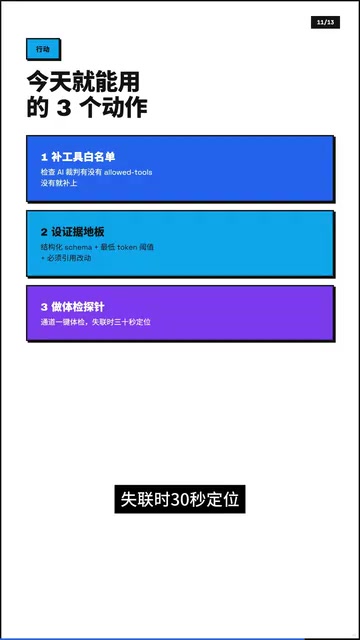
More importantly, here are three concrete actions that require no new framework and take effect the same day:
- Check whether your AI judge has a tool whitelist — if not, add one.
- Set an evidence floor for acceptance conclusions: structured schema, minimum token threshold, mandatory citation of the change.
- Build a health-check probe for the channel so that when it drops, you can localize the problem within 30 seconds.
Closing Thoughts
Trusting a judge is not about taking its verdict at face value — it's about seeing what it actually did and examining its evidence. The moment a gate yields to self-attestation, it loses its power to discriminate. As AI takes on a growing role in code acceptance, learning how to keep an eye on the judge itself is becoming the new frontier of engineering reliability.
Related articles

Understanding DeepSeek in 3 Minutes: The Rise from a Quant Hedge Fund to an Open-Source AI Leader
DeepSeek's history in 3 minutes: from High-Flyer Quant's compute build-up to V2's MLA inference cost cuts, V3's $5.576M training bill, R1's open-source global shock, and V4 with a $7B Series A.

Local Creative Writing Model Showdown: Fine-tuned Qwen3.8 27B Wins, DeepSeek v4.1 Underwhelms
Bilibili creator tests seven local creative writing models: Hemingway and HumanLike Chat based on Qwen3.8 27B perform best, DeepSeek v4.1 is plain, Dongfang Shuo ranks last with confused characters. Includes three test prompts, scores, and usage advice.

Liang Wenfeng's Three Big Bets: Why Did DeepSeek Open-Source Its 82% Gross Margin?
Why did DeepSeek open-source DeepInfer, its 82% gross margin inference framework, and then launch a hundred-billion funding round? An analysis of Liang Wenfeng's three big bets and the open-source strategy.