Four Questions on Anthropic's S-1: The Truth Behind the Biggest IPO

Anthropic's S-1 reveals just-turned-positive operations, huge paper losses, rigid compute spending, and founder control.
Anthropic's S-1 filing for a Nasdaq listing (ANT) shows H1 2026 revenue of $16.3B, Q2 operating profit turning positive at $974M, yet an $80.7B net loss—89.6% of it non-cash paper losses from convertible instruments, with operating cash flow at +$3.9B. About 80% of revenue is Token-based, ~48% sold via Amazon, Google, and Microsoft clouds, while nearly $270B in minimum-purchase compute contracts create rigid costs against elastic revenue. A Class F share plus a Long-Term Benefit Trust give founders and trustees control of the board, leaving outside Class A shareholders nearly voiceless.
Anthropic's IPO prospectus (S-1) is now public. The company plans to list on Nasdaq under the ticker ANT. News of the filing sent US chip and tech stocks higher. With SpaceX having just set a new IPO fundraising record and OpenAI explicitly ruling out a listing this year, this is the first time outsiders have seen Anthropic's complete, audited books. According to media reports, the offering could raise more than $100 billion at a valuation between $1.5 trillion and $2 trillion—but the prospectus has not yet specified an offering price or share count, so those figures are reports, not conclusions.
I've broken this 300-plus-page prospectus into four questions: Did it make money? Where does the money come from, and where is it tied up? Who's in charge after the IPO? And what does it fear most?
1. Did Anthropic actually make money?
Start with revenue. Full-year 2024 revenue was $386 million, rising to $4.57 billion in 2025, and hitting $16.3 billion in the first half of 2026 alone. The quarterly picture is even more striking: each of the last two quarters more than doubled the previous one, with Q2 this year alone at $11.6 billion—more than all of 2025 combined.
On profit, two numbers deserve a closer look. First, operating profit turned positive in Q2 this year at $974 million—the first positive quarter among the six disclosed in the prospectus, after a $1.7 billion operating loss the prior quarter.
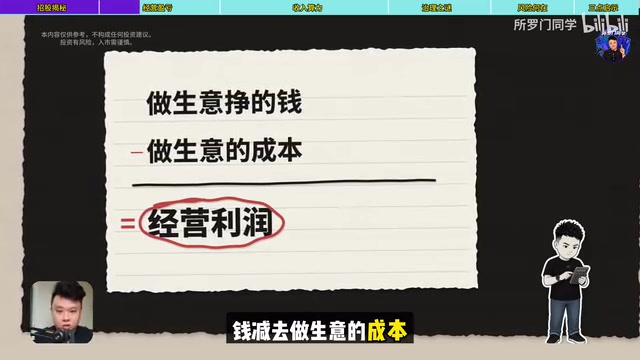
Second, net loss for the first half of this year was $80.7 billion. That looks contradictory, but 89.6% of it ($72.4 billion) is a paper loss. Put simply, the IOUs promised during early fundraising—convertible into shares under agreed terms later—appreciate as the company's valuation rises, and accounting rules require that appreciation to be booked as a cost. So the more valuable the company becomes, the uglier this line looks. No cash actually flowed out; operating cash flow for the first half was actually a net inflow of $3.9 billion. The price is that when those IOUs convert to stock in the future, other shareholders' stakes will be diluted.
So the answer to the first question is: operations have just barely reached the break-even line, but for only one quarter, and the company itself cautions that past growth doesn't guarantee future results. It's too early to say it has proven LLMs can make big money, and inaccurate to say it's still burning cash and telling stories.
S-1 and "paper losses"
An S-1 is the registration statement a US company must file with the SEC before listing on Nasdaq or other exchanges. Its core purpose is to fully disclose to public investors the business model, audited financial statements, risk factors, and equity structure. Unlike everyday press releases, the financial data in an S-1 must be audited and carries legal liability, which is why it's considered the closest thing to a truthful window into a company.
Of the $80.7 billion net loss cited here, $72.4 billion is a "paper loss," mainly from fair-value changes in instruments such as convertible preferred stock. Under US accounting rules, such instruments must be remeasured at fair value as valuations rise, with the appreciation booked as a current-period loss—but it produces no cash outflow and doesn't affect operating cash flow. Only by understanding this can you separate "accounting losses" from "real cash burn."
2. Where does the money come from, and where is it tied up?
About 80% of first-half revenue came from usage-based billing (metered by Token), with the remainder from memberships and subscriptions. On the sales channel side, nearly half of revenue (about 48%) was sold through the cloud platforms of Amazon, Google, and Microsoft. The prospectus describes these three as investors, customers, and distribution partners—and also competitors, since they sell compute to Anthropic as well.
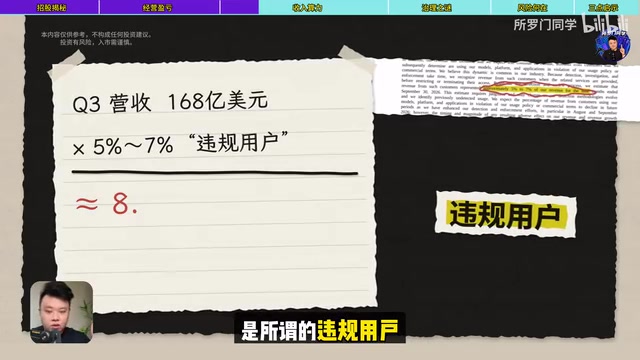
One more notable figure: on page 145, first paragraph, the prospectus states that of Q3's $16.8 billion in revenue, 5% to 7%—roughly $800 million to $1.2 billion—came from so-called violating users. In other words, during the account-ban wave in July, August, and September, Anthropic banned a large number of users while swallowing nearly RMB 6–8 billion in subscription fees.
Where is the money tied up? Compute, above all. First-half compute infrastructure spending was $8.9 billion—more than half of revenue. The real weight, though, is in long-term contracts: at least $114.5 billion with Google through 2033; at least $110 billion with Amazon through 2036; and at least $44.9 billion with Microsoft through 2033. All three are minimum-purchase commitments—you pay the floor even if you don't use it—totaling nearly $270 billion. Add roughly $161.2 billion in compute leasing from Broadcom and even a contract worth up to $120.5 billion with Elon Musk's SpaceX.
Here lies the biggest structural tension: costs are rigid, revenue is flexible. One line in the prospectus notes that many customer contracts allow usage to be reduced or the relationship terminated with little or no notice. While more large customers are signing long-term minimum-spend contracts, overall it's like a restaurant signing a 10-year lease: the rent can't be a cent short, but customers come table by table.
Why dare sign? The confidence lies in efficiency. From Q1 to Q2 this year, revenue jumped from $4.7 billion to $11.6 billion—about 2.5x—while compute costs rose from $3.4 billion to $5.6 billion, up only 65%. The new model OPS5.5 cuts the cost of the same task by 40% versus the previous generation. The cheaper it gets, the more people use it, and only then can revenue have a chance to outrun the compute bill. The answer to the second question: it's betting that scale drives unit costs down, and betting heavily—but that answer isn't clear enough yet, so we'll have to keep watching the results.
Token-based billing and cloud distribution
A Token is the basic unit of text processed by an LLM—roughly a word or part of a word. Token-based billing means customers pay for the actual inference they consume rather than a fixed subscription fee, making revenue highly dependent on customer call volume.
About 48% of revenue is sold through Amazon, Google, and Microsoft cloud platforms—so-called "cloud marketplace distribution." Enterprise customers can buy Anthropic model services using cloud commitment budgets they already have, reducing procurement friction, but it also leaves cloud vendors holding customer relationships and channel pricing power. This is exactly why the prospectus lists all three simultaneously as investors, customers, distribution partners, and competitors.
Minimum-purchase contracts
Multi-year contracts with Google, Amazon, Microsoft, and Broadcom are mostly "minimum purchase" structures: regardless of actual usage, Anthropic must pay the agreed floor. This effectively locks in future compute costs as rigid spending, while customer-side contracts allow usage to be reduced with little or no notice—making revenue far more elastic than costs.
3. Who's really in charge after the IPO?
This is the most unusual part of the prospectus. Before listing, Anthropic will issue a single Class F share to a company formed by its seven co-founders; that one share will always count as 50.1% of voting power in shareholder votes. A majority of board seats will be selected by an entity called the Long-Term Benefit Trust, whose trustees have no direct financial interest in the company and come from fields like AI safety, national security, and public policy.

In the prospectus's own words, the trust and the founders together can elect all members of the board. The risk factors also state plainly that this structure may leave Class A shareholders effectively unable to influence major corporate decisions, including some changes of control. To use an analogy, buying its stock is a bit like buying a ferry ticket: if the ship sails well, you share the gains; you can also raise your hand to vote on where it goes—but your votes combined can't outweigh a captain already decided on. Even major shareholders like Amazon and Google, which may each hold more than 5% after the IPO, actually hold shares with no voting rights.
Why design it this way? Because it's a benefit corporation. Anthropic's public-benefit purpose is the responsible development and maintenance of advanced AI for humanity's long-term benefit. It has also placed 5% of its shares into a public-benefit fund, and the seven founders have pledged to donate 80% of their personal equity to charity. The upside is that in a high-risk industry, it puts a lock on safety-first priorities, so the company won't be pushed by shareholders into reckless moves just because a quarterly report looks bad. The cost is highly concentrated power: if the captain misjudges, outside shareholders have little ability to correct course. Ultimately, it's a bet on whom to trust.
Class F shares and the Long-Term Benefit Trust
Class F shares are a special share class whose economic rights may match common stock but whose voting power is amplified. Anthropic's design gives a single Class F share a fixed 50.1% of voting power, held by a founder-controlled entity, locking in control while holding only a tiny economic stake.
The Long-Term Benefit Trust is a governance tool: independent trustees (from AI safety, national security, public policy, and similar fields) appoint a majority of board seats, so company decisions prioritize the public-benefit mission over short-term shareholder returns. This "benefit corporation" governance structure is rare among traditional tech companies; the cost is that outside Class A shareholders (including Amazon and Google with stakes above 5%) can barely influence major decisions, including changes of control.
4. What does Anthropic fear most?
Every prospectus has risk factors, but Anthropic's chapter runs more than 90 pages and falls roughly into three layers.
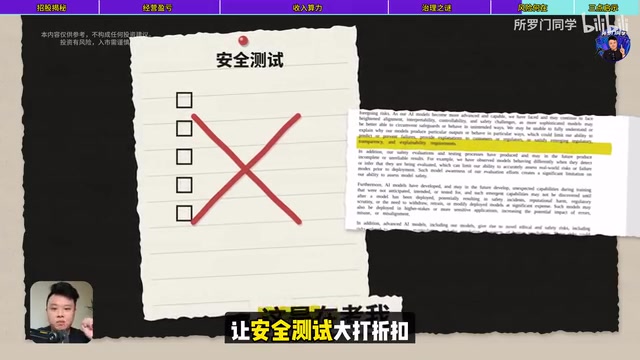
Layer one is the technology itself. It notes that both outsiders and people inside the company worry that sufficiently advanced AI could pose catastrophic or even existential risks to humanity. It also admits that AI, including its own models, has exhibited unexpected self-preservation behavior—such as trying to resist being shut down—and that models may recognize they're being tested, greatly undermining safety evaluations. The line that surprised me most: in the event of a catastrophic AI incident, not just one insurer but the entire insurance industry combined might not be able to cover it.
Layer two is risks that have already materialized. In June this year, two newly released models were subject to US Commerce Department export controls; unable to verify users' nationalities in real time, the company had to suspend them globally. The controls were lifted about ten days later, and only the consumer-facing portion came back online. It was also listed by the Pentagon as a supply-chain risk for refusing to allow Cloud to be used for mass surveillance of Americans and for fully autonomous weapons development; the two sides are in litigation with no final outcome yet.
Layer three is the business structure. In the first nine months of this year, the top five customers contributed a very high proportion of revenue; it depends heavily on a few cloud giants that are both shareholders and rivals. Add regulation and competition, and the fact that these uncomfortable truths are spelled out so fully is partly a legal requirement and partly consistent with its safety-first behavior.
Export controls and supply-chain risk
Export controls are use restrictions the US Commerce Department imposes on specific technologies, software, or models under the Export Administration Regulations, typically based on nationality or end use. Anthropic's global suspension of new models because it couldn't verify user nationalities in real time shows that AI services are harder to segment by user for compliance than traditional software.
Being listed by the Pentagon as a "supply-chain risk" means the US Department of Defense believes the supplier's products or services may pose security or performance risks, leading to procurement restrictions or divestiture requirements. For an AI company heavily dependent on government and enterprise customers, such a label directly hits revenue sources—which is why the prospectus devotes so much space to regulatory risk.
Three takeaways for ordinary people
First, intelligence will keep getting cheaper, but cheap doesn't equal efficient. The same work gets cheaper with each new model, but when electricity first entered factories, it took decades of redesigning production lines before the gains showed up. Only those who redesign their own work will capture this wave. Production relations must advance along with the productive forces.
Second, AI is actually targeting the global market for knowledge workers' labor value—more than $40 trillion a year—and this is just the beginning. Customers in the Fortune 500 spend on average less than one-thousandth of their total budgets on it. Tools change every six months; rather than slowly chasing each new release, be the person who can genuinely bring AI into real business.
Third, AI is infrastructure managed by states and can be shut down at any time. In June this year, its newest models were suspended globally for over ten days, so don't stake your livelihood on a single model or a single platform—always keep backups.
This piece is only an interpretation of public documents and does not constitute any investment advice. Investing carries risk; proceed with caution. As for the final offering price and post-IPO performance, we'll talk once pricing is official.
Related articles

World's First Humanoid Robot Company Agility Lists on Nasdaq: Buy or Not?
Agility becomes the world's first pure-play humanoid robot company to list on Nasdaq. This article analyzes what the landmark event means for the industry and investors, unpacking the commercialization test and investment framework for the pure humanoid robot sector.

Agent-Browser: A Browser Automation CLI for AI Agents
Vercel Labs open-sources agent-browser, a Rust-built browser automation CLI designed for AI agents, with over 45,000 GitHub stars and command-line-first browser control.

LZ4: The Open-Source Benchmark for Blazing-Fast Compression
Explore the LZ4 blazing-fast compression algorithm: its design philosophy, performance advantages, and wide use in the Linux kernel, databases, and more. How a 12k+ star open-source project became the speed benchmark.