Four TPU Systems in One Year: A New Cadence for Hardware-AI Model Co-Design
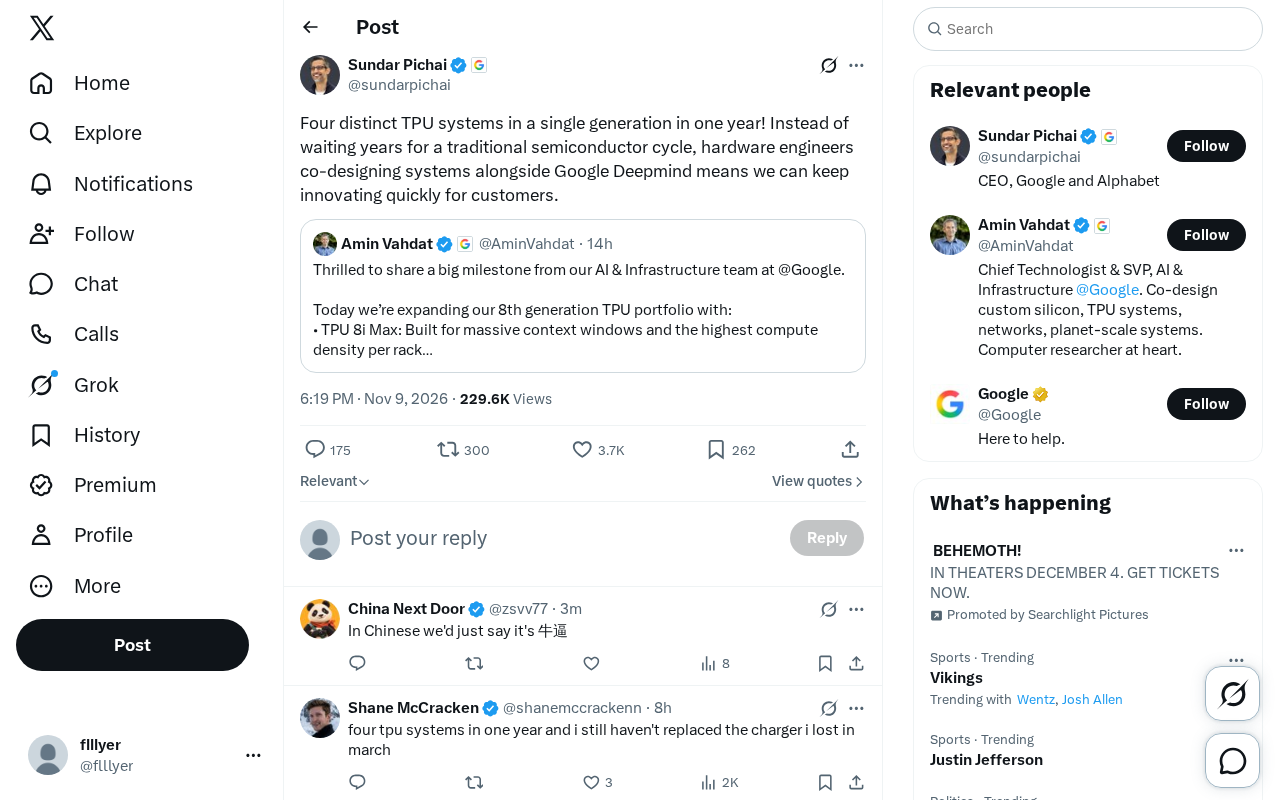
Google launched four systems of the same TPU generation in one year, with hardware-software co-design breaking the slow semiconductor cycle.
Starting from a social media post, the article points out that Google launched four different systems within the same TPU product generation in a single year, breaking the traditional semiconductor iteration cadence measured in years. The core is not a process upgrade but deep collaboration between hardware engineers and Google DeepMind from the design stage, enabling hardware to respond quickly to changes in model requirements. The article analyzes that this essentially pushes iteration from the product level down to the system level, with the four systems likely differentially optimized for different training scales, inference latencies, and energy-efficiency targets, thereby providing customers with more granular options. Finally, the article notes that this model relies on the naturally low coordination costs of hardware and model teams within the same company, making it difficult for external vendors to replicate directly, but the depth of hardware-software co-design and iteration speed are becoming new dimensions of AI hardware competition.
Breaking the Traditional Semiconductor Cycle
In the traditional semiconductor industry, a new piece of hardware often takes years from design to deployment, with long iteration cycles. But this cadence is being disrupted. A post on X (formerly Twitter) points out that within the same TPU product generation, four different systems were launched in a single year. This is not simply a process upgrade, but the result of hardware engineers and Google DeepMind collaborating deeply from the design stage.
Breaking the Traditional Semiconductor Cycle
The traditional chip development flow is usually linear: define specifications, design, tape-out, verification, mass production—each step can take months. The original text emphasizes "rather than waiting for the years-long traditional semiconductor cycle," implying that the TPU team adopted a more aggressive parallel strategy.
The core of this strategy is that hardware is no longer built first and then adapted to software; instead, it advances in sync with the model R&D team. When DeepMind's model requirements change, hardware design can respond quickly rather than waiting for the next generation. Four systems in a year essentially pushes "iteration" down from the product level to the system level.
Tape-out is one of the most critical and expensive steps in chip development, referring to submitting the designed layout data to a wafer fab to begin manufacturing. A tape-out on an advanced process can cost tens of millions of dollars, and it usually takes months from tape-out to receiving testable chips. Because of this, in the traditional flow every tape-out strives to succeed on the first try, and design teams spend a lot of time on simulation and verification. The reason "four systems in a year" is aggressive is that it implies more frequent tape-out and verification loops—feasible only when design fault tolerance is high, software can compensate for hardware defects, and the team can bear the cost of trial and error.
The difference between system-level iteration and product-level iteration is also worth explaining. Product-level iteration refers to releasing a new generation externally, usually at intervals of one to two years; system-level iteration, by contrast, quickly derives system forms for different workloads on the same chip platform by adjusting packaging, memory configuration, interconnect topology, board and chassis design. The former is constrained by the silicon itself, while the latter works more at the engineering layer above the chip, so the cadence can be much faster.
Co-Design: Hardware and Models Moving Toward Each Other
The original text mentions that "hardware engineers co-design systems with Google DeepMind," which is not simply requirement alignment. In the AI accelerator field, model architectures evolve far faster than traditional hardware planning cycles. If the hardware team plans at the usual cadence, the model form may have already changed by the time the product launches.
Co-design means hardware engineers can directly understand DeepMind's bottlenecks in training and inference, while the model team can also know hardware constraints in advance. This two-way feedback shortens the path from idea to silicon. Each of the four systems in a year may be optimized for different workload characteristics or deployment scenarios.
Hardware-Software Co-design has a specific meaning in the AI accelerator field: it requires the model team to share operator distribution, memory access patterns, precision requirements, and other information with the hardware team during architecture exploration, and the hardware team uses this to decide parameters such as matrix unit size, on-chip cache capacity, and interconnect bandwidth. This contrasts with the traditional "set specs first, then adapt" model, which often results in hardware being outdated relative to mainstream models by the time it launches.
TPU (Tensor Processing Unit) is Google's custom AI accelerator developed in-house since 2015, initially designed for inference and later extended to training. Its architecture is heavily customized around tensor operations and relies on software stacks such as the XLA compiler to map models onto hardware. Because TPUs are not sold retail but provided as instances through Google Cloud, the hardware team can observe real workloads more directly—an organizational precondition for its rapid system-level iteration.
What It Means for Customers
The original text's bottom line is "rapid and continuous innovation for customers." With four systems launched in a year, customers get not a single-spec product but more granular options—different systems may correspond to different scales of training tasks, different inference latency requirements, or different energy-efficiency targets.
Rapid iteration also means customers do not have to wait through long product cycles to use hardware optimized for new models. When AI application scenarios change quickly, the flexibility of hardware supply is itself a competitive advantage.
Can This Model Be Replicated?
TPU is a typical example of Google building and using its own hardware, with hardware and model teams within the same company, so coordination costs are naturally low. For external chip vendors, replicating this cadence would require extremely deep partnerships with model companies, or even changing their existing product planning processes.
But the trend is clear: competition in AI hardware is no longer just about process and compute, but also about iteration speed and the depth of hardware-software co-design. The signal sent by four systems in a year is that the cadence of hardware innovation is aligning with software.
Related articles
GPT-6.2 and Astra Launch Together: OpenAI Has Finally Figured Out Its Release Cadence
OpenAI releases GPT-6.2 Sol and Astra together, with Plus users able to try them in ChatGPT Work and Codex. This article breaks down the positioning differences between the two models, Astra's practical use in long-document retrieval and rewriting, and how the simultaneous dual-model launch affects user workflows.

GPT-6.2 Dual-Model Hands-On: How Big Is the Gap Between Astra and Sol in Clock-Making and Game-Building?
GPT-6.2 Astra vs Sol hands-on: Blender clock, neon shooter, and Formula racing compared. Astra spends $419 with strong execution; Sol costs $197 but drops to 2 FPS. Both still trail Fable and Opus in games and aesthetics.

GPT-6.2 Astra and Sol Released: A Big Cost Drop, and How to Choose Between the Two Models
OpenAI releases GPT-6.2 Astra and GPT-6.2 Sol: Astra tackles professional tasks, Sol targets low-cost everyday use, with cost per task cut to under a third.