Four-Way Shuttle Scheduling: Path Planning, Traffic Control, and Deadlock Prevention

Multi-shuttle scheduling boosts throughput by coordinating task allocation, path planning, and traffic control—not by adding vehicles or speed alone.
This article explores the principles and practices of multi-shuttle scheduling in four-way shuttle AS/RS, arguing that system performance depends on task allocation, path planning, traffic control, and shared equipment coordination rather than single-vehicle speed. It covers key challenges like task imbalance, path conflicts, deadlocks, and shuttle-lift coordination, outlines a six-step scheduling workflow, proposes five core strategies, and highlights WMS/WCS roles and KPI evaluation.
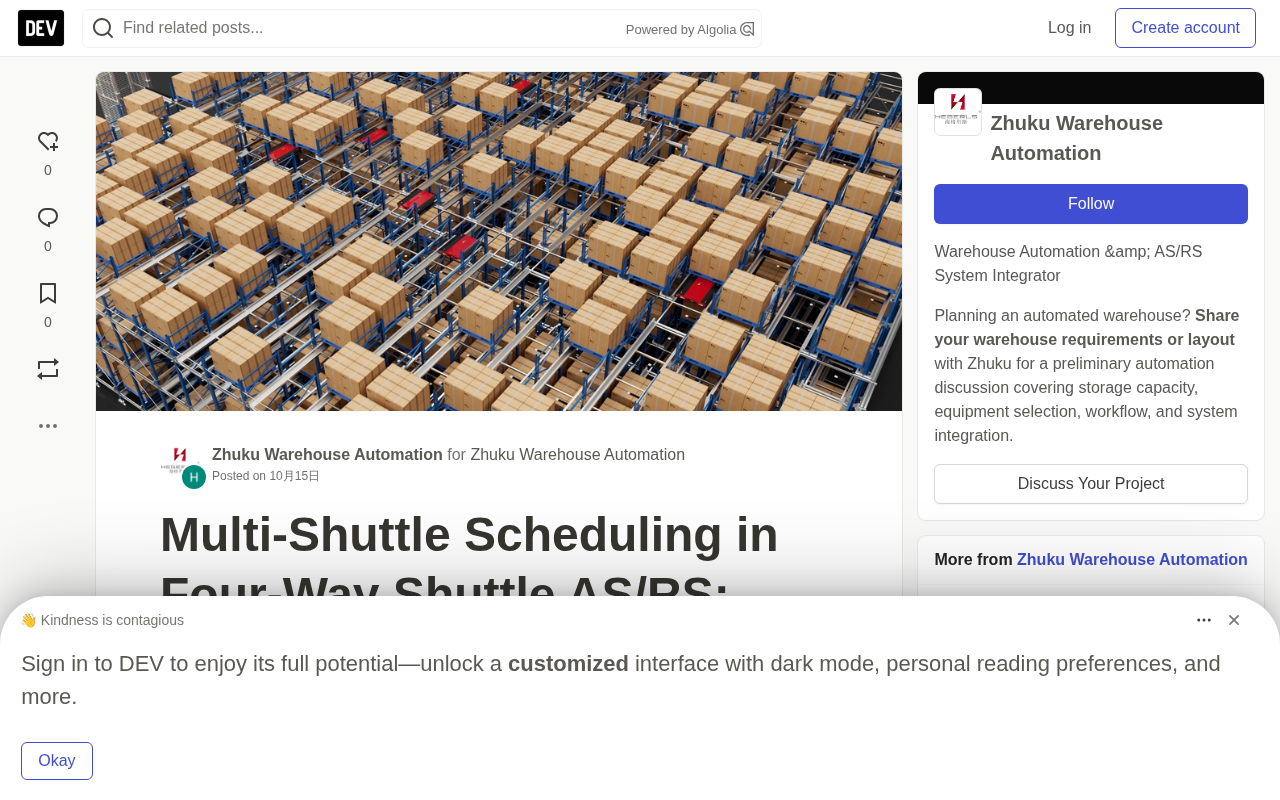
In four-way shuttle automated storage and retrieval systems (AS/RS), shuttles can move both horizontally and vertically within high-density racking. When multiple shuttles operate simultaneously, system performance no longer depends solely on the speed of an individual vehicle—it depends on how the warehouse control system coordinates task allocation, path planning, and traffic control.
The core of multi-shuttle scheduling lies in reasonably distributing storage and retrieval tasks among multiple shuttles while coordinating their movements, priorities, and resource usage to improve system throughput and operational stability.
Why Multi-Shuttle Scheduling Matters
Adding more shuttles can increase the potential handling capacity of an automated warehouse, but the improvement is not necessarily proportional to fleet size. When more vehicles operate within the same racking structure, they may compete for shared aisles, intersections, transfer points, and lifts. Without coordination, this leads to increased waiting times, repeated re-planning, and reduced productive operating time per vehicle.
Task Allocation and Workload Imbalance
If too many tasks are assigned to the same shuttle while other vehicles sit idle, the fleet cannot effectively utilize available capacity. Task allocation needs to consider travel distance, vehicle position, destination, task urgency, battery status, and the expected availability of shared resources—not just the number of orders already assigned.
Path Conflicts and Congestion
Two shuttles may need the same rack intersection, transfer point, or narrow aisle at nearly the same time. Without coordinated traffic control, one vehicle must wait for the other to pass. Repeated conflicts create congestion at critical locations and reduce overall system throughput.
Deadlock vs. Livelock: Deadlock refers to a state where a group of vehicles or resources fall into circular waiting, and none can make progress. Livelock occurs when vehicles are not blocked but keep moving without ever completing their tasks (for example, two vehicles repeatedly yielding to each other in a narrow aisle, swapping positions back and forth). Livelock is more insidious because it does not manifest as an obvious standstill, yet it still consumes time and battery power. Multi-shuttle systems should guard against both when designing traffic rules: the former relies on dependency detection and recovery, while the latter relies on deterministic yielding priority rules to avoid endless "courtesy loops."
Deadlock and Blocking
Deadlock occurs when vehicles or resources wait on each other, preventing the related operations from progressing. For example, one shuttle occupies a critical intersection waiting for a downstream resource, blocking another shuttle from reaching the area needed to complete its task. Collision avoidance alone cannot eliminate this problem—a system can prevent physical collisions while still allowing inefficient waiting patterns or deadlocks.
Coordination Between Shuttles and Shared Equipment
In many four-way shuttle systems, shuttles need to work with lifts, conveyors, transfer mechanisms, and warehouse software. A shuttle may complete its movement but still be unable to finish its task because the receiving lift is occupied or the next transfer point is unavailable. Effective scheduling must coordinate the complete material handling flow rather than optimizing shuttle motion in isolation.
How a Multi-Shuttle Scheduling System Works
A practical scheduling architecture typically combines a warehouse management system (WMS), a warehouse control system (WCS), equipment controllers, and real-time status feedback.
Step 1: Generate and Prioritize Warehouse Tasks
The WMS generates storage, picking, replenishment, and other tasks based on orders, inventory rules, and operational requirements. Tasks can be prioritized by factors such as customer order deadlines, outbound sequencing, inventory location and destination, batch processing rules, and equipment availability. High-priority tasks should not automatically interrupt all lower-priority tasks—the scheduler must also consider the cost of interrupting work in progress.
Step 2: Assign Tasks to Suitable Shuttles
The WCS evaluates available shuttles and assigns work according to warehouse operating rules. Decision factors include: the distance from the shuttle's current position to the pick-up point, the estimated completion time for the entire task, current vehicle workload and queue, expected congestion along the route, battery level and operational status, and the availability of lifts and transfer points. The goal is to balance fleet utilization and delivery performance, rather than simply assigning each new task to the nearest shuttle.
Step 3: Plan Collision-Free Paths
After task assignment, the path planner determines how the shuttle reaches its destination. Paths can be represented as a graph structure where nodes represent locations and edges represent allowed movements. The planner must account for actual rack geometry, permitted travel directions, transfer mechanisms, and equipment constraints. Algorithms such as A* can help find efficient paths, but shortest-path computation alone does not guarantee efficient multi-vehicle operation—the planner must also consider the positions and planned movements of other shuttles.
A* Algorithm vs. Multi-Agent Path Finding (MAPF): A* is a heuristic single-agent shortest-path search algorithm that guides the search by estimating the "remaining cost from the current position to the goal," efficiently finding optimal paths on weighted graph structures. However, A* treats other vehicles as static obstacles or ignores them entirely, which leads to mutually conflicting paths in multi-vehicle scenarios. MAPF (Multi-Agent Path Finding) searches in a joint state space, planning conflict-free paths for all vehicles simultaneously. Common algorithms include Conflict-Based Search (CBS), Prioritized Planning, and MAPF-LNS. MAPF can provide theoretically conflict-free solutions, but computational complexity grows rapidly with the number of vehicles. In practice, systems often adopt a compromise of "batch planning plus runtime traffic control."
Step 4: Reserve Critical Resources and Coordinate Traffic
Before entering shared or restricted areas, shuttles may need authorization to occupy the relevant segments, intersections, or transfer resources. Controllers can use reservation rules, passage priorities, time windows, or other traffic management mechanisms to coordinate vehicle movements. If the required resource is unavailable, the shuttle should wait at a designated safe location where the system design permits. Waiting vehicles should not unnecessarily block critical paths.
Step 5: Execute Tasks and Monitor Equipment Status
The WCS sends instructions to the relevant equipment controllers and monitors feedback such as position, movement completion, transfer status, and fault signals. When actual operating conditions differ from the plan, the controller can update task assignments or recompute affected paths. This feedback loop helps the system respond to unexpected delays, resource blocking, equipment failures, and changes in task priority.
Step 6: Confirm Completion and Update the Task Queue
After material transfer is confirmed, the system updates the task status and makes the next scheduling decision. The next task might be another pick, a storage operation, or a repositioning move. Where the process allows, coordinating consecutive tasks can reduce unnecessary empty travel. The key principle is that task allocation and path planning should operate as interconnected parts of a continuous control process.
Five Core Strategies for Efficient Multi-Shuttle Scheduling
Dynamic Task Allocation
Static task allocation assigns vehicles according to fixed rules or predetermined work zones, which works well for predictable workloads but may fall short when order volumes or equipment status change. Dynamic task allocation evaluates the current system state and adjusts assignments on demand. A useful scheduling objective is to minimize estimated task completion time while accounting for travel cost, congestion, equipment availability, and priority constraints.
Multi-Agent Path Planning
Multi-agent path planning considers the movements of multiple vehicles rather than treating each shuttle as an independent unit. The optimal path for one shuttle may become inefficient when other vehicles pass through the same area. A coordinated planner can evaluate potential conflicts at intersections, opposing traffic on restricted segments, shared resource occupancy, waiting time caused by other vehicles, and the impact of path changes on in-progress tasks.
Collision Avoidance and Deadlock Prevention
Collision avoidance and deadlock prevention are related but distinct objectives. Collision avoidance prevents incompatible movements from occupying the same physical space simultaneously; deadlock prevention seeks to avoid vehicles or resources falling into mutually dependent waiting states. Common techniques include: resource reservation (reserving critical segments or intersections before vehicles enter), priority management (giving tasks or vehicles priority according to rules while avoiding permanent starvation of low-priority tasks), safe waiting zones (keeping waiting vehicles away from intersections where layout permits), look-ahead planning (evaluating multiple subsequent moves rather than just the next step), and deadlock detection and recovery (monitoring prolonged waits and dependency cycles, and releasing or reallocating resources through controlled recovery procedures).
Safe Waiting Zone: A designated temporary stopping location reserved within the racking structure that does not block other vehicles' passage. When a shuttle needs to wait for a resource or yield, it should remain in these zones rather than blocking intersections or main aisles. The number and placement of safe waiting zones directly affect scheduling flexibility: too few, and waiting vehicles overflow onto critical paths, causing cascading congestion; too many, and they occupy storage locations that could otherwise hold goods, reducing storage density. A reasonable approach is to place safe waiting zones near intersections, in front of lift entrances, and mid-way along long aisles, and to explicitly specify in the scheduling rules that vehicles "must wait at designated locations."
Coordinated Scheduling of Lifts and Shuttles
In systems where shuttles depend on lifts to change levels, lift availability can become a major bottleneck. A shuttle may complete its horizontal movement and then wait for a lift, while another shuttle simultaneously occupies the lift or approaches the same transfer point. The scheduler should comprehensively consider shuttle arrival estimates, lift occupancy, transfer readiness, and downstream availability. For example, when a lift cannot reasonably handle requests from multiple shuttles, the controller should avoid directing multiple shuttles to the same lift simultaneously.
Lift Bottlenecks and the "Fleet-to-Lift Ratio": Lifts are typical serial shared resources in four-way shuttle systems, typically capable of serving only one vehicle (or one pair of cars) at a time. As a result, the system's theoretical throughput ceiling is often determined by the number of lifts rather than the number of shuttles. An empirical approach is to first estimate the peak inbound/outbound frequency demand for lift round trips, then work backward to determine the required number of lifts, and finally determine the shuttle fleet size—if the number of shuttles far exceeds lift handling capacity, the excess vehicles will only queue at lift entrances, adding congestion and energy consumption.
Reducing Empty Travel and Task Sequencing
Empty travel consumes time without advancing inventory movement. Where operating rules permit, the controller can sequence compatible storage and retrieval tasks to reduce unnecessary repositioning. However, minimizing travel distance is not always the best decision—a slightly longer path may avoid congested intersections, and a less convenient task assignment may prevent delays to high-priority outbound orders. The scheduling objective should balance travel distance, completion time, throughput, and operational constraints.
How WMS and WCS Work Together
The WMS and WCS serve different roles, but their decisions must remain consistent. The WMS primarily manages inventory and warehouse tasks, while the WCS coordinates equipment execution and material movement through the automated system.
| Function | WMS Responsibility | WCS Responsibility |
|---|---|---|
| Inventory management | Maintain inventory records and storage rules | Execute inventory-related equipment movements |
| Task generation | Create and prioritize warehouse tasks | Receive, sequence, and dispatch executable tasks |
| Shuttle scheduling | Provide task priorities and business constraints | Assign work and coordinate vehicle movements |
| Path planning | Provide task endpoints and operating rules | Plan paths and manage movement conflicts |
| Equipment control | Track task and inventory status | Coordinate shuttles, lifts, conveyors, and transfer equipment |
| Exception handling | Manage inventory and order exceptions | Respond to equipment failures, path blocking, and execution delays |
Well-integrated systems allow task priorities to influence equipment scheduling without the WMS controlling every shuttle movement. At the same time, the WCS should return reliable execution status to ensure that warehouse tasks are not marked complete before the related operations are confirmed.
How to Measure Multi-Shuttle Scheduling Performance
Scheduling algorithms should be evaluated using operational metrics rather than vehicle speed alone. The following KPIs help determine whether a multi-shuttle control strategy is effective:
| KPI | What It Measures | Why It Matters |
|---|---|---|
| System throughput | Number of storage or retrieval tasks completed per hour | Shows overall handling capacity |
| Average task cycle time | Time from task release to completion | Reflects task responsiveness |
| Shuttle utilization | Proportion of time vehicles perform productive work | Helps identify excessive idle time |
| Wait time ratio | Proportion of waiting time to total operating time | Reveals congestion and resource bottlenecks |
| Empty travel ratio | Proportion of travel without payload to total travel | Indicates room for task sequencing improvement |
| Conflict frequency | Number of path or resource conflicts within a defined period | Helps assess traffic management effectiveness |
| Deadlock and recovery events | Number and duration of blocked operations | Indicates system stability |
| Lift utilization | Effective use of shared lift equipment | Helps identify vertical transfer bottlenecks |
These metrics should be evaluated together. For example, high shuttle utilization does not necessarily mean high warehouse throughput if vehicles spend excessive time waiting in congested areas.
Why Adding More Shuttles Doesn't Necessarily Increase Throughput
Adding more shuttles can increase capacity when the existing fleet is the primary bottleneck. But when shared resources are saturated, returns may diminish. Consider a warehouse where multiple shuttles frequently need the same lift or intersection—adding vehicles increases the number of potentially conflicting movements but does not increase the lift's handling capacity or create additional physical travel space. In this case, new shuttles may generate more waiting time rather than productive work.
Before expanding the fleet, operators should investigate: whether current shuttles are executing tasks or waiting for resources, whether congestion is concentrated at specific intersections or floors, whether lifts can handle the expected transfer demand, whether task allocation causes unnecessary cross-warehouse travel, and whether scheduling decisions account for downstream availability.
A Practical Implementation Framework
A structured implementation process can reduce commissioning risk and help teams validate scheduling performance. Phase 1: Model the warehouse—map the racking structure, permitted travel directions, intersections, lift connections, transfer points, and safe waiting locations. Phase 2: Establish operating rules—define task priorities, vehicle eligibility, resource reservation rules, fault response, and deadlock recovery procedures. Phase 3: Configure scheduling logic—integrate task allocation, path planning, traffic management, and equipment coordination into the control architecture. Phase 4: Test with representative workloads—simulate outbound peaks, uneven task distribution, equipment delays, path blocking, and changes in task priority. Phase 5: Validate actual performance—compare measured throughput, cycle time, waiting time, conflict frequency, and equipment utilization against agreed targets. Phase 6: Optimize using operational data—identify recurring bottlenecks and adjust scheduling parameters, task sequences, or resource allocation rules.
How to Choose the Right Multi-Shuttle Scheduling Strategy
Not every warehouse needs the same scheduling complexity. Small systems with small fleets and limited traffic interaction may run well with rule-based task allocation and simple path reservation. High-density warehouses with multi-level storage, shared lifts, frequent task arrivals, and many interacting vehicles may benefit from more advanced path planning and adaptive scheduling. The choice should reflect fleet size and expected growth, racking geometry and travel constraints, number and capacity of lifts, peak inbound/outbound workloads, task priority and inventory handling requirements, required system availability and recovery behavior, and integration with existing ERP, MES, and warehouse software.
The most sophisticated algorithm is not automatically the best choice. The practical goal is to achieve the required throughput and reliability with a testable, maintainable, and scalable control strategy.
Frequently Asked Questions
What is multi-shuttle scheduling in a four-way shuttle warehouse? Multi-shuttle scheduling coordinates task allocation and vehicle movements for multiple shuttles, considering task priorities, path availability, shared resources, and equipment status to improve system throughput and reliability.
How does the WCS coordinate multiple four-way shuttles? The WCS receives executable tasks, assigns work to suitable shuttles, manages paths and resource reservations, coordinates associated equipment, and monitors execution feedback.
How do you prevent deadlocks in a multi-shuttle AS/RS? Common methods include resource reservation, traffic priorities, safe waiting zones, look-ahead planning, and deadlock detection with recovery procedures. The right combination depends on racking geometry, fleet size, and shared resource constraints.
Does adding more shuttles always increase warehouse throughput? No. Additional shuttles can increase capacity when vehicle availability is the primary constraint, but congestion, lift capacity, and poor task allocation can limit the improvement.
What is the difference between path planning and task scheduling? Task scheduling determines which vehicle should execute a task and when; path planning determines how that vehicle reaches its destination while respecting movement and safety constraints.
One-line Summary
Multi-shuttle scheduling improves system throughput by coordinating task allocation, path planning, and traffic control—not simply by adding vehicles or increasing individual vehicle speed.
Paragraph Summary
This article systematically explains the principles and practices of multi-shuttle scheduling in four-way shuttle AS/RS. The core idea is that system performance depends on task allocation, path planning, traffic control, and shared equipment coordination—not the speed of a single vehicle. The article analyzes key issues such as task imbalance, path conflicts, deadlock and blocking, and shuttle-lift coordination, presents a six-step scheduling process (generate tasks, assign vehicles, plan paths, reserve resources, monitor execution, confirm and update), and proposes five core strategies: dynamic task allocation, multi-agent path planning, collision avoidance and deadlock prevention, lift coordination, and empty travel reduction. It also emphasizes the division of responsibilities between WMS and WCS and the comprehensive evaluation of KPIs such as throughput and wait time ratio.
Related articles

Chain of Thought Isn't Just for AI: How Humans Can Use CoT to Improve Thinking Quality
Chain of Thought isn't just a prompt trick for large models. Starting from a Hacker News discussion, this article analyzes why CoT works for human thinking too, breaks down actionable ways to transfer it, and highlights the key differences between human CoT and machine CoT.
Cloudflare Teams Up with OpenAI: Closi…
Cloudflare Teams Up with OpenAI: Closing the Loop from Vulnerability Discovery to Defense with AI
Cloudflare uses OpenAI Daybreak to investigate security vulnerabilities and generate reviewable remediation plans, while developers use Codex to boost coding efficiency and quality.

Orca Multi-Agent Orchestration in Practice: A Guide to Parallel Collaboration with Claude and Codex
Orca is Stable AI's free open-source agent workbench supporting 34 agents like Claude Code and Codex in parallel. Learn its Git worktree isolation, multi-model orchestration, and mobile management.