FP64, INT8, and FP4/6/8: The Battle Over AI Precision Formats

The precision format debate is essentially a trade-off among accuracy, throughput, and memory.
Using the saying "FP64 Is All You Want, INT8 Is All You Need, FP4/6/8 Is All You Have" as a thread, the article deconstructs the stances behind three numerical formats. FP64 represents scientific computing's pursuit of trustworthiness but has exited deep learning training; INT8 is a validated inference quantization format with manageable error on most tasks; FP4/FP6/FP8 is the realistic constraint after co-evolution of native hardware support and engineering infrastructure. Precision choice is not purely numerical but about objective functions, and the mature approach is layered mixed precision rather than taking sides.
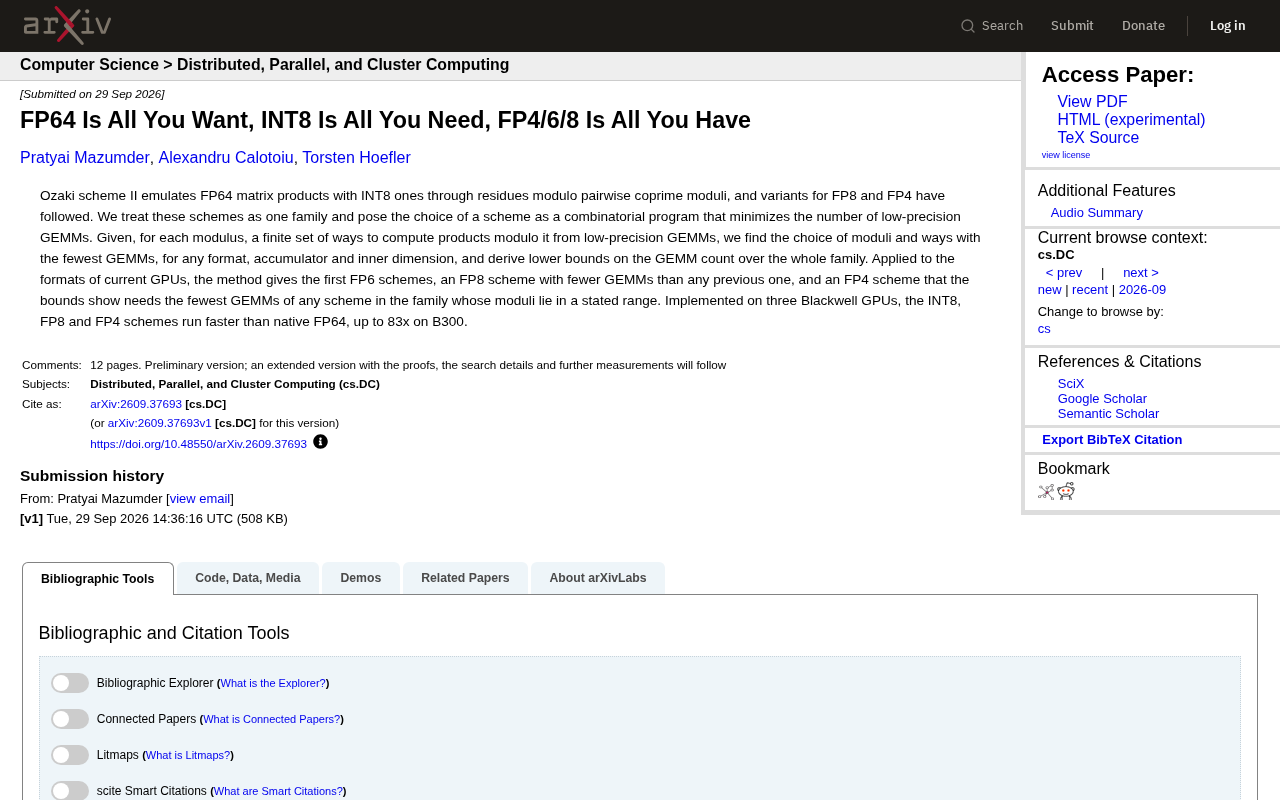
Three Narratives in One Title
The saying circulating in tech communities—"FP64 Is All You Want, INT8 Is All You Need, FP4/6/8 Is All You Have"—is itself a small fable about AI hardware precision. It juxtaposes three numerical formats, hinting at three completely different stances: FP64 represents the fundamentalism of scientific computing, INT8 represents the engineering pragmatism of "good enough," and FP4/FP6/FP8 represents the real-world constraint of "these are all you actually have" under current hardware and model compression trends.
This discussion has drawn considerable attention in the community, and the divergence in the comments illustrates precisely that: the choice of precision format has never been purely a numerical question—it's a question about objective functions. Are you optimizing for accuracy, throughput, memory, or ecosystem compatibility?
FP64: The Diluted "Correctness"
FP64 advocates have a very clean argument: if the computation itself has errors, all subsequent optimizations are built on shifting sand. In fields like climate simulation, computational fluid dynamics, and high-precision physics simulation, double precision has long been the default because it makes numerical results independent of implementation details and operation order.
But in the deep learning context, FP64 has essentially exited the training stage. Backpropagation's precision requirements for gradients are not that stringent, while the memory and bandwidth costs of FP64 are several times higher. The so-called "All You Want" is more of an idealized nostalgia than a practical engineering recommendation.
What Are FP64 / FP32 / FP16 / Low-Precision Formats
FP64 (double-precision floating point) and FP32 (single-precision floating point) both follow the IEEE 754 standard: the former uses 64 bits to represent a floating-point number, with 52 bits for the mantissa, providing about 15–17 decimal significant digits; the latter uses 32 bits with a 23-bit mantissa, about 7 significant digits. FP16 is further compressed to 16 bits, while FP8, FP6, and FP4 are non-IEEE-standard low-precision floating-point formats that typically require block-level scaling factors. The lower the bit width, the fewer significant digits and narrower dynamic range it can represent, but the higher the throughput per operation and the lower the memory bandwidth usage. It is precisely this "precision for efficiency" trade-off that forms the numerical basis for understanding the three narratives in the title: FP64 pursues determinism of results, INT8 pursues cost efficiency, and FP4/6/8 is the realistic choice under native hardware support.
INT8: The Engineering Watershed
INT8 is the quantization format that has truly been validated at scale. From an inference deployment perspective, compressing weights and activations from floating point to 8-bit integers can significantly reduce memory usage and improve throughput while keeping accuracy loss manageable. This is why INT8 is almost standard in inference acceleration toolchains.
The "All You Need" claim holds because, for a large number of vision, recommendation, and classification tasks, INT8's quantization error falls within the business-acceptable range. But its boundaries are also clear: when a model is sensitive to long-tail distributions, or when the task itself depends on fine-grained numerical differences, INT8's error gets amplified. INT8 is not a master key—it's an inflection point on the cost-performance curve.
Basic Mechanisms of Quantization and Calibration
The core of INT8 quantization is mapping floating-point tensors to an 8-bit integer range, typically using a linear mapping: q = clamp(round(x / s) + z), where s is the scale factor and z is the zero-point, both determined by the calibration process. Common calibration methods include "min-max" statistics and KL divergence calibration, the latter attempting to make the activation distribution before and after quantization as close as possible. Weight and activation quantization strategies can be designed separately and combined with "quantization-aware training (QAT)" to simulate quantization errors during training, mitigating accuracy loss. Compared to the training phase, quantization risk in the inference phase is lower because weights are fixed and activation distributions are relatively stable—which is why INT8 has become standard in inference toolchains.
FP4/FP6/FP8: Reality Defined by Hardware
The most intriguing part of the title is the last half-sentence—FP4/6/8 Is All You Have. This half-sentence shifts the perspective from algorithms to hardware: the new generation of accelerators provides native support for low-precision formats, and FP8 and even FP4 are gradually becoming genuinely usable paths in training and inference pipelines.
A consensus that repeatedly appears across multiple sources of discussion is that the feasibility of low-precision training depends heavily on supporting technologies—fine-grained scaling, error compensation, mixed-precision scheduling. Without these engineering supports, simply reducing bit width only leads to divergence. In other words, "all you have is FP4/6/8" is not a pure downgrade but the result of co-evolution among hardware, compilers, and training recipes.
Dissenting Voices
There are clear divisions in community discussions as well. Some argue that the low-precision route is eroding numerical reproducibility, making model behavior difficult to debug; others believe that for the vast majority of production-level AI applications, reproducibility was never a hard requirement—throughput and cost are. This divergence has no standard answer; it depends on whether you treat the model as a scientific instrument or an industrial component.
Mixed-Precision Training and Microscaling Formats
The key to making the low-precision route practical is "mixed-precision training": maintaining an FP32 or BF16 master weight copy in memory while computing forward and backward passes in low-precision formats, periodically updating with the high-precision copy to avoid accumulation errors and gradient underflow. Recent microscaling formats (such as MXFP4, MXFP6) further share a scaling exponent across blocks of data, giving low-precision tensors a wider dynamic range. Together with "block-level scaling," "stochastic rounding," and "loss scaling," these technologies form the engineering prerequisites for feasible low-precision training. Therefore, the availability of FP4/6/8 is not just a matter of numerical format but depends on systematic coordination among compilers, operator libraries, and training recipes.
What Numerical Reproducibility Means
Reproducibility typically means that the same input produces consistent results on the same model and same hardware; a stricter requirement is consistency across different hardware, different library versions, and different parallelization strategies. Low-precision operations amplify numerical differences caused by non-deterministic factors such as summation order and thread scheduling, making debugging and fault localization harder. For scientific computing and safety-critical scenarios, reproducibility is a hard requirement; for most industrial-grade AI applications, engineering practice tends to accept some uncertainty in exchange for lower cost and higher throughput. This also explains the root of the community divergence: what's really being debated is not precision itself but the role of the model in the business.
Precision Choice Is Essentially Objective Function Choice
Looking at the three formats together, we find they correspond to three different ways of asking questions. FP64 asks "is the result trustworthy?" INT8 asks "is the cost controllable?" FP4/6/8 asks "what does the hardware allow me to do?"
Truly mature engineering judgment is often not a binary choice between full precision and low precision but rather a layered approach: keep higher precision for numerically sensitive parts and quantize aggressively for highly redundant parts. The value of this hybrid strategy in practice far exceeds taking sides on a single format.
As for the rhetorical structure of the original title, it's more of a playful jab at technical discourse—behind every "All You X" hides an omitted qualifier: for whom, on what task, at what cost.
FAQ
Does FP64 still have a place in AI?
It still has value in scientific computing and simulation tasks that require high numerical stability, but in mainstream deep learning training it has largely been replaced by FP32 and lower precisions.
Does INT8 quantization always lose accuracy?
There will be loss, but through calibration and quantization-aware training the error can be kept within business-acceptable ranges, depending on how sensitive the task is to numerical details.
Does low-precision training require additional supporting infrastructure?
Yes. Fine-grained scaling, mixed-precision scheduling, and error compensation mechanisms are prerequisites for the low-precision route; lacking these supports easily leads to training divergence.
One-line Summary
The precision format debate is essentially a trade-off among accuracy, throughput, and memory as objective functions.
Paragraph Summary
Using the popular saying "FP64 Is All You Want, INT8 Is All You Need, FP4/6/8 Is All You Have" as a thread, the article deconstructs the different stances behind three numerical formats. FP64 represents the fundamentalist pursuit of result trustworthiness in scientific computing but has essentially exited the main stage of deep learning training; INT8 is a large-scale validated inference quantization format with manageable error on most tasks, an inflection point on the cost-performance curve; FP4/FP6/FP8 represents the realistic constraint after co-evolution of native hardware support and engineering supports (fine-grained scaling, mixed-precision scheduling, error compensation). The article points out that precision choice is not a purely numerical question but one about objective functions, and that the mature approach is layered handling and mixed precision rather than taking sides on a single format.
Related articles

Don't Rush to Hire an AI Assistant: Try Your Own Agent First
Starting from a Hacker News discussion, this explores why developers have AI Agents but rarely use them, and how real usage, low-risk tasks, and failure logs can bring Agents into real workflows.

RuneScape Hacked: Jagex Urges Players to Change Passwords Immediately
RuneScape and Old School RuneScape went offline due to unauthorized access. Jagex confirms a data breach affecting millions of players' emails, potentially including hashed passwords and authenticator info. Players are urged to change passwords immediately.

Qobuz Streaming Limited-Time Deal: Up to 20% Rebate and 60% Off Albums
Qobuz Cyber Monday promotion: gift cards up to 20% off, selected album downloads up to 60% off, plus a 30-day free trial. Analysis of its Hi-Res positioning, target users, and buying advice.