RuneScape Hacked: Jagex Urges Players to Change Passwords Immediately

RuneScape suffered unauthorized access exposing millions of players' emails and other data; officials took services offline and urged password changes.
RuneScape and Old School RuneScape went offline on Saturday after Jagex detected unauthorized system access. The developer confirmed a data breach affecting millions of players' email addresses and potentially hashed passwords and authenticator information. Services have been restored, and players are strongly advised to change passwords immediately, review login activity, and enable 2FA. The article analyzes the risks of hashed password and authenticator data exposure, noting attackers could use this material for credential stuffing or phishing, and reminds players to avoid password reuse. The incident also prompts reflection on security infrastructure investment in the gaming industry, emphasizing that password uniqueness and 2FA should become daily security habits.
Incident Overview: RuneScape Suddenly Goes Offline Over the Weekend, Data Breach Confirmed
According to RSS feed reports, RuneScape and Old School RuneScape suddenly went offline on Saturday, with developer Jagex taking emergency measures after detecting unauthorized access to its systems. Jagex subsequently confirmed a data breach affecting millions of players' email addresses and potentially involving hashed passwords and authenticator information. Services have now been restored, but the company strongly advises all players to change their passwords immediately.
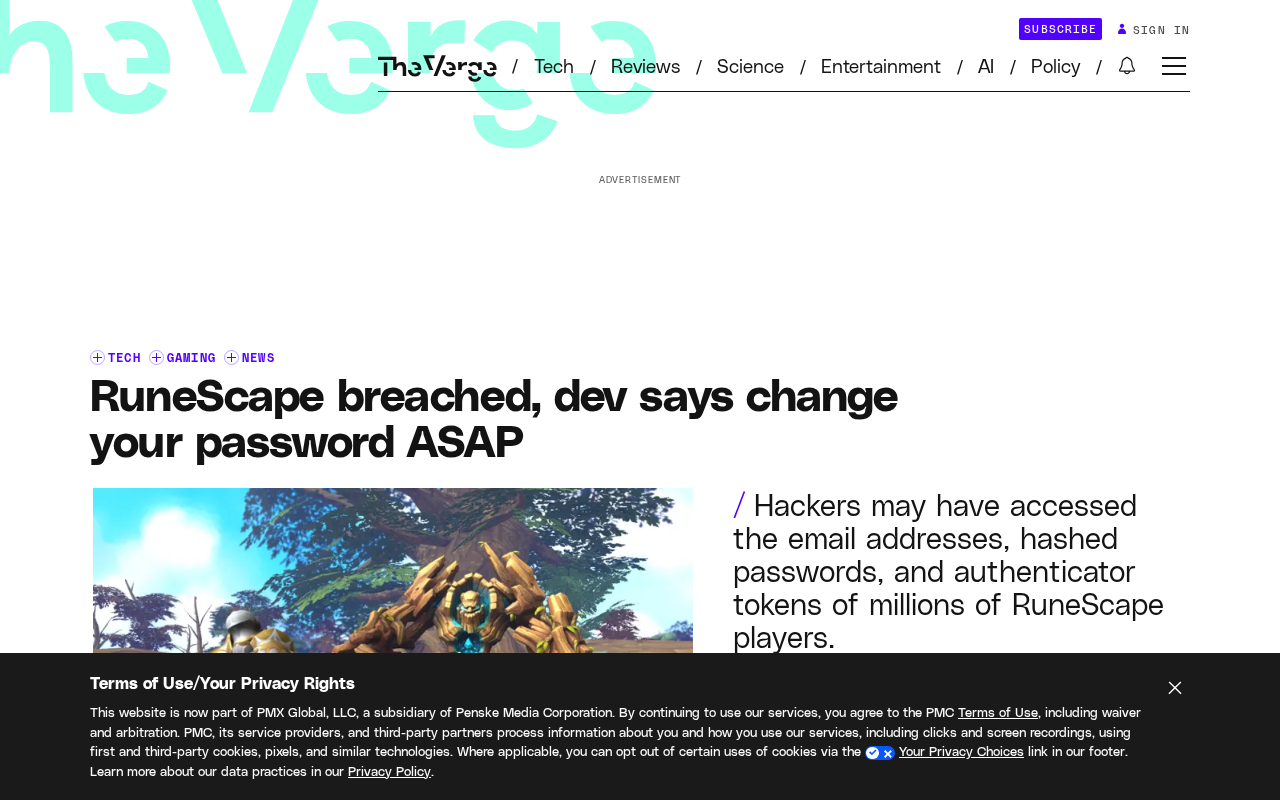
This incident once again thrusts data security in the gaming industry into the spotlight. For long-established MMORPGs with massive user bases, account security is not just about virtual property—it also involves player privacy and trust.
Scope of the Breach: Emails Hit Hardest, Passwords and Authenticator Info Potentially Affected
According to Jagex's preliminary investigation, the core data exposed in this breach is players' email addresses, numbering in the millions. Additionally, hashed passwords and authenticator-related information may also have been obtained by attackers.
Hashed passwords typically undergo one-way encryption, requiring attackers to invest significant computing power to crack them, making it relatively difficult to directly recover plaintext passwords. However, reports also note that attackers may still exploit this information through other means such as credential stuffing or phishing. The potential leak of authenticator information is even more concerning, as it is a critical component of two-factor authentication—once compromised, account security is significantly undermined.
Hashed passwords refer to the result of converting plaintext passwords into fixed-length strings through one-way hash functions (such as SHA-256, bcrypt) for storage. Ideally, hash functions are irreversible—servers only store hash values, and when users log in, the system performs the same operation on the entered password and compares the results. After obtaining hashes, attackers typically use brute-force enumeration, dictionary attacks, or rainbow tables to guess the original passwords; using salting and slow hash algorithms (such as bcrypt, Argon2) can significantly increase cracking costs. Therefore, "hashed password leakage" is not equivalent to plaintext leakage, but if the algorithm strength is insufficient or user passwords are simple, they may still be cracked.
Credential Stuffing refers to attackers using username/email and password combinations leaked from one platform to attempt batch logins on other platforms. Since many users reuse the same passwords across different websites, once data from one platform is exposed, attackers can use "one credential for multiple purposes" to conduct lateral intrusions. The main defenses against credential stuffing include: setting unique passwords for each website (password managers can help), enabling two-factor authentication, and platform-side detection of anomalous login behavior (such as IP changes, rate limiting). If the email addresses and hashed passwords from this RuneScape breach are cracked, they would be prime material for credential stuffing attacks.
Official Response: Services Restored, Changing Passwords Is the Priority
Jagex quickly took services offline after the incident to contain the impact, and game services have now returned to normal operation. The primary official recommendation is: all players should change their passwords immediately.
For players, simply changing the RuneScape account password may not be enough. If players have used the same or similar passwords on other platforms, it is recommended to change those as well to avoid chain reactions caused by credential stuffing attacks. Additionally, enabling two-factor authentication (2FA) and checking account login activity records are also necessary security hardening steps.
Two-Factor Authentication (2FA) is a security mechanism that adds a second verification factor beyond passwords, with common forms including time-based one-time passwords (TOTP, such as Google Authenticator), SMS verification codes, and hardware security keys. The "authenticator" used by RuneScape falls under the TOTP category. The core value of 2FA is that even if attackers have the password, they still need the second factor to log in. However, if the authenticator seed (secret key) itself is leaked, attackers can generate valid one-time passwords themselves, greatly reducing the protective effect of 2FA—which is why the authenticator information leak in this incident is particularly concerning.
Implications for Players and the Industry: Game Account Security Cannot Be Ignored
This is not the first large-scale data breach in the gaming industry. Gaming platforms with massive user bases have always been prime targets for hackers, as accounts are often linked to payment information, social connections, and virtual items with trading value.
The problems exposed by this incident are worth reflecting on for the entire industry: while game companies pursue gameplay innovation and commercialization, are they investing enough resources in security infrastructure? From detecting the intrusion to public disclosure, Jagex's response speed was reasonably timely, but the data breach itself indicates shortcomings in the defense system. For players, regularly changing passwords, avoiding password reuse, and enabling two-factor authentication are the fundamentals of protecting their account security.
Conclusion
The RuneScape data breach serves as a wake-up call for all users of online services. The exposure of millions of email addresses and potentially password hashes and authenticator information means attackers may already possess material to launch further attacks. Jagex advises players to change their passwords immediately, and broader security practices—including password uniqueness and two-factor authentication—should become daily habits for every player. Services have been restored, but rebuilding trust will take much longer.
Related articles
Don't Rush to Hire an AI Assistant: Try Your Own Agent First
Starting from a Hacker News discussion, this explores why developers have AI Agents but rarely use them, and how real usage, low-risk tasks, and failure logs can bring Agents into real workflows.

FP64, INT8, and FP4/6/8: The Battle Over AI Precision Formats
From FP64 and INT8 to FP4/FP6/FP8, an analysis of the AI numerical precision format debate: why FP64 has faded from training, how INT8 became the inference standard, and how low-precision training depends on hardware and engineering support.

Qobuz Streaming Limited-Time Deal: Up to 20% Rebate and 60% Off Albums
Qobuz Cyber Monday promotion: gift cards up to 20% off, selected album downloads up to 60% off, plus a 30-day free trial. Analysis of its Hi-Res positioning, target users, and buying advice.