FRCTL: A All-in-One Creative Visual Engine That Runs in Your Browser

FRCTL is a browser-based visual engine combining generative creation, live audio-visual performance, and creator monetization.
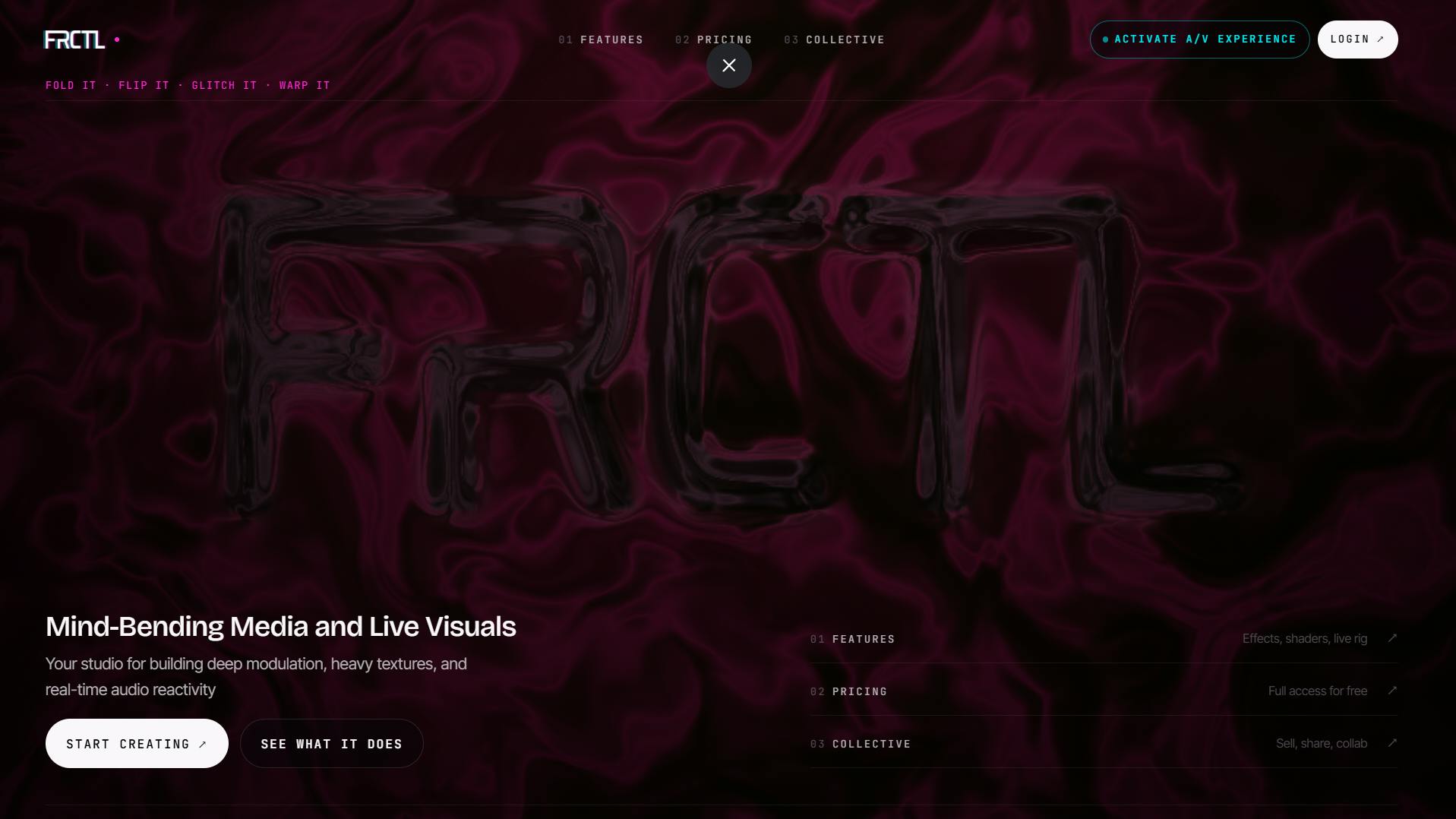
FRCTL is a browser-based visual creation platform for VJs, musicians, and visual artists that aims to cover the full workflow from asset generation to finished deliverable in a single tool. It features 190+ built-in effects, shader-generated scenes, and audio routing to any parameter for real-time audio-visual sync — capabilities that previously required desktop software like TouchDesigner or Resolume. It exports directly to cover art, Spotify Canvas, and social clips, and includes a community marketplace called Collective where creators can sell presets and loops, forming a closed-loop ecosystem of tools, community, and monetization.
One Engine for Your Entire Visual Workflow
For visual artists, VJs, and music creators, getting from raw assets to a finished deliverable often means juggling multiple applications. FRCTL aims to solve that pain point with a single browser-based engine — one that brings generative visual creation, live performance, and content monetization into a unified workflow.
As described on Product Hunt, FRCTL positions itself as "everything artists need to deliver and perform." You can import your own footage or build generative scenes from shaders. Once you've crafted a visual style, you can export cover art, Spotify Canvas clips, or social media shorts directly — no need to switch tools.
190+ Effects and Audio-Driven Real-Time Modulation
What makes FRCTL stand out is its real-time responsiveness and modulability. The platform claims over 190 built-in effects and supports "infinite modulation," meaning nearly every parameter can be controlled dynamically.
Even more significant is audio routing — users can feed audio signals into any parameter, letting visuals react to sound in real time. This is a core requirement for VJ performances and music visualization. Combined with full-screen output, camera and canvas capture, FRCTL puts live performance front and center as a primary use case.
In other words, this isn't just a post-render tool — it's a performance engine you can drive on the fly in Live mode. That kind of real-time audio-visual coupling has traditionally required desktop-class software like TouchDesigner or Resolume. FRCTL brings it to the browser, lowering the barrier to entry.
Shaders are small programs that run on the GPU and determine the color and lighting of every pixel on screen. In generative visuals, artists often use shader languages like GLSL or HLSL to "paint" images directly with mathematical formulas, rather than relying on traditional media assets. This means complex visuals — patterns, gradients, fluid simulations, noise — can be generated entirely through code and are naturally suited for real-time parametric control. FRCTL's combination of shader scenes and audio routing leverages exactly this: by feeding audio data like amplitude and frequency directly into shader parameters, it makes visuals "breathe" with the music.
Modulation, as used here, borrows from synthesizer terminology — using one signal to dynamically alter another parameter's value. For example, an LFO might control hue shift, or a drum transient might trigger a zoom. "Infinite modulation" means the platform imposes no limit on the number of modulatable parameters — in theory, every knob on every effect can become a target for audio or other signal modulation.
A Closed Loop from Creation to Monetization
FRCTL's other distinguishing feature is its attempt to build a complete ecosystem loop, not just a creative tool. The product summarizes its value proposition with four verbs: Create, Perform, Monetize, and Collab.
On the monetization side, users can sell their presets and loops in a community marketplace called Collective. The platform also provides a member feed with posts and comments, enabling interaction and collaboration between creators. This "tool + community + marketplace" model has become increasingly common in design and creative software — it drives user retention while giving creators a direct revenue stream.
Spotify Canvas is Spotify's vertical looping video feature for tracks, EPs, or albums (typically 3–8 seconds), displayed in place of album art during mobile playback to enhance the listening experience visually. For independent musicians, Canvas has become a standard part of releases — but producing assets that meet the specs (vertical, no audio track, seamless loop) often requires extra video editing steps. FRCTL's built-in export for this format means artists can generate a Spotify-ready file in one click after finishing their visual work, eliminating cross-application format conversion. This also explains why the platform targets both visual artists and musicians — these two audiences overlap heavily in the Canvas production workflow.
The Trade-Offs of Going Browser-Based
Building a complex real-time visual engine inside a browser is itself a noteworthy technical decision. The advantages are clear: cross-platform compatibility, no installation required, easy sharing. FRCTL's appearance in Product Hunt's Vercel Day category further suggests a deep reliance on modern web technology stacks.
That said, browser environments typically face performance ceiling challenges when handling intensive real-time shader rendering and low-latency audio — especially in live performance scenarios where stability is critical. How well FRCTL holds up in practice is something that will need real-world validation.
According to Product Hunt data, FRCTL was built by Aven Carter, earned 71 upvotes, and ranked 20th on its launch day, appearing in categories including Design Tools, Music, and Art. While comments are still sparse, its "all-in-one creative engine" approach makes it a new option worth watching for independent artists and musicians looking to streamline their workflow.
Vercel is a cloud platform focused on frontend and full-stack application hosting, well known for its deep support of the Next.js framework. "Vercel Day" is a themed Product Hunt collection centered on tools in the Vercel ecosystem — being featured there signals that FRCTL's architecture aligns closely with modern web development stacks (such as WebGL, Web Audio API, and WebAssembly). Real-time graphics rendering in the browser primarily relies on WebGL (or the next-generation WebGPU), which allows web pages to directly invoke the GPU to run shader programs. Audio processing depends on the Web Audio API's low-latency audio node graph. These two browser-native APIs are mature enough to support fairly sophisticated real-time applications — but compared to native desktop software, they still carry inherent limitations in multi-threading, memory management, and system-level audio priority. That's the technical root of the "performance ceiling challenges" mentioned above.
Summary
FRCTL packages generative visuals, live performance, and creator monetization into a single browser engine, pitching a smooth experience of "import, sync audio to visuals, export finished content." For VJs, musicians, and visual designers who need to rapidly produce multi-format assets, it aims to cover the full chain from creation to sales with a single tool. Whether it can deliver on its promises in terms of performance and ecosystem remains to be seen — but the direction it represents, creative tools going web-native and community-driven, is very much a real trend.
Related articles

How Big Can Stars Really Get? The Physical Limits of the Largest Stars
Red supergiants are the largest stars by volume, with radii up to 2,000 times the Sun, engulfing the inner solar system. But there is no precise upper limit on stellar size—models predict up to 15,000 solar radii. The most massive blue stars are far smaller than red supergiants—biggest and heaviest are two different things.

Apple HomeView Smart Display Full Feature Breakdown: Wall-Mount or Desktop, $299
Apple launches HomeView, a $299 smart display with wall-mount and desktop options, 12MP camera for facial recognition, smart home control, music playback, and recipe step-by-step cooking. Full breakdown of watch faces, apps, privacy, and cooking integration.

Where Did the Promised New Studio Go? Craft Computing Answers After Five Years
Craft Computing's host responds to viewer questions: the new studio promised five years ago was shelved as construction costs soared from $30,000 to $75,000, and was replaced by a 168-square-foot garage conversion.