free-claude-code Open Source Project Analysis: The Truth and Risks of Using Claude Code for Free

Analyzing free-claude-code: a viral open-source project promising free AI coding tools, with hidden risks.
The GitHub project free-claude-code has exploded to 43K+ stars by promising free access to Claude Code, Codex, and Pi across terminals, desktops, IDEs, and mobile. Built as an LLM gateway/proxy layer in Python, it addresses cost barriers, fragmented multi-device experiences, and lack of voice interaction. However, developers should be cautious about service stability, data privacy risks, compliance with vendor ToS, and long-term sustainability before adopting it for anything beyond experimental use.
Project Overview
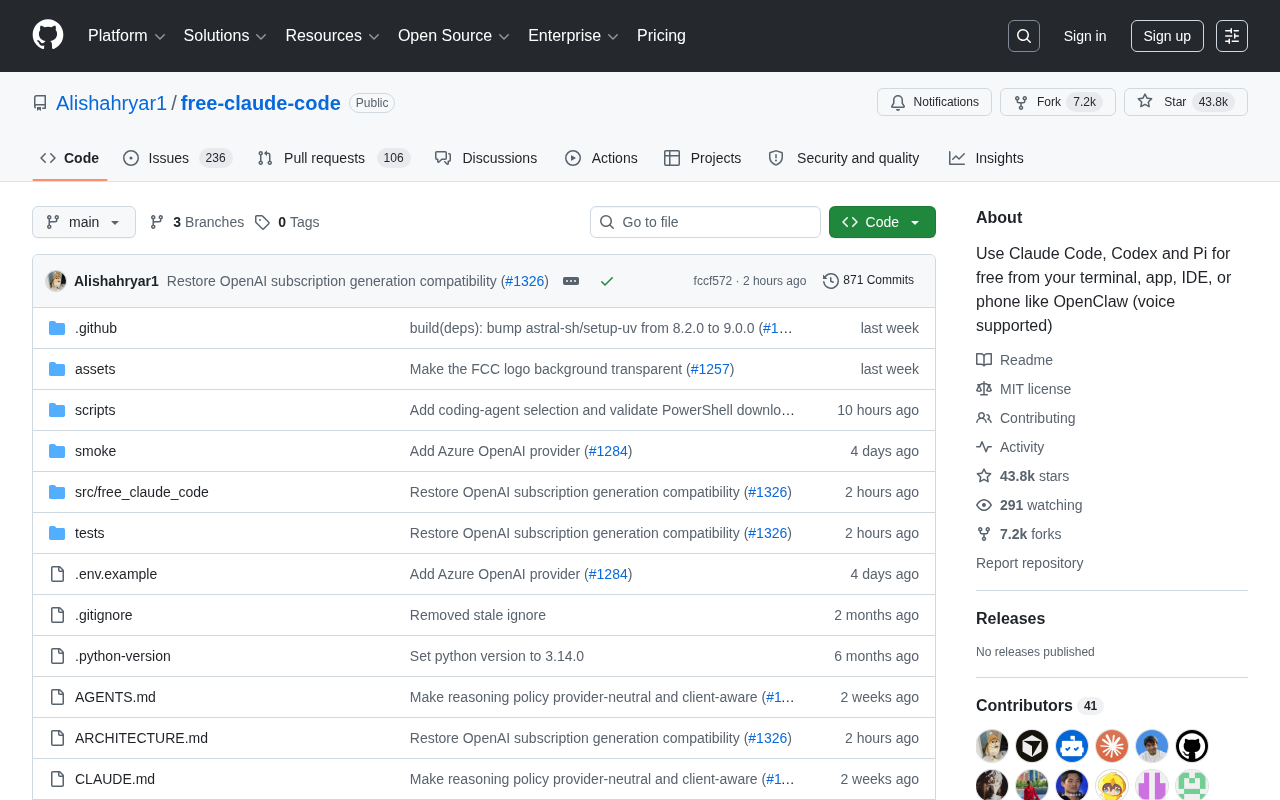
The recently viral open-source project free-claude-code (by Alishahryar1) on GitHub has garnered widespread attention from the developer community. The project has accumulated over 43,000 stars and 7,000+ forks in a short period, with nearly 300 new stars per day—a testament to its immense popularity.
The project's core selling point is straightforward: enabling developers to use Claude Code, Codex, and Pi and other AI programming tools for free across terminals, desktop apps, IDEs, and even mobile phones. Its user experience benchmarks against the recently popular OpenClaw and supports voice interaction. Written primarily in Python, the project positions itself as a cross-platform AI programming assistant access solution.
Technical Background: Claude Code, Codex, and Pi
Claude Code is an AI programming assistant launched by Anthropic, based on its Claude series of large language models, specifically optimized for code generation, debugging, and refactoring scenarios. It runs in a terminal-native manner, capable of directly reading project files, executing commands, and performing multi-step autonomous programming tasks. Codex originates from the OpenAI ecosystem—initially a version of GPT-3 fine-tuned for code tasks that later evolved into the underlying engine for products like GitHub Copilot. More recently, OpenAI has also launched a standalone Codex agent product. Pi is a conversational AI developed by Inflection AI, known for its natural, emotionally rich interaction style. While not specifically a programming tool, its conversational capabilities can assist developers with technical Q&A.
OpenClaw is a recently popular open-source AI programming tool in the developer community that attempts to provide an open, self-hostable alternative to Claude Code. The current AI programming assistant market is fiercely competitive: GitHub Copilot holds the first-mover advantage, Cursor excels in deep IDE integration, Windsurf (formerly Codeium) pursues a free-tier strategy, Augment Code targets the enterprise market, and Claude Code stands out with its powerful agentic coding capabilities.
For developers long constrained by paid subscriptions or API quotas, such an integrated solution claiming to be "free" is naturally highly attractive. But behind the hype, we should rationally examine its technical implementation and actual value.
What Developer Pain Points Does free-claude-code Address
Current mainstream AI programming tools—whether Anthropic's Claude Code, OpenAI's Codex, or other model services—commonly face several pain points:
Excessive Barriers to Entry and Costs
High-quality AI programming assistants mostly require paid subscriptions or per-token billing, representing an ongoing expense for individual developers, students, or budget-constrained teams. Current mainstream LLM APIs use a per-token billing model, where tokens are the basic units of text processing by the model (in English, approximately 1-1.5 tokens per word; in Chinese, approximately 1.5-2 tokens per character). Taking Claude 3.5 Sonnet as an example, input pricing is $3 per million tokens and output is $15; GPT-4o has similar pricing. In an active AI-assisted programming scenario, developers might consume hundreds of thousands of tokens per day, with monthly costs easily reaching tens to hundreds of dollars. Claude Code's Max subscription plan is priced at $100-200 per month with certain usage limits. It is precisely this sustained high cost that drives the developer community's strong demand for free alternatives.
free-claude-code attempts to lower this barrier through a unified access layer, giving more people the opportunity to experience top-tier AI programming capabilities.
Fragmented Multi-Device Experience
Developers work across dispersed scenarios: sometimes typing commands in a terminal, sometimes writing code in an IDE, occasionally wanting to quickly query something on a phone. This project emphasizes a consistent experience across terminal, desktop, IDE, and mobile, allowing AI assistants to follow developers' workflow transitions rather than being locked to a single platform.
Lack of Voice Interaction Capabilities
The project specifically emphasizes "voice supported"—supporting voice input for interacting with AI programming assistants. This has practical value in mobile scenarios or situations requiring hands-free operation, and represents the trend of AI programming tools evolving from pure text toward multimodal interaction.
Voice interaction in programming scenarios represents an important evolution in human-computer interaction. Its technical pipeline typically includes: Automatic Speech Recognition (ASR, such as OpenAI Whisper) converting speech to text, large language models understanding intent and generating code, and optional Text-to-Speech (TTS) feedback. The challenge lies in the fact that programming languages are filled with symbols, indentation, and precise syntactic structures—the efficiency of describing code purely through voice is far lower than keyboard input. Therefore, the best use cases for voice in programming tend to be high-level intent description, code review discussions, and quick Q&A on mobile, rather than line-by-line code dictation.
Technical Implementation: Aggregation Proxy Architecture Analysis
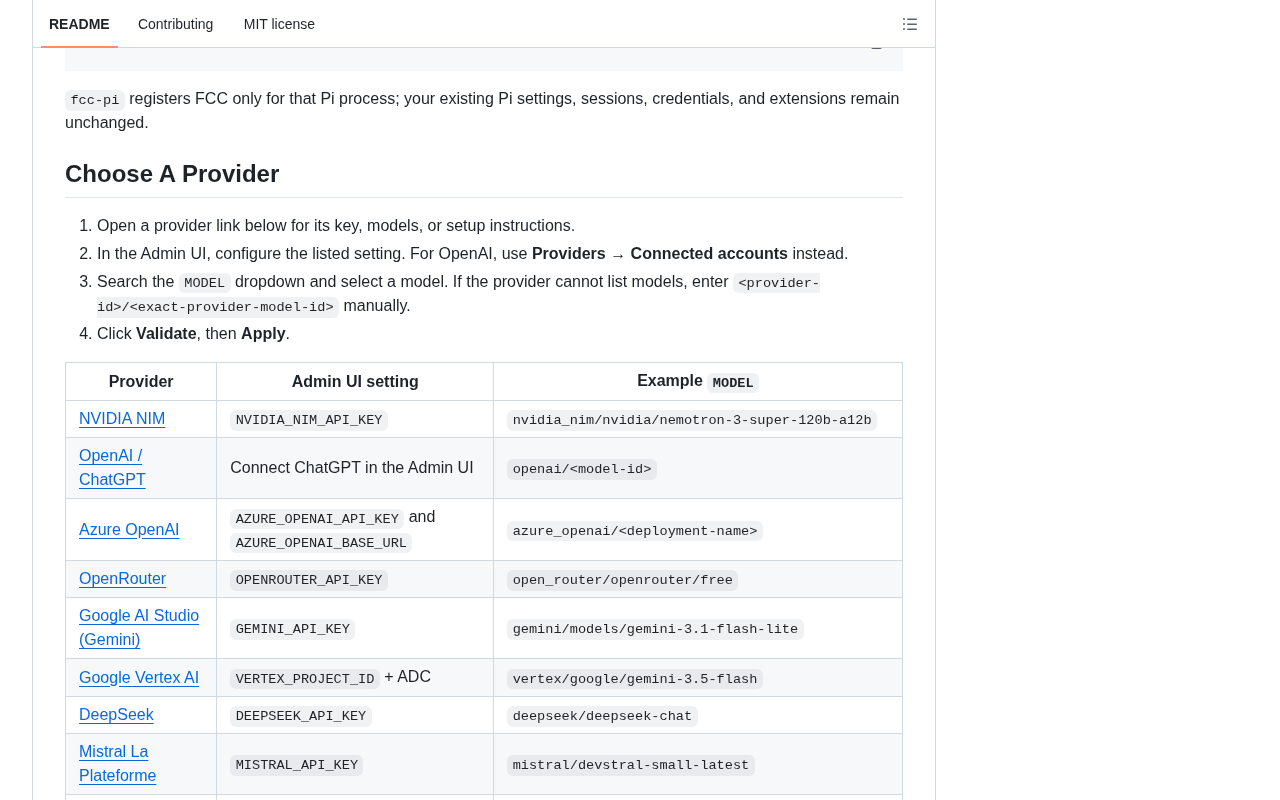
From the project description, free-claude-code is essentially an aggregation and proxy layer that integrates multiple AI model services (Claude, Codex, Pi) under a unified entry point while providing multi-platform client support. This "one entry point, multiple backends" architectural approach is consistent with the numerous LLM gateway and proxy projects that have emerged in recent years.
Technical Details of LLM Gateway Architecture
An LLM Gateway or Proxy layer is a middleware architectural pattern that inserts a unified routing and management layer between user applications and underlying large language model APIs. Typical open-source implementations include projects like LiteLLM, OneAPI, and LobeChat. Core functionalities of such architectures typically include: unified multi-model interface adaptation (standardizing different vendors' API formats to OpenAI-compatible format), request routing and load balancing, token usage tracking and rate limiting, API key pool management, and caching and retry mechanisms. The advantage of this pattern is that it decouples upper-layer applications from underlying model providers, making switching or aggregating multiple model services transparent. However, it also introduces additional latency, single-point-of-failure risks, and potential security concerns.
What you might not have noticed is that the word "free" often implies some underlying resource acquisition mechanism—possibly through shared quotas, free-tier APIs, community resource pools, or other means. When using such tools, developers should pay attention to the following:
- Service stability: Solutions relying on third-party free resources typically cannot guarantee long-term availability;
- Data privacy: Code and conversation content pass through the proxy layer, requiring assessment of sensitive information leakage risks;
- Compliance: Confirm whether the access method complies with the original service's terms of service to avoid account or legal risks.
Critical Thinking Behind the Community Hype
The project's ability to surge to high star counts in a short period reflects the developer community's strong demand for low-cost, highly available AI programming tools. As AI-assisted programming gradually becomes a standard part of daily workflows, open-source explorations around "how to use these capabilities more conveniently and economically" are emerging intensively.
Rational Interpretation of Star Growth
GitHub star count is an important indicator of an open-source project's attention level, but it needs to be interpreted cautiously. Explosive short-term star growth can stem from multiple factors: social media amplification effects, clickbait-style project naming, meeting specific trending demands, or even star manipulation. Healthy open-source projects typically need to be evaluated on other dimensions: actual code contributor count, issue response speed, documentation completeness, test coverage, and long-term commit activity. For projects like free-claude-code, 43,000 stars are certainly impressive, but developers should pay more attention to its code quality, maintainers' sustained commitment, and whether there is a clear technical roadmap.
Sustainability Issues of Free Open-Source Tools
On one hand, such projects lower the barrier to technology exploration and promote AI tool adoption; on the other hand, the sustainability of "free" remains an unresolved question. Historically, many similar projects quickly became ineffective after gaining attention due to original vendor policy adjustments or resource depletion. For example, numerous early free proxy projects based on ChatGPT reverse engineering became defunct after OpenAI strengthened anti-abuse mechanisms; similarly, solutions relying on free trial quota pools often face collapse when vendors adjust their policies.
Practical Advice for Using free-claude-code
For developers who wish to try it, a cautious approach is recommended:
- Do not use it for production environments or sensitive projects—prioritize experimental, non-core scenarios for testing;
- Thoroughly understand how it works rather than blindly chasing the "free" label;
- Follow official channels—legitimate subscriptions for tools like Claude Code remain the reliable choice for long-term stable use;
- Audit code security—before running any proxy-type tool, check whether it exhibits potential risk behaviors such as data exfiltration or credential harvesting.
Conclusion
The explosive popularity of free-claude-code is a microcosm of the surging demand for AI programming tools. It responds to developers' pursuit of convenience through features like a unified entry point, multi-platform support, and voice interaction. However, beneath the halo of "free," risks related to stability, privacy, and compliance should not be overlooked.
For the community, the value of such projects may lie not only in "saving money" but also in the product form innovation they demonstrate—how to truly and seamlessly integrate AI assistants into developers' multi-scenario workflows. This direction is worth continuous exploration by both the open-source community and commercial vendors. In the current era of rapidly evolving AI programming tools, maintaining curiosity about new tools while staying vigilant about risks—both are indispensable.
Related articles

persistent-inference: Solving TF/Keras Cold Start Problems with Just Two Files
Deep dive into the persistent-inference open-source project: solve TF/Keras cold start problems with just two files by keeping models resident in memory, eliminating reload overhead.

Do AI Certifications Actually Impress Recruiters? A Practical Guide for Career Switchers
A blockchain developer switching to AI—which certifications are worth it? This guide analyzes the real value of AI certs, compares Hugging Face vs AWS options, and offers project-based alternatives.

Laguna S 2.1 Performance Upgrade: 10x Rate Limit Increase, 250B Tokens Processed Daily
Poolside announces major Laguna S 2.1 upgrade with 10x rate limits, 250B daily tokens on OpenRouter, 1M context dedicated deployment, and integration with cline, opencode, and other AI coding agents.