Free Data Science Learning Resources Guide: An Efficient Path to Getting Started on Zero Budget
A comprehensive guide to learning data science for free using Kaggle Learn, freeCodeCamp, Fast.ai, and more.
This article addresses the common challenge of learning data science on a limited budget. Instead of seeking pirated courses, it recommends high-quality free resources including Kaggle Learn, freeCodeCamp, Fast.ai, and Coursera's audit mode. It provides a practical zero-to-hero learning roadmap covering Python basics, data processing with NumPy/Pandas/Matplotlib, statistics, and machine learning, emphasizing project-based learning over course hoarding.
A Common Yet Thought-Provoking Plea for Help
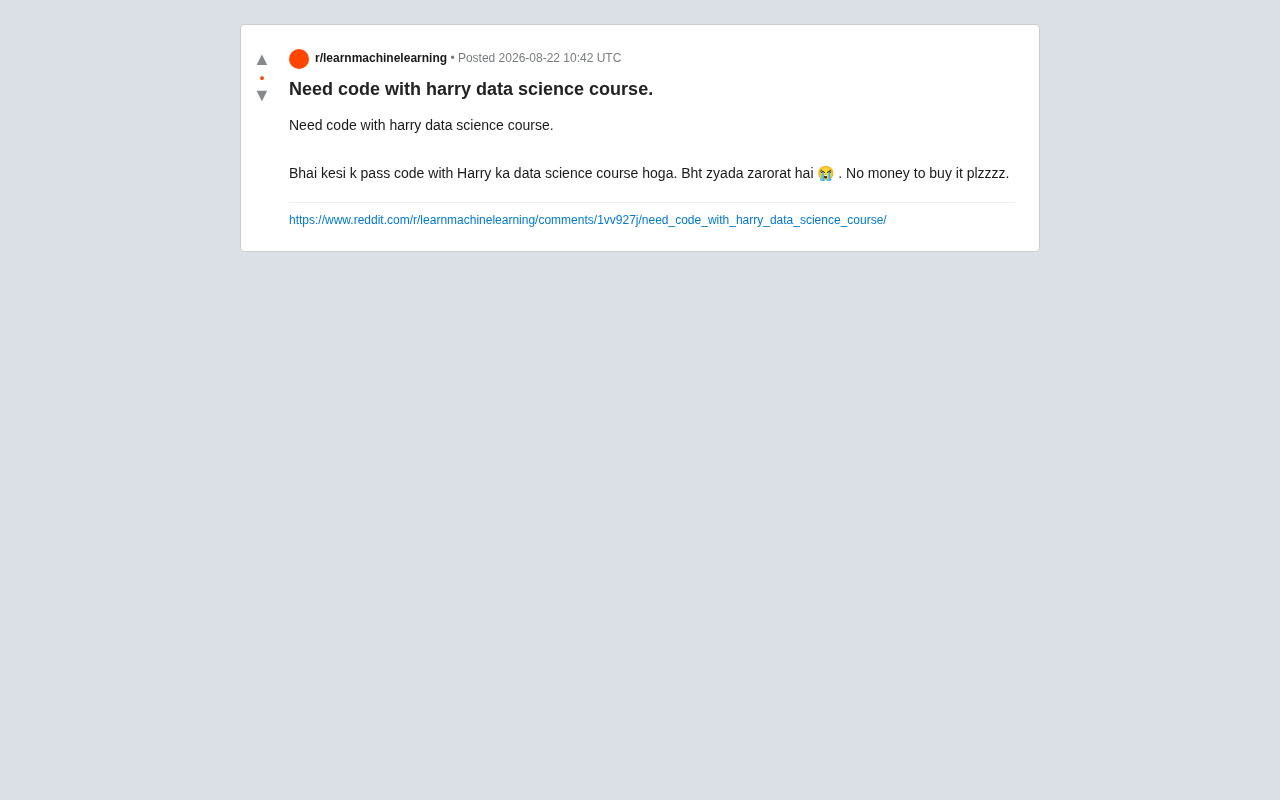
I recently came across a help request on Reddit — simple in content, yet deeply touching. A learner wrote: "Does anyone have CodeWithHarry's data science course? I desperately need it but can't afford it, please."
Behind this post lies a widespread dilemma in today's tech learning landscape: the gap between quality educational resources and learners' financial capacity. CodeWithHarry is a well-known programming education brand founded by Indian educator Haris Ali Khan, widely popular for teaching programming and data science in Hindi. Its core competitive advantage lies in explaining programming concepts in Hindi, filling the technical education gap for India's massive non-English-speaking population. India has over 1.5 billion people, but fewer than 10% are fluent in English. Students from tier-2 and tier-3 cities face significant language barriers when confronting all-English platforms like Coursera and Udemy. CodeWithHarry's channel currently has over 18 million subscribers, making it one of the largest programming education channels in South Asia. Its business model follows the classic "free funnel + paid deep-dive" approach — offering free basic tutorials on YouTube to attract traffic, then selling structured paid courses on its own platform for revenue. This model is widely adopted in India's EdTech sector, with platforms like Unacademy and Physics Wallah following similar logic. However, paid courses remain a significant financial burden for many cash-strapped students.
Rather than discussing how to obtain pirated resources, this article aims to explore a deeper question: How can you learn data science legally and efficiently on a limited budget?
Why Seeking Pirated Courses Is Not Recommended
Legal and Ethical Risks
Sharing or downloading copyrighted paid courses constitutes infringement. For independent educators like CodeWithHarry, course revenue is a crucial pillar supporting the continued creation of free content. CodeWithHarry already provides a massive amount of high-quality free programming tutorials on YouTube — pirating paid courses could actually undermine the sustainability of this free ecosystem.
The economic model for independent educational creators differs fundamentally from large platforms. Coursera or Udemy are backed by venture capital and corporate partnerships, but individual creators like CodeWithHarry are highly dependent on paid course revenue to cover team salaries, video production costs, and platform maintenance expenses. According to YouTube creator economy reports, ad revenue typically covers only 30%-50% of content production costs, with paid courses and brand partnerships being the core profit sources. Once piracy spreads at scale, creators' paid conversion rates drop sharply, directly resulting in reduced frequency of free content output or lower production quality — and the ultimate losers are precisely the learners who can't afford to pay. This creates a paradox: piracy helps individual learners in the short term but destroys the production foundation of free educational content in the long run.
Significantly Diminished Learning Outcomes
Pirated courses often lack accompanying Q&A support, community engagement, and ongoing updates. Data science is a rapidly evolving field where tools and best practices constantly change. An outdated course being circulated privately may no longer reflect the latest tech stack and industry demands.
Data science especially requires up-to-date learning materials because its tech stack iterates far faster than traditional software development. Take the Python ecosystem as an example: Pandas 1.0, released in 2020, introduced nullable integer types and string type refactoring; the 2.0 version in 2023 defaulted to the Apache Arrow backend, dramatically improving memory efficiency and computation speed while deprecating many old APIs. Similarly, scikit-learn continuously introduces new model selection strategies and Pipeline features, and TensorFlow's architecture was almost completely rewritten from 1.x to 2.x. At the tooling level, Jupyter Notebook is gradually being replaced by JupyterLab and VS Code's Notebook extensions; data orchestration tools have expanded from Airflow to include Dagster and Prefect. Learners using pirated courses from 2-3 years ago may spend significant time mastering outdated APIs and workflows, only to need relearning when entering the job market.
Recommended Free and High-Quality Data Science Learning Resources
The good news is that data science happens to be one of the richest fields for free learning resources. Here are completely free options whose quality rivals paid courses.
Systematic Free Courses on YouTube
- CodeWithHarry Official Channel: Much of the foundational knowledge the help-seeker wanted can actually be found on the free channel, including Python basics, Pandas, NumPy, and other core library tutorials.
- freeCodeCamp: Offers complete data science and machine learning hands-on courses running several hours long, all free and continuously updated. freeCodeCamp is a nonprofit organization founded in 2014 whose YouTube channel has over 9 million subscribers. Its long-form video courses, produced in collaboration with university professors and industry experts, cover the full spectrum from Python basics to advanced machine learning.
- Krish Naik: An Indian educator focused on data science and machine learning, with in-depth and well-structured content.
Free Data Science Courses from Authoritative Platforms
-
Kaggle Learn: Offers micro-courses in Python, machine learning, data visualization, and more, complete with real datasets and an online coding environment. After completing courses, you can jump straight into competition practice. Kaggle Learn is a micro-course series launched in 2018 by Google's Kaggle platform, designed with a philosophy fundamentally different from traditional MOOCs. Each course takes only 4-8 hours to complete, using an interactive "concept explanation + immediate coding practice" format — learners don't need to configure a local environment and can write and run code directly in browser-based Kaggle Notebooks. It currently covers over a dozen courses including Python, Pandas, data visualization, intro to machine learning, feature engineering, SQL, and deep learning — all free with completion certificates. More importantly, Kaggle simultaneously hosts the world's largest data science competition platform and dataset repository (over 300,000 public datasets), allowing learners to seamlessly transition from micro-courses to real competitions to test their skills. Kaggle competition rankings and Notebook showcases have become widely recognized proof of competence in the data science field, with many employers referencing candidates' Kaggle Profiles during hiring.
-
Free Introductory Courses from Google and IBM: These tech giants offer free audit options on platforms like Coursera, covering data analytics and machine learning fundamentals. Notably, Coursera's "audit" mode is an important free entry point that many learners are unaware of. When a user selects a course, there's usually an inconspicuous "Audit this course" link next to the paid enrollment button (for specializations, you need to select audit for each course individually). Audit mode allows learners to access all video lectures, reading materials, and some coding exercises for free, but without the ability to submit graded assignments or earn certificates. For popular programs like the Google Data Analytics Professional Certificate and IBM Data Science Professional Certificate, audit mode is sufficient to acquire the core knowledge. Additionally, Coursera offers a Financial Aid program — qualifying learners can submit an application and receive full course access (including certificates) for free after a 15-day review period, with a fairly high approval rate. This means even learners who need certificates have a legitimate free pathway.
-
Fast.ai: A completely free, hands-on deep learning course with an excellent industry reputation, ideal for advancing after building a foundation. Fast.ai was co-founded in 2016 by former Kaggle Chief Scientist Jeremy Howard and University of San Francisco professor Rachel Thomas. Its core teaching philosophy is the "top-down approach" — letting learners quickly build working deep learning models using high-level APIs first, then gradually deconstructing the underlying principles. This stands in stark contrast to the traditional academic "bottom-up" path that starts with linear algebra and calculus. Fast.ai also maintains an open-source deep learning library of the same name, built on PyTorch, that greatly simplifies the model training workflow. The course's alumni community is extremely active, with over 100,000 technical discussion posts accumulated on its forums. Notably, Fast.ai's commitment to being completely free is written into its organizational charter, and Jeremy Howard has publicly stated that "democratizing deep learning" was his founding motivation. The many success stories of people transitioning from zero background to working data scientists through Fast.ai courses have made it one of the most highly regarded courses among self-taught career changers.
Replace "Course Anxiety" with Practice
Many beginners fall into a common trap: believing they must find the "best course" before they can start learning. In reality, the core competitive advantage in data science comes from hands-on practice, not how many courses you've bookmarked.
Project-Based Learning is particularly effective in data science, closely tied to "situated learning theory" and "constructivist learning theory" in cognitive science. Cognitive psychology research shows that knowledge detached from application contexts easily becomes "inert knowledge" — learners can recall concepts during exams but fail to apply them to real problems. A project-driven approach embeds learning within authentic problem-solving processes, forcing learners to actively construct connections between knowledge points. Specifically in data science, a complete Kaggle project typically involves data acquisition, cleaning, exploratory analysis, feature engineering, model training, tuning, and result presentation — this pipeline covers virtually all the knowledge points of a paid course, but learners naturally acquire these skills while driven by solving specific problems. Furthermore, GitHub project portfolios have become more persuasive proof of capability than academic credentials in data science hiring, especially for career changers without a formal CS background.
Start Learning Through Projects
Rather than endlessly searching for the perfect tutorial, pick an interesting dataset and start analyzing it right away. Kaggle has a massive collection of public datasets — from Titanic survival prediction to house price analysis — all excellent practice projects.
The Titanic survival prediction dataset (Titanic: Machine Learning from Disaster) on Kaggle is essentially the "Hello World" of data science. The dataset contains information on 891 passengers — age, sex, fare, cabin class, port of embarkation, and other features — along with labels indicating whether they survived. It became the go-to starter project because of its moderate scale (not overwhelming for beginners), rich feature types (including numerical, categorical, and missing values, naturally suited for practicing data cleaning), and the problem itself being intuitive (prior knowledge like "women and children first" can serve as a starting point for feature engineering). As of 2024, over 15,000 teams have submitted solutions to this competition, with tens of thousands of related tutorials and Notebooks forming an incredibly rich learning ecosystem. From simple logistic regression to complex ensemble learning, learners can iteratively improve model performance on the same dataset, gaining intuitive experience with the complete machine learning workflow.
A Zero-to-Hero Data Science Learning Roadmap
Here's a pragmatic free learning roadmap:
- Python Basics (~2 weeks): Master syntax, data structures, functions, and other core concepts
- The Data Processing Trio: NumPy, Pandas, and Matplotlib — master data cleaning and visualization. NumPy provides high-performance multidimensional array operations (implemented in C and Fortran under the hood, running tens to hundreds of times faster than pure Python loops); Pandas builds on NumPy, offering the DataFrame — a spreadsheet-like data structure that serves as the core tool for data cleaning and transformation; Matplotlib is Python's most classic plotting library, upon which nearly all other visualization libraries (Seaborn, Plotly, etc.) are built. Mastering these three gives you the fundamental capability to handle the vast majority of structured data analysis tasks.
- Statistics and Math Foundations: Khan Academy offers free systematic courses covering probability theory and linear algebra. These mathematical foundations are not decorative requirements — understanding probability distributions is a prerequisite for hypothesis testing and Bayesian inference, while linear algebra is the mathematical language for understanding regression analysis, Principal Component Analysis (PCA), and neural network forward propagation.
- Introduction to Machine Learning: scikit-learn official documentation + Kaggle competition practice. scikit-learn is the most mature traditional machine learning library in the Python ecosystem, providing a complete toolchain from data preprocessing and feature selection to model training and evaluation. Its API design follows a unified fit-predict paradigm with a relatively gentle learning curve.
- Build Your Portfolio: Create a personal portfolio on GitHub to showcase your practical analysis capabilities
Conclusion: Courses Were Never the Scarce Resource
The Reddit poster's situation deserves sympathy, but the answer doesn't lie in finding that specific paid course. In the field of data science, what's truly scarce has never been learning materials — it's the patience to keep practicing and the ability to solve problems.
Free resources are already sufficient to transform a complete beginner into a job-ready data science practitioner. Instead of spending time hunting for pirated materials, open Kaggle Learn and write your first line of code — that's the real shortcut to data science.
Related articles

Chain of Thought Isn't Just for AI: How Humans Can Use CoT to Improve Thinking Quality
Chain of Thought isn't just a prompt trick for large models. Starting from a Hacker News discussion, this article analyzes why CoT works for human thinking too, breaks down actionable ways to transfer it, and highlights the key differences between human CoT and machine CoT.
Cloudflare Teams Up with OpenAI: Closi…
Cloudflare Teams Up with OpenAI: Closing the Loop from Vulnerability Discovery to Defense with AI
Cloudflare uses OpenAI Daybreak to investigate security vulnerabilities and generate reviewable remediation plans, while developers use Codex to boost coding efficiency and quality.

Orca Multi-Agent Orchestration in Practice: A Guide to Parallel Collaboration with Claude and Codex
Orca is Stable AI's free open-source agent workbench supporting 34 agents like Claude Code and Codex in parallel. Learn its Git worktree isolation, multi-model orchestration, and mobile management.