Free Full-Power GPT and Gemini? In-Depth Review and Risk Analysis of an AI Aggregation Platform

Analyzing the features and security risks of an AI aggregation proxy platform
This article analyzes an AI aggregation platform that claims to offer free, VPN-free access to mainstream LLMs like GPT, Gemini, and Claude. The platform achieves unlimited usage through an account pool mechanism and supports cross-model conversational collaboration. However, the article warns of significant risks including privacy leaks, potential service interruptions at any time, violations of platform terms of service, and clearly inflated model version numbers in the platform's marketing.
Disclaimer & Background
Recently, top-tier AI large language models like GPT, Gemini, Claude, and Grok have continued to iterate, constantly pushing the boundaries of their capabilities. However, for users in mainland China, directly accessing these models' official websites often means facing the dual barriers of network restrictions and paid subscriptions.
Technical Background: These access barriers stem from multiple overlapping factors — geographic IP blocking, payment method restrictions (requiring foreign credit cards), and each platform's KYC (Know Your Customer) compliance requirements. OpenAI explicitly lists mainland China as an unsupported region, and Anthropic's Claude follows suit. It's precisely this real-world demand that has spawned a thriving gray-market proxy service industry and an endless stream of "access AI without a VPN" solutions.
A video on Bilibili introduced an AI aggregation site that claims to offer free, VPN-free direct access to the official interfaces of multiple mainstream AI large language models. This article provides an objective analysis of this solution, helping readers understand its features and potential risks.
Important Notice: This article is purely a technical analysis and does not constitute a usage recommendation. Using third-party proxy sites to access AI services may involve risks related to account security, privacy leaks, and terms of service violations. Readers should exercise their own judgment.
What Can This AI Aggregation Platform Actually Do?
Multi-Model Aggregation: One Entry Point for All Major LLMs
The site's core selling point is consolidating access to the world's major AI large language models into a single platform. According to the video demo, users can jump directly to the official chat pages of GPT, Gemini, Grok, Claude, and more — without changing their network environment.
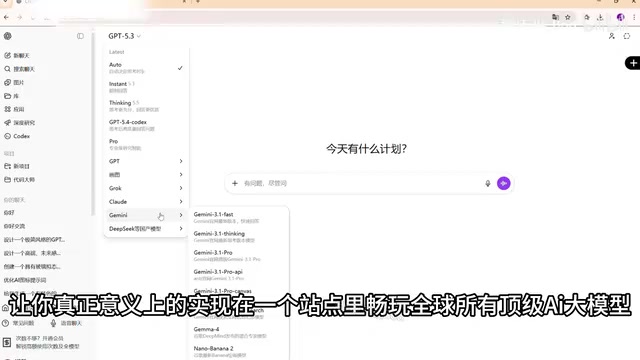
From the demo, the platform offers two usage modes:
- All-Model Arena: Switch between different models within a single chat window, with context memory preserved across switches
- Individual Official Site Access: Provides a dedicated direct channel to each model's official website
This design genuinely addresses the pain point of constantly switching between multiple AI platforms. The cross-model context memory feature, in particular, theoretically allows users to compare response quality from different models within the same conversation.
Which AI Models Are Supported? A Coverage Overview
According to the video, the platform claims to support the following models:
- OpenAI Series: GPT-5.5 (the latest version mentioned in the video), GPT image generation models
- Google Series: Gemini 3.1 Pro (with Ultra account privileges)
- Anthropic Series: Claude Opus latest version
- xAI Series: Full Grok model lineup
- Domestic Models: DeepSeekAd V4 and others

The video specifically demonstrated GPT's code generation and instant preview functionality, having the model generate an interactive mini-game and play it directly in a side panel. This corresponds to OpenAI's Canvas feature and Anthropic's Artifacts feature — Canvas launched in October 2024, allowing users to collaboratively write and edit code or documents with GPT in a dedicated editing panel; Claude's Artifacts supports rendering interactive content such as HTML, SVG, and React components directly in the conversation sidebar. These two features represent an important trend in AI's evolution from pure text conversations to "actionable workspaces," and they are indeed core experiences unique to the official platforms.
The Account Pool Mechanism: The Truth Behind Unlimited Free Usage
The most noteworthy technical implementation of this platform is its "account pool" mechanism. According to the introduction, the platform has hundreds of built-in official accounts. When a user hits the usage limit on one account, they can switch to another account with a single click to continue the conversation.
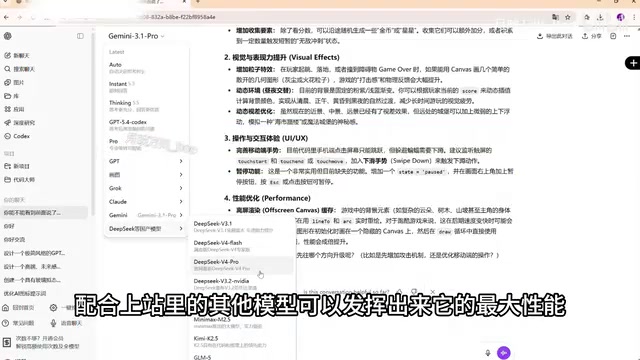
The technical principle behind an Account Pool is this: the platform maintains a large number of paid accounts on its backend and distributes user requests across different accounts via load-balancing algorithms, automatically switching when an account hits its API call limit or gets flagged by risk controls. This is essentially a systematic circumvention of the platform's Rate Limit mechanism — the platform acts as an account-scheduling middleware layer, with users actually consuming someone else's account quota. This architecture violates the ToS (Terms of Service) of virtually every major AI platform and is the fundamental reason why such services face the constant risk of being shut down.
Hands-On Experience: What Actually Works Well
The Practical Value of Cross-Model Conversational Collaboration
The video demonstrated a particularly practical scenario: first using GPT to generate content, then switching to Gemini to have it review and refine the previous conversation. This kind of cross-model collaborative workflow genuinely has value in real-world applications, such as:
- Using one model to generate a first draft and another to proofread and polish it
- Comparing how different AI models understand the same question
- Leveraging each model's strengths for complementary results
The Integrated DeepSeek V4 Experience
The platform also integrates China's latest DeepSeek V4 model, supporting web search and deep thinking features. For users who need to use both domestic and international AI models simultaneously, this kind of all-in-one integration genuinely saves the hassle of switching back and forth.
Risk Warning: The Hidden Cost of "Free"
Although the platform appears quite attractive on a feature level, the following risks cannot be ignored from technical and security perspectives.
Privacy Leaks and Account Security Concerns
Using shared accounts means your conversation content could potentially be seen by other users, and may also be logged and analyzed by the platform operator. Conversations involving personal privacy, trade secrets, or sensitive information should absolutely never be conducted through such platforms.
Service Could Be Interrupted at Any Time
The shared account pool model is highly dependent on account survival rates. Once OpenAI, Google, or other providers detect abnormal login behavior and ban accounts in bulk, the entire service could shut down without warning — with zero guarantees.
Compliance and Legal Risks
Bypassing paid restrictions through shared accounts almost certainly violates the terms of service of each AI platform. Users may also face associated legal risks during use.
Version Numbers Are Clearly Exaggerated
The version numbers mentioned in the video — "GPT 5.5," "Claude 4.7 Opus," "Gemini 3.5" — are clearly inconsistent with the actual versions officially released by each company.
Inflated version numbers are a widespread phenomenon in the AI proxy service market, rooted in users' strong psychological demand for the "latest and most powerful" models. In reality, as of mid-2025, OpenAI's latest officially released series is GPT-4o and the o-series reasoning models — GPT-5 has been officially previewed but is not yet broadly available; Anthropic's latest Claude version is Claude 3.7 Sonnet; Google's latest stable Gemini version is Gemini 2.5 Pro. Fabricated labels like "GPT-5.5" and "Claude 4.7" are marketing tactics designed to attract users and do not reflect actual model capabilities.
Related articles
 Product Reviews
The Programmer's Desk Setup Guide: Building a Workspace That Feels Like Home
Discover how programmers build productive, comfortable workspaces. From multi-monitor setups to ergonomic design, explore the desk philosophy that drives focus and flow.
 Product Reviews
Qoder vs Cursor Real-World Comparison: Which $20/Month AI IDE Is Better?
Hands-on comparison of Qoder vs Cursor AI IDEs: Agent autonomy, human interaction count, and architecture decisions. Qoder needed only 2 interactions vs Cursor's 8.
 Product Reviews
Cursor Cloud Agent Demo: Eliminating Bottlenecks Across the Entire Software Development Lifecycle
Deep analysis of Cursor's Cloud Agent demo showing how cloud VMs, automated test artifacts, and a full-chain control plane systematically eliminate human bottlenecks across the software development lifecycle.