Free Interactive Resource: 3D Teardowns of 40+ Humanoid Robots and a Full Supply Chain Overview
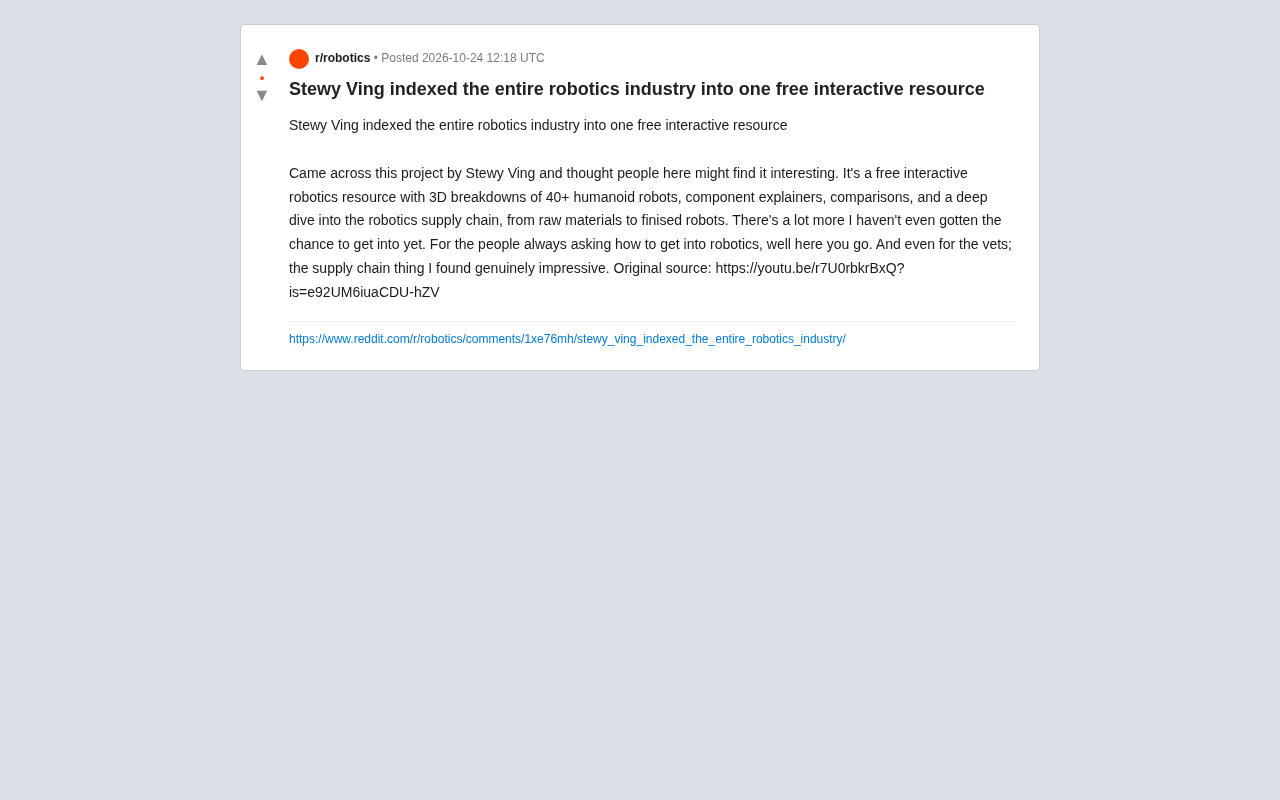
A free interactive resource lowers the barrier to understanding the humanoid robotics industry through 3D teardowns and supply chain mapping.
The free interactive robotics resource shared on Reddit, created by Stewy Ving, includes 3D teardowns of over 40 humanoid robots with rotating and zooming to view joints, sensors, and actuators, plus component explanations and comparison tools. It also maps the robotics supply chain from raw materials to finished products. Beginners gain intuitive understanding; practitioners get supply chain insights and new perspectives. Note: data sources and update frequency are unspecified, so treat it as a starting point rather than an authoritative reference.
A free resource that "tears down" the robotics industry for you
Recently, a post on Reddit caught my attention: someone shared a free interactive robotics resource created by Stewy Ving. It uses 3D teardown diagrams to showcase more than 40 humanoid robots, and offers component explanations, comparison tools, and an in-depth breakdown of the robotics supply chain from raw materials to finished products. For anyone looking to understand the robotics industry, this is undoubtedly an entry point with extremely high information density.
More than just "spectating": 3D teardowns and detailed component breakdowns
The most intuitive part of this resource is the 3D teardowns of over 40 humanoid robots. Users can rotate and zoom within the interactive interface to inspect key components such as joints, sensors, and actuators on each robot. For beginners, this is more intuitive than looking at flat diagrams or videos; for practitioners, it also allows quick comparison of the similarities and differences between different designs.
The post mentions that the resource also includes "component explanations" and "comparison" features. This means you can not only look at a single robot, but also compare different models side by side in terms of their choices for a given component. This design approach is essentially building a structured knowledge base rather than a simple showcase page.
Core components of humanoid robots typically include actuators, sensors, reducers, and controllers. Actuators are responsible for converting electrical energy into mechanical motion, with common types including motor-driven, hydraulic-driven, and pneumatic-driven; sensors include vision cameras, force/torque sensors, IMUs (inertial measurement units), etc., used to perceive the environment and the robot's own state. Reducers (such as harmonic reducers and RV reducers) are used to improve torque precision and are key components of joint modules. Controllers are responsible for motion planning and real-time control. Understanding the functions and selection differences of these components is the foundation for making sense of the 3D teardown diagrams.
Supply chain overview: from raw materials to finished products
What really struck me as in-depth was the supply chain section. The original poster specifically mentioned, "The supply chain part impressed me." This resource doesn't stop at the robots themselves but extends upstream, mapping out the entire chain from raw materials to final products.
For people who want to enter the robotics industry, understanding the supply chain is often more important than understanding a single product. For example, what materials do actuators require? Which suppliers do sensors depend on? This information is usually scattered across various reports, but here it has been consolidated. Although I haven't been able to verify the accuracy of every link one by one, it at least provides an explorable framework.
The robotics supply chain can be broadly divided into three segments: upstream raw materials and core components, midstream body manufacturing and system integration, and downstream application scenarios. Upstream includes metal materials (such as aluminum alloys and titanium alloys), rare-earth permanent magnet materials (used in motors), semiconductors (chips and sensors), etc.; core components cover reducers, servo motors, controllers, sensors, and more. The midstream involves humanoid robot body assembly and software algorithm integration. The downstream serves scenarios such as industrial manufacturing, logistics, healthcare, and services. Supply chain bottlenecks often concentrate in high-precision reducers, high-performance servo motors, and specialized chips—the progress of domestic substitution in these segments directly affects industry costs and production capacity.
Who is it for? Beginners and veterans can each get what they need
The original poster said: "For people who keep asking 'how do I get into the robotics industry,' this is the answer." Indeed, for beginners, the 3D teardowns and component explanations can quickly build an intuitive understanding; for seasoned practitioners, the supply chain mapping and side-by-side comparisons may offer new perspectives.
However, it should be noted that the completeness of information and update frequency of this resource are currently unclear. The original post did not mention data sources or update times, so caution is needed when citing it. If you're interested in the robotics industry, you might treat it as a starting point for exploration rather than the sole authoritative reference.
Interactive 3D teardowns are a presentation method based on WebGL or similar 3D rendering technologies, where users can rotate and disassemble models by dragging with the mouse and zooming with the scroll wheel. Compared with static images or videos, it allows users to choose viewing angles and disassembly levels on their own, making it better suited for understanding complex mechanical structures. Such resources usually require pre-processing CAD models to be lightweight in order to balance detail and loading speed. For knowledge-based content products, interactive 3D can significantly lower the barrier to spatial imagination, but production and maintenance costs are relatively high, and update frequency is also constrained by the availability of model data.
A brief observation
What makes this project noteworthy is partly that it lowers the barrier to understanding the robotics industry. Presenting complex information in an interactive way is itself an effective form of information design. Whether it can continue to be updated and cover more robot models remains to be seen. But at least for now, it offers a free entry point worth checking out.
One-line Summary
A free interactive resource lowers the barrier to understanding the humanoid robotics industry through 3D teardowns and supply chain mapping.
Paragraph Summary
The free interactive robotics resource shared on Reddit, created by Stewy Ving, includes 3D teardown diagrams of over 40 humanoid robots, supports rotating and zooming to view joints, sensors, actuators, and other components, and offers component explanations and side-by-side comparison features. The resource also maps out the robotics supply chain from raw materials to finished products, helping users understand the dependencies between upstream materials and core components. For beginners, it can quickly build intuitive understanding; for practitioners, the supply chain mapping and comparison tools can provide new perspectives. However, the original post does not specify data sources or update frequency, so timeliness should be considered when citing it—it is suitable as a starting point for exploration rather than the sole authoritative reference.
Related articles
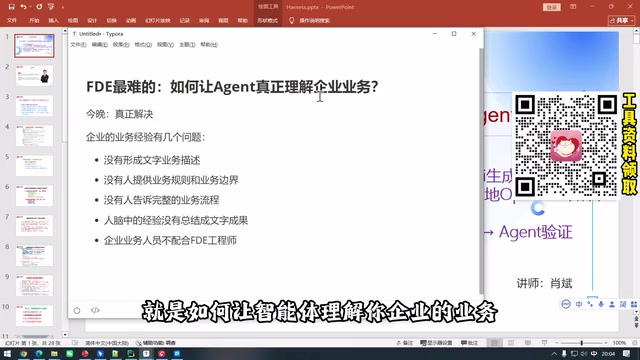
OpenWiki in Practice: Enabling Agents to Understand Enterprise Source Code Business Logic Without Documentation
Based on a Bilibili OpenWiki practice-sharing session, this article explains how to make an Agent read enterprise source code to automatically extract business rules and build a knowledge base without relying on business documentation, and expose it to agents via the MCP protocol. It also covers enterprise implementation challenges and the boundaries of the approach.
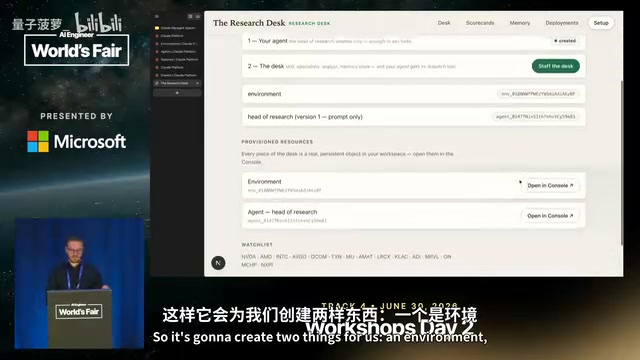
Claude Managed Agents in Practice: Self-Correction + Long-Term Memory
Based on an Anthropic live workshop, this article explains how Claude Managed Agents build research agents with self-correction and long-term memory, covering multi-agent collaboration, Outcomes self-supervision, Vaults credential security, and custom orchestration.
LangChain Agent Event Streaming Explained: A Practical Guide
A deep dive into LangChain 1.3's Event Streaming feature, covering the six event types—Raw, Messages, Tool Calls, Values, Custom, and Interleave—and key practical tips for Agent developers.