Free Pascal Compiler Adds Dynamic Package Support, Modernizing the Pascal Ecosystem

Free Pascal adds dynamic package support, filling the modular deployment gap and modernizing the Pascal ecosystem.
Driven by the Lazarus team, Free Pascal now supports dynamic packages, allowing programs to load modular units at runtime similar to Delphi packages and .NET assemblies. Integrated with Lazarus's package system, it forms a complete development-to-deployment chain and addresses Free Pascal's static-compilation-only limitation. Hacker News discussion focuses on ABI stability, cross-platform compatibility, and static linking trade-offs, noting dynamic packages are most valuable for plugins but require careful version management and symbol conflict handling. Plugin-based IDEs, extensible industry software, and module-licensed commercial apps will benefit directly, while small or startup-sensitive programs should still prefer static linking. Overall, it is a meaningful expansion of Free Pascal's ongoing modernization, not a replacement for existing patterns.
Title
Free Pascal Compiler Adds Dynamic Package Support, Modernizing the Pascal Ecosystem
Meta Description
Free Pascal adds dynamic package support, giving the Lazarus ecosystem runtime module loading capabilities. This article examines the technical principles of dynamic packages, their practical impact on Pascal developers, and community discussions about ABI stability and deployment complexity.
Article Content
The Free Pascal compiler has recently gained dynamic package support, a change driven by the Lazarus project team and discussed on Hacker News. For the Pascal ecosystem, which has long relied on static compilation, dynamic packages mean more flexible modular deployment and runtime extensibility, giving Object Pascal a bit more competitiveness in modern software architectures.
What Dynamic Packages Are and Why They Matter
Dynamic Packages are essentially modular units that can be loaded at runtime. Traditional Pascal programs typically statically link library code into the executable, which is simple to deploy but lacks flexibility; dynamic packages allow functionality to be split into independent modules that can be loaded or replaced on demand after the program starts, similar to Delphi's package mechanism and .NET assemblies.
Free Pascal has long been known for cross-platform static compilation, and the addition of dynamic package support fills the gap in modular deployment. For IDEs, plugin systems, and large desktop applications, this means functional modules can be updated without recompiling the main program, reducing distribution size and upgrade costs.
ABI (Application Binary Interface) stability is a prerequisite for dynamic packages to work reliably. The ABI defines how compiled modules call each other: how parameters are passed, how structures are laid out, and how symbols are named and exported. Unlike source-level APIs, the ABI is fixed once compiled; any change in compiler version, calling convention, or record field alignment on either side can cause runtime crashes rather than compile errors. C++ has long suffered from dynamic library compatibility issues due to the lack of a unified ABI, while Delphi mitigates this through package version numbers and binding to the runtime library (RTL). Free Pascal supports multiple platforms and target CPUs, and the calling conventions and symbol mangling rules differ significantly across platforms. Therefore, dynamic packages need to explicitly define compiler version ranges and RTL dependencies to ensure binary compatibility between the main program and packages.
Symbol conflicts and version management are equally critical. Dynamic packages add symbols to the global namespace at runtime, and if multiple packages export symbols with the same name, overwriting or resolution ambiguity can occur. Common practices include using namespace prefixes, explicit symbol visibility control, and assigning unique identifiers and version numbers to packages. Dependencies between packages also need to be validated during loading to avoid version inconsistencies caused by "diamond dependencies."
Technical Implementation and Lazarus's Role
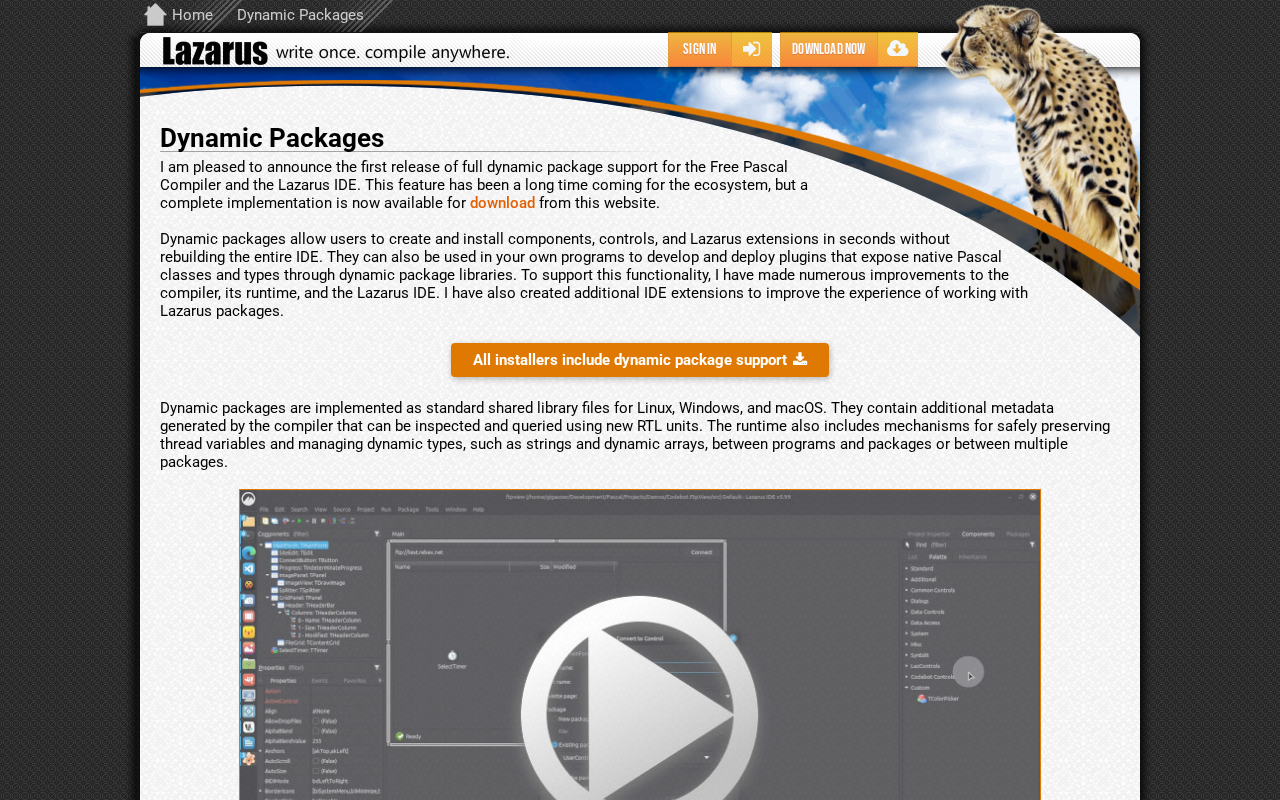
According to getlazarus.org, the dynamic package capability is deeply integrated with the Lazarus IDE's package system. Lazarus itself uses packages as its code organization unit, and dynamic packages give these packages runtime loading capabilities beyond compile time, forming a complete chain from development to deployment.
The discussion on Hacker News (188 points, 44 comments) shows that community concerns focus on ABI stability, cross-platform compatibility, and trade-offs with traditional static linking. Some comments note that dynamic packages are most valuable in plugin architectures but require careful handling of version management and symbol conflicts.
Lazarus's package system is the core mechanism of its code organization: a package consists of several units, with dependencies, search paths, and compilation options described in .lpk files, which the IDE and build tools use to determine compilation order. Traditionally, Lazarus packages are ultimately statically linked into the executable; so-called "design-time packages" are only used to register components with the IDE and do not exist independently at runtime. Dynamic packages extend this model to runtime: packages are compiled into independent shared libraries, and the main program loads them when needed and hooks components or services according to registration information. This is consistent with Delphi's Runtime Packages approach, but cross-platform handling must deal with differences in formats and loading semantics among Windows DLLs, Linux .so, macOS .dylib, and others.
Practical Impact on the Pascal Ecosystem
Pascal still has a stable user base in desktop applications, industrial control, and education, and dynamic package support brings software architectures in these scenarios closer to mainstream practices. Plugin-based IDEs, extensible industry software, and commercial applications licensed by module are all direct beneficiaries.
From a broader perspective, this update is part of Free Pascal's ongoing modernization. The compiler introduces new capabilities while maintaining backward compatibility, which helps attract new projects to adopt Object Pascal and provides a gradual modernization path for existing codebases.
What Developers Should Keep in Mind
Dynamic packages are not without costs. Runtime loading introduces additional deployment complexity, and matching package versions with the main program requires explicit agreements; in cross-platform scenarios, differences in dynamic library formats across systems also need to be encapsulated. For small tools or programs sensitive to startup performance, static linking remains the safer choice.
Overall, dynamic package support is a meaningful expansion of the Free Pascal toolbox rather than a replacement for existing patterns. Whether to adopt it depends on a project's trade-offs between modularity, upgrade flexibility, and deployment simplicity.
One-line Summary
Free Pascal adds dynamic package support, filling the gap in modular deployment and driving modernization of the Pascal ecosystem.
Paragraph Summary
Driven by the Lazarus team, the Free Pascal compiler has added dynamic package support, allowing programs to load modular functional units at runtime, similar to Delphi's package mechanism and .NET assemblies. This capability is deeply integrated with Lazarus's package system, forming a complete chain from development to deployment and addressing Free Pascal's long-standing strength only in static compilation. Discussion on Hacker News focuses on ABI stability, cross-platform compatibility, and trade-offs with static linking, noting that dynamic packages are most valuable in plugin architectures but require careful handling of version management and symbol conflicts. The article argues that plugin-based IDEs, extensible industry software, and commercial applications licensed by module will directly benefit, while small tools or programs sensitive to startup performance should still choose static linking. Overall, this is a meaningful expansion of Free Pascal's ongoing modernization rather than a replacement for existing patterns.
Related articles

DeepCell: One-Click AI Generation of Documents, Spreadsheets, and Slides
DeepCell tops Product Hunt with one-click generation of documents, spreadsheets, and slides, using the .deepcell format for linked updates, designed for System 2 tasks like modeling and sales reviews.

Doneas: 15-Minute Daily Accountability Calls That Keep Indie Developers From Procrastinating
Doneas is a daily accountability tool for indie developers: plan tasks on Monday, join a 15-minute call with five builders each day, and log deliveries on a public progress page. This article analyzes its core mechanics, effectiveness, and potential issues around retention and matching.

Fastlane 2.0: Fully Automated AI Ad Campaigns, From Creative to Optimization
Fastlane 2.0 is an AI ad automation tool: enter your website and it learns your brand, generates video and image ads, and runs and optimizes them on Meta, TikTok, Instagram, and YouTube.