FreeDNS: A Classic Choice for Free Dynamic DNS Services
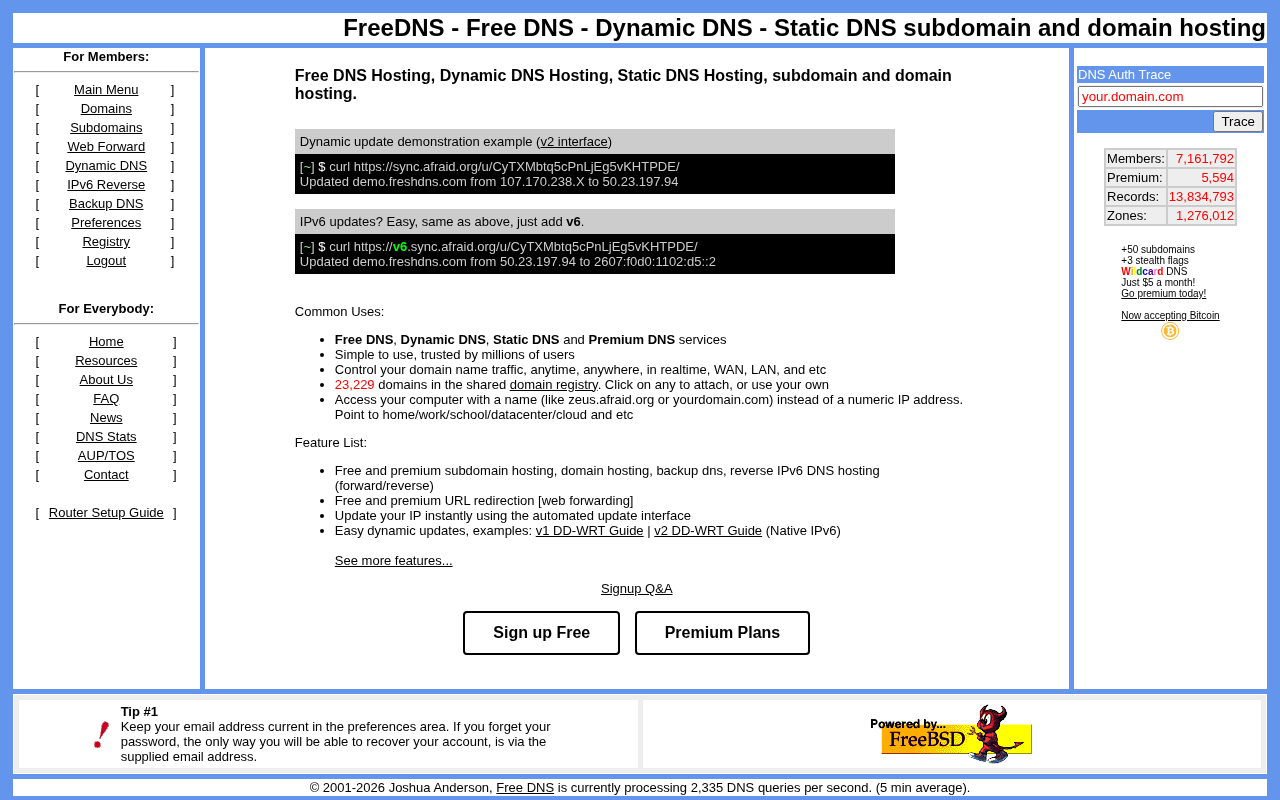
FreeDNS is a community-oriented hosting service offering free dynamic DNS and a shared domain pool.
FreeDNS (freedns.afraid.org) is a free dynamic DNS hosting platform long operated by Joshua Anderson, enabling users without a fixed public IP to access home servers, NAS devices, and self-hosted projects via a stable domain. Its most distinctive feature is the community shared domain pool, where users can create subdomains from the platform's many domain suffixes or share their own domains. It supports updating A/AAAA records via clients, router plugins, and HTTP requests with no complicated verification, making it very accessible for budget-conscious developers and experiments. Hacker News reviews are polarized: supporters praise its free, open old-school internet spirit and stability, while critics cite an outdated interface, uneven shared-domain reputation, and abuse-related sustainability risks. Compared with Cloudflare, DuckDNS, and No-IP, FreeDNS stands out for its "shared domain pool + completely free + no mandatory confirmation" combination—ideal for technical individual users, but not for scenarios requiring enterprise SLAs or security protection.
What Is FreeDNS?
FreeDNS (freedns.afraid.org) is a platform offering free dynamic DNS (DDNS) hosting, created and long operated by Joshua Anderson. Its core value: it lets users without a fixed public IP access their home servers, NAS devices, Raspberry Pis, or other self-hosted projects through a stable domain name.
Unlike most commercial DNS services, FreeDNS uses a community sharing model—users can not only use the vast range of domain suffixes provided by the platform, but also share their own domains for other users to create subdomains. This "domain pool" mechanism is its most distinctive feature.
Core Features and Use Cases
Dynamic DNS Updates
FreeDNS supports updating A/AAAA records through clients, router plugins, or simple HTTP requests. For home broadband users, this means that even if the IP assigned by the carrier changes frequently, the domain can automatically point to the new address within minutes.
How Dynamic DNS (DDNS) Works
Ordinary DNS records are static, manually configured by the domain owner and rarely changed; home broadband typically uses DHCP to assign IPs, and addresses change periodically. The core mechanism of DDNS is to introduce an "update client": it periodically detects the machine's current public IP (for example, by accessing an echo service like ipify), and once it finds a discrepancy with the value already recorded in DNS, it calls the update API provided by the service provider to refresh the A record (IPv4) or AAAA record (IPv6) to the new address.
To prevent update requests from being forged by others, services like FreeDNS generate a unique update token for each domain, and the client completes authentication and writes through a URL of the form https://freedns.afraid.org/dynamic/update.php?<token>. Router firmware (such as OpenWrt's ddns-scripts), Synology NAS, and tools like ddclient and inadyn all have built-in support for this type of interface. The TTL (time to live) setting determines how quickly recursive resolvers worldwide can perceive the new record after an IP change; it is usually set to around 60 seconds to balance timeliness and query load.
Shared Domain Pool
The platform has thousands of available domain suffixes. After registering, users can directly choose one and create a subdomain without purchasing a domain themselves. For budget-conscious developers, students, or experimental projects, this greatly lowers the barrier.
Shared Domain Pools and Subdomain Delegation
The reason a shared domain pool is feasible rests on DNS's hierarchical delegation structure. A domain owner can create subdomains for others in their own authoritative DNS (such as alice.example.com) and delegate the A/AAAA and other records of these subdomains to FreeDNS for hosting. To visitors, the resolution process is still a standard recursive query, and it is not apparent who actually manages the subdomain; but for the domain owner, this means opening control of part of the namespace to unfamiliar users on the platform.
The risk of this model is "reputation spillover": if a subdomain is used for phishing or spam, the reputation of the entire parent domain may be affected and it may be blacklisted. Therefore FreeDNS requires sharers to weigh this themselves and reserves the right to remove abusive behavior. Understanding this makes it clear why the community is particularly sensitive to "uneven reputation of shared domains"—it is not a purely technical issue, but one of trust and governance.
Self-Hosting and Privacy-Friendly
FreeDNS does not require a complicated verification process, nor does it force binding to commercial services. Its interface is simple, and its documentation, though plain, is practical enough—suitable for technical users who like to do things themselves.
Community Feedback and Discussion Hotspots
In the related Hacker News discussion (214 points, 56 comments), community opinions on FreeDNS are clearly polarized.
Supporters see it as a continuation of the "old-school internet spirit": free, open, and not dependent on big-tech ecosystems. Many users shared their experiences running home servers, monitoring nodes, and remote access with FreeDNS, emphasizing its stability and long-term availability.
Criticism focuses on several aspects: an interface that has stayed in the style of years past, uneven reputation of some shared domains, and the sustainability of a free service under abuse. Some commenters pointed out that such services need to rely on community self-discipline, otherwise they are easily dragged down by spam registrations and malicious use.
Comparison with Other Solutions
In today's market, Cloudflare DNS, DuckDNS, No-IP and other solutions each have their own focus. Cloudflare offers more powerful security and management features but requires your own domain; DuckDNS is lighter but has limited domain choices; No-IP's free version has periodic confirmation restrictions.
FreeDNS's differentiation lies in the combination of "shared domain pool + completely free + no mandatory confirmation." It does not aim to become an enterprise-grade DNS service, but serves users willing to accept a certain roughness in exchange for low barriers and autonomy.
Who Is It For?
If you have a home server, a NAS that needs remote access, or are doing IoT/network experiments, FreeDNS is an option worth trying. It is especially suitable for:
- Home broadband users without a fixed IP
- Developers who do not want to pay for dynamic DNS
- Experimental projects that want to quickly obtain a usable subdomain
But if you need enterprise-level SLAs, DDoS protection, or fine-grained permission management, commercial DNS services remain the safer choice.
Conclusion
FreeDNS is not a fashionable product, but it solves a real and long-standing need. In an era of increasingly concentrated cloud services, small community-driven infrastructure that insists on being free still has irreplaceable value. For technical users, understanding its positioning and boundaries is more important than simply pursuing "free."
One-line Summary
FreeDNS is a community-oriented hosting service offering free dynamic DNS and a shared domain pool.
Paragraph Summary
FreeDNS (freedns.afraid.org) is a free dynamic DNS hosting platform long operated by Joshua Anderson, whose core value is enabling users without a fixed public IP to access home servers, NAS devices, and self-hosted projects via a stable domain. Its most distinctive feature is the community shared domain pool: users can create subdomains from the platform's vast range of domain suffixes and can also share their own domains for others to use. The platform supports updating A/AAAA records via clients, router plugins, and HTTP requests, with no complicated verification process, making the barrier extremely low for budget-conscious developers and experimental projects. Hacker News discussion is polarized: supporters praise its free, open old-school internet spirit and long-term stability, while critics point to an outdated interface, uneven reputation of shared domains, and sustainability risks from abuse. Compared with Cloudflare, DuckDNS, and No-IP, FreeDNS differentiates itself with "shared domain pool + completely free + no mandatory confirmation," suitable for technical individual users but not for scenarios requiring enterprise SLAs and security protection.
Related articles
AI Gains Confined to Tech? Non-Tech Industries See Little Payoff
Apollo analysis finds AI's economic returns remain highly concentrated in tech, with no quantifiable payoff yet in non-tech sectors. We break down the key arguments, Hacker News debate, and practical implications for enterprise AI investment and measurement.

AI Agents on Your Phone: Where's the Line Between Convenience and Privacy?
A developer finds people accept AI agents operating laptops but feel uneasy about phones. This article analyzes the trust gap behind data density, permission models, and observability, exploring the specific task boundaries users are willing to hand to mobile AI agents.

In the AI Era, Why Does BBC's Blue Planet III Deliberately Keep "Imperfect" Shots?
BBC's Blue Planet III bucks the AI trend by deliberately keeping imperfect shots to prove authenticity. This article analyzes the trust logic behind this strategy and its implications for content creators in the AI era.