freehire: An Open-Source Job Search Engine Built in Go

Open-source project freehire builds an aggregated job search engine for job seekers in Go.
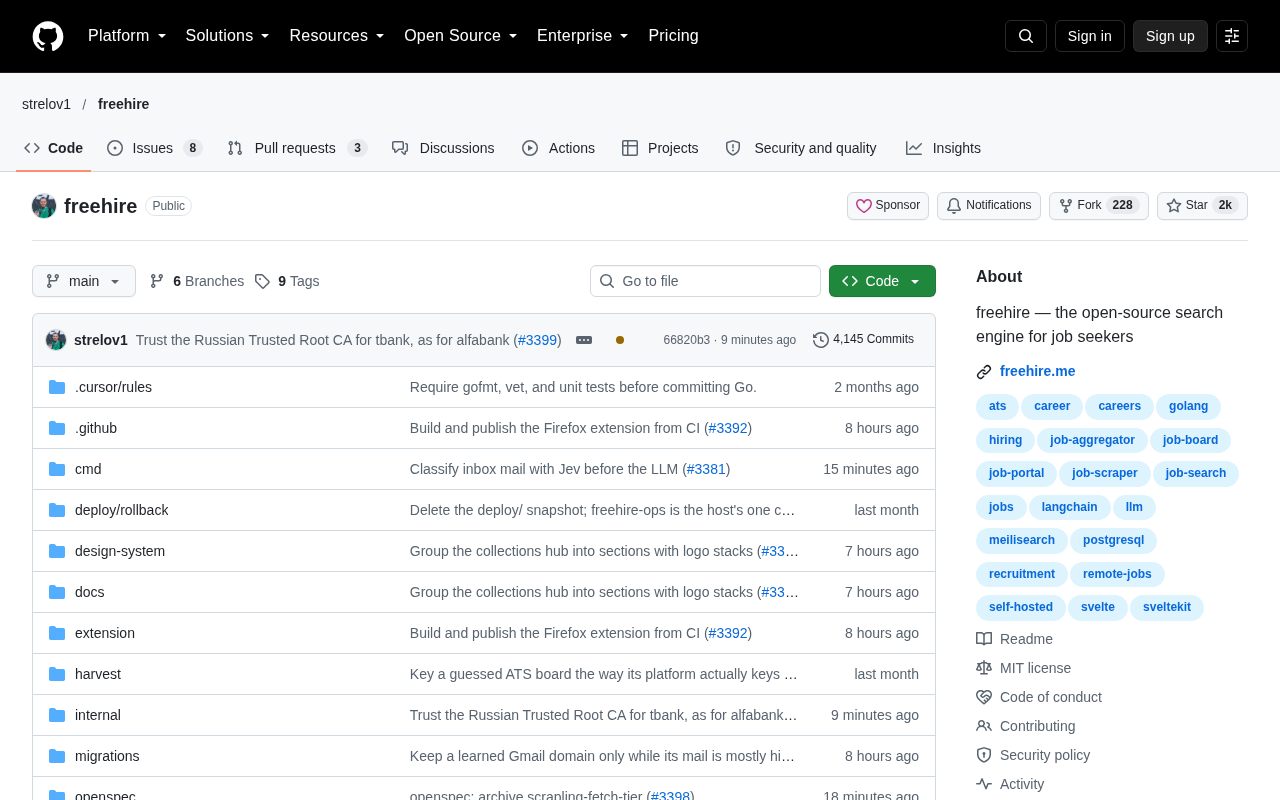
freehire is an open-source project by strelov1 on GitHub, positioned as a search engine for job seekers. Written in Go, it has about 1,997 stars and 228 forks, with 405 new stars in a day. It aims to solve scattered job info and ad clutter by aggregating jobs through one entry point. The article analyzes Go's concurrency and single-binary deployment advantages for search, and notes the open-source model enables self-hosting and community co-building. It also warns that real challenges lie in data source stability, index updates, and relevance ranking.
Job seekers often have to switch back and forth between multiple job boards, and scattered information plus heavy advertising severely reduces search efficiency. The open-source project freehire on GitHub aims to change this—building a search engine focused on job seekers using the Go language.
Project Overview: A Search Tool Born for Job Seekers
freehire was initiated by developer strelov1 and is positioned as "an open-source search engine for job seekers." The project is written in Go and has earned approximately 1,997 stars and 228 forks on GitHub, with 405 new stars in a single day—a clear sign of its popularity.
Judging from its name and description, freehire's core idea is to aggregate scattered job information so that job seekers can complete searches through a single entry point instead of jumping between multiple platforms. Being open source means anyone can view, deploy, or even build upon it—especially appealing to users who care about privacy or want to self-host their own job search tool.
Technology Choice: Why Go
Go has natural advantages for building web services and search-type applications: a lightweight concurrency model, a single binary after compilation, and simple deployment. For a search engine that needs to crawl, index, and respond quickly to queries, these features directly affect development efficiency and operating costs.
Choosing Go also lowers the barrier to community contribution—the code structure is relatively clear, the standard library covers networking and concurrency scenarios, and developers can quickly understand the project architecture and submit improvements.
Concurrency Model and Single-Binary Deployment
Go's concurrency model is based on goroutines and channels. Goroutines are lightweight threads managed by the Go runtime, with an initial stack of only a few KB, so hundreds of thousands can be created easily without exhausting resources like OS threads. This allows the search engine to crawl multiple data sources simultaneously, process index updates in parallel, and respond to a large volume of queries with high throughput using concise code. Channels provide a type-safe communication mechanism between goroutines, and combined with the select statement, they make timeout control and multiplexing easy to implement.
Compiling to a single static binary is another major advantage: Go programs don't depend on an external runtime or virtual environment, and after cross-compilation they can run directly on the target server. Container images can be made extremely small (based on scratch or alpine), significantly reducing deployment and operations costs. For individual users who want to self-host an instance, downloading an executable is all it takes to start the service—a much lower barrier than solutions requiring runtime configuration and dependency management.
Basic Architecture of a Search Engine
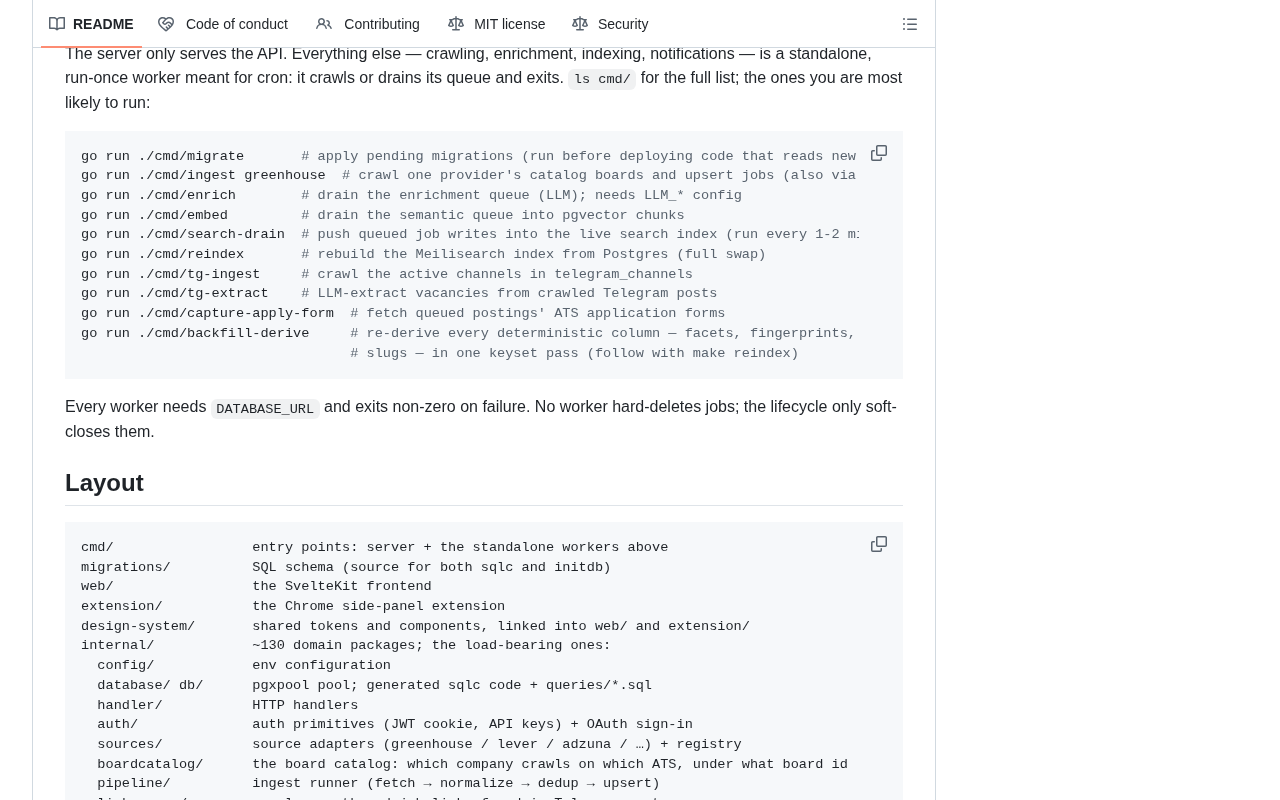
A typical job search engine usually consists of three stages: crawling (crawler/fetcher), indexing (indexer), and retrieval (retriever). The crawling layer is responsible for obtaining job data from various job boards, requiring handling of anti-scraping strategies, rate control, and data cleaning; the indexing layer structures job information and builds an inverted index to support fast keyword matching; the retrieval layer receives user queries, performs tokenization, filtering, and relevance ranking, then returns results. Go's standard library covers HTTP clients, JSON parsing, and concurrent scheduling fairly comprehensively, making it suitable for quickly building this pipeline.
Possibilities Opened Up by the Open-Source Model
Recruitment information has long suffered from platform fragmentation, and aggregated search is the most direct need for job seekers. freehire enters with an open-source approach, meaning it can be deployed as a personal instance or jointly maintained by the community for data sources and retrieval logic.
However, the real challenge for search engine projects often lies not in the code itself, but in the stability of data sources, the frequency of index updates, and the relevance ranking of results. Whether these engineering details can be continuously maintained determines whether the project can evolve from "an interesting experiment" into "a daily usable tool."
Relevance Ranking and Inverted Index
The quality of search engine results depends largely on the ranking algorithm. A common approach is based on an inverted index—recording which documents each word appears in—combined with scoring models such as TF-IDF or BM25 to measure how well query terms match job descriptions. BM25 builds on TF-IDF by introducing document length normalization and term frequency saturation, making it more robust for job descriptions of varying lengths. For job search scenarios, factors such as time decay (newer postings weighted higher), geographic filtering, and skill tag matching also need to be considered. Tuning these ranking strategies often consumes more effort than crawling itself, and it is the watershed for whether an open-source project can be used daily.
Data Source Stability and Compliance
A practical constraint faced by aggregation projects is the accessibility of data sources. Job boards may change page structures, add anti-scraping verification, or limit access frequency, causing scraping scripts to fail frequently. In addition, the compliance boundaries for scraping public job information are not consistent across jurisdictions, and projects need to clarify the scope of data usage and respect the target sites' robots protocols. These non-code factors determine whether aggregated search can operate over the long term.
Who Should Pay Attention
If you are looking for a job, or are interested in aggregated search or Go backend development, this project is worth bookmarking. Its star growth curve shows that the community has real demand for "open-source job search," and future data source coverage and retrieval quality will be key things to watch.
One-line Summary
Open-source project freehire uses Go to build an aggregated job search engine for job seekers.
Paragraph Summary
freehire is an open-source project initiated by developer strelov1 on GitHub, positioned as a search engine for job seekers. Written in Go, it has earned approximately 1,997 stars and 228 forks, with 405 new stars in a single day. The project aims to solve the problem of job information being scattered across multiple job boards and cluttered with ads, which reduces search efficiency, by aggregating job information through a single entry point. The article analyzes how Go's advantages in concurrency model and single-binary deployment fit search-type applications, and notes that the open-source model allows personal self-hosting and community co-building. It also reminds readers that the real challenges for a search engine lie in engineering details such as data source stability, index update frequency, and relevance ranking, which determine whether the project can move from experiment to a daily usable tool.
Related articles

Chain of Thought Isn't Just for AI: How Humans Can Use CoT to Improve Thinking Quality
Chain of Thought isn't just a prompt trick for large models. Starting from a Hacker News discussion, this article analyzes why CoT works for human thinking too, breaks down actionable ways to transfer it, and highlights the key differences between human CoT and machine CoT.
Cloudflare Teams Up with OpenAI: Closi…
Cloudflare Teams Up with OpenAI: Closing the Loop from Vulnerability Discovery to Defense with AI
Cloudflare uses OpenAI Daybreak to investigate security vulnerabilities and generate reviewable remediation plans, while developers use Codex to boost coding efficiency and quality.

Orca Multi-Agent Orchestration in Practice: A Guide to Parallel Collaboration with Claude and Codex
Orca is Stable AI's free open-source agent workbench supporting 34 agents like Claude Code and Codex in parallel. Learn its Git worktree isolation, multi-model orchestration, and mobile management.