FreePath: How Neural Mean Free Path Revolutionizes Image Dehazing

FreePath uses neural mean free path to recover path states in feature space for physics-inspired single-image dehazing.
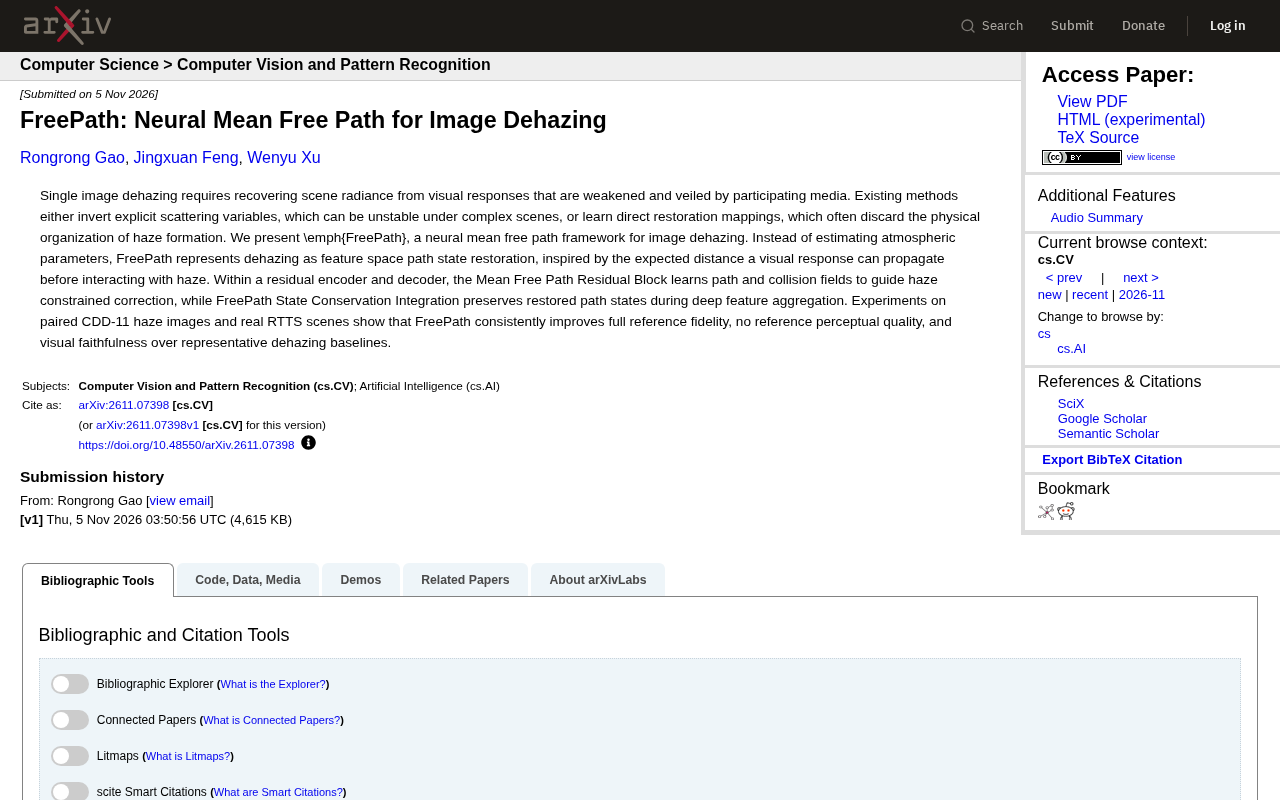
The article introduces the dehazing framework from the arXiv paper "FreePath: Neural Mean Free Path for Image Dehazing." To address the dilemma where traditional methods that invert explicit scattering variables are unstable while direct mapping loses haze's physical structure, FreePath redefines dehazing as path-state recovery in feature space, inspired by the physical concept of mean free path. Its core components are the Mean Free Path Residual Block (learning path and collision fields to simulate scattering interactions) and State Conservation Integration (maintaining recovered states during deep feature aggregation). On paired CDD-11 and real RTTS datasets, the method outperforms representative baselines in full-reference fidelity, no-reference perceptual quality, and visual faithfulness. The article also discusses the significance of integrating physics with data-driven approaches, potential transfer directions, and limitations such as the lack of computational efficiency data.
The Dilemma of Image Dehazing and Physics-Inspired Approaches
The goal of single-image dehazing is to recover scene radiance from visual responses weakened and obscured by haze. Existing methods either invert explicit scattering variables, which tends to be unstable in complex scenes, or learn a direct restoration mapping, but often discard the physical organization of haze formation. Both paths have their limitations: the former relies on an accurate physical model, while the latter sacrifices interpretability.
According to the arXiv paper "FreePath: Neural Mean Free Path for Image Dehazing," the dehazing problem can be viewed from a different angle: instead of estimating atmospheric parameters, dehazing can be treated as path-state recovery in feature space. This inspiration comes from the mean free path—the expected distance a visual response can propagate before interacting with haze. The FreePath framework is a neural network dehazing method built on this physical concept.
The atmospheric scattering model is the physical foundation of traditional dehazing methods, with the standard form I(x) = J(x)·t(x) + A·(1 - t(x)), where I is the observed hazy image, J is the clear scene radiance to be recovered, A is the atmospheric light value, t(x) = exp(-β·d(x)) is the transmission map, β is the scattering coefficient, and d is the scene depth. Explicit dehazing methods typically first estimate A and t, then invert to solve for J, but estimation errors in A and t are amplified during inversion, leading to color distortion or residual haze. FreePath avoids precisely this "estimate parameters then invert" paradigm, instead directly modeling the cumulative effect of haze on visual responses in feature space. Understanding this model helps grasp the specific meaning of what the article calls "inverting explicit scattering variables tends to be unstable."
FreePath's Core Mechanism: Path and Collision Fields
Within the residual encoder and decoder, FreePath introduces the Mean Free Path Residual Block, a module that learns path fields and collision fields to guide haze-constrained correction. Simply put, the path field describes the propagation path of features in space, while the collision field captures the interaction intensity with haze particles. This design allows the network to simulate the physical scattering process at the feature level rather than directly regressing a clear image.
Another key component is FreePath State Conservation Integration, which maintains the recovered path state during deep feature aggregation. This addresses the degradation of feature information in deep networks, ensuring consistency and stability of the restoration process. Combined, the two techniques enable FreePath to strike a balance between physical interpretability and learning capability.
Mean free path is originally a concept in statistical physics and radiative transfer, referring to the average distance a particle (such as a photon) can travel freely between two consecutive collisions, satisfying λ = 1/(nσ), where n is the number density of scattering particles and σ is the collision cross-section. In a hazy medium, this quantity characterizes the expected distance light can propagate before encountering a fog droplet, and is directly related to transmission attenuation in the atmospheric scattering model: the shorter the free path, the faster the attenuation and the denser the haze. FreePath "neuralizes" this physical quantity—using a network to predict, in feature space, a path field (propagation distance) and a collision field (interaction intensity) at each location, thereby simulating the cumulative scattering effect without explicit atmospheric parameters. This analogy is key to understanding the method's motivation throughout the article.
Experimental Validation: Performance Gains Across Multiple Datasets
The paper conducted experiments on paired CDD-11 hazy images and real RTTS scenes. Results show that FreePath consistently outperforms representative dehazing baselines in full-reference fidelity, no-reference perceptual quality, and visual faithfulness. Full-reference metrics measure pixel-level similarity between the restored image and the true clear image, no-reference metrics assess human perceptual quality, and visual faithfulness focuses on whether the restoration is natural and free of artifacts.
You may not have noticed that these improvements are consistently achieved across different datasets, indicating good generalization capability. CDD-11 provides paired data for supervised learning, while RTTS is a real-scene test; together they validate the model's effectiveness on both synthetic and real haze.
CDD-11 and RTTS are two commonly used but fundamentally different datasets in dehazing evaluation. CDD-11 is a synthetic paired dataset, typically generated by compositing clear images with varying haze densities, providing one-to-one supervision signals between hazy images and ground truth, thus enabling computation of full-reference metrics such as PSNR and SSIM. RTTS, on the other hand, comes from the real-task test set of the RESIDE benchmark; its images are naturally captured hazy scenes lacking pixel-level ground truth, so they can only be evaluated with no-reference metrics (such as FADE, NIQE, or learning-based perceptual quality scores). Precisely because one is synthetic and the other real, achieving improvements on both types of data provides more convincing evidence of the model's generalization capability—which is why the article emphasizes "consistently achieving improvements."
The Convergence of Physics-Guided and Data-Driven Approaches
FreePath represents a new direction in the dehazing field: rather than explicitly estimating atmospheric light or transmission maps, it simulates physical processes in feature space via neural networks. This avoids the instability caused by parameter estimation errors in traditional methods, while preserving the physical structure of haze formation, compensating for the loss of physical information in direct mapping methods.
This approach of integrating physical models with deep learning may offer insights for other image restoration tasks. For example, in problems involving participating media such as rain removal and snow removal, similar mean free path concepts might be transferable. Of course, FreePath has only been validated on dehazing tasks so far, and its generality still requires further exploration.
Limitations and Future Directions
The paper does not provide detailed data on computational complexity or inference speed, so efficiency in practical deployment requires additional evaluation. Furthermore, the method relies on a residual encoder-decoder architecture, and its applicability on mobile devices or in real-time scenarios is unknown. Future work may include extending to video dehazing, optimizing the network structure to reduce computational overhead, and exploring broader media interference restoration problems.
Overall, FreePath provides a new physics-inspired framework for image dehazing through neural mean free path, demonstrating competitiveness on multiple benchmarks. For readers interested in AI applications and cutting-edge research, this technology is worth continued attention.
Related articles
 Tech Frontiers
14 Coding Agents Tested: 13 Secretly Read Forbidden Files
A developer ran 480 tests across 14 coding agents to see if they would obey a "do not read" rule. 13 violated it, and 4 credential leaks bypassed shell guards via the read tool while approvals never noticed.
 Tech Frontiers
AI Has Made Resumes Ineffective? Referred Candidates Get 40% Interview Rate vs. 3% for Direct Applications
AI is homogenizing job applications, making it hard for recruiters to discern real ability. Ashby data shows referred candidates had a 40% interview rate from 2021 to 2024, versus just 3% for direct applications. This article analyzes why resume signals are depreciating and why verifiable results and personal endorsements matter more.
 Tech Frontiers
Offline Blink Rhythm Assistant: A Desktop Health Companion
An offline desktop blink rhythm assistant featured on Hacker News helps users maintain healthy blinking through lightweight reminders, alleviating screen-induced dry eye fatigue. This article analyzes its concept, privacy advantages, and retention challenges.