FreeToken: A Local Inference Engine for Running Large-Scale Models on the Desktop

FreeToken uses Python to bring datacenter-grade model serving scheduling to the desktop, making massive models runnable locally.
FlashML-org/FreeToken is an open-source Python project aiming to extend datacenter-scale model serving capabilities down to personal computers, with over 15,000 stars and 1,500+ forks. Its core approach isn't simply wrapping inference frameworks but introducing service-oriented scheduling: through fine-grained VRAM management and multi-request batching, it keeps throughput usable for large models whose parameters exceed a single GPU's VRAM on desktop hardware. The article analyzes its handling of VRAM bottlenecks and concurrency queues, noting it's best suited for developers and teams who need to run very large models locally or serve models as shared services, while cautioning that public information is limited, model support lists and performance benchmarks are lacking, and users should verify compatibility and assess maintenance costs before getting started.
Why Local Inference Needs a New Answer
Large model capabilities are advancing rapidly, but the barrier to deployment hasn't dropped in tandem. Cloud APIs are convenient, but they mean ongoing costs, data leaving your premises, and network dependency. Many developers and teams want to run models on their own machines, but the reality is: not enough VRAM, throughput too low, and queues form as soon as concurrency rises. FlashML-org/FreeToken on GitHub attempts to resolve this contradiction—its goal is to bring datacenter-grade model serving capabilities to the desktop. The project is implemented in Python and has already garnered over 15,000 stars, with 232 new stars today, indicating that demand for local inference is attracting widespread attention.
FreeToken isn't positioned as yet another "wrapper" around an inference framework, but rather as a solution for the specific scenario of "running massive models efficiently on local hardware." The question it seeks to answer is: when model parameters far exceed a single GPU's VRAM, can desktop-grade hardware still deliver usable response speeds?
Core Approach: Bringing Server-Side Scheduling to the Personal Computer
From its description, FreeToken emphasizes "datacenter-scale model serving." This typically implies several things: loading and sharding management for very large models, batch scheduling of requests, and fine-grained utilization of limited VRAM. The traditional approach is to load models directly with an inference framework—single request, single GPU, VRAM fully occupied all at once; FreeToken instead introduces a service-oriented mindset, enabling desktop environments to manage model lifecycle and request queues like a server.
Aiming for "Runs at All" Rather Than "Runs Everything"
The value of high-star projects often lies in their trade-offs. FreeToken doesn't claim to support all models or all hardware; instead, it focuses on making "massive models" usable locally. For individual developers, the most practical pain point isn't running a 7B model—it's wanting to try larger models but being limited by VRAM. FreeToken's direction is to make such attempts feasible: even if speed isn't optimal, you can at least get it running.
Real-World Challenges of Local Inference and How FreeToken Addresses Them
The biggest difference between desktop environments and datacenters is resource instability: small VRAM, low memory bandwidth, and no dedicated accelerator card clusters. FreeToken is designed to solve efficiency problems under exactly these constraints.
The Contradiction Between VRAM and Model Scale
It's the norm for large models to not fit entirely into a single consumer-grade GPU. FreeToken's approach follows a "service-oriented" path: through finer-grained memory management and request scheduling, it maintains acceptable throughput on limited hardware. The original text doesn't disclose specific technical details, but from the phrase "fast and efficiently," it emphasizes overall efficiency rather than simply low latency or high throughput.
The VRAM footprint of large model inference roughly consists of three parts: model weights, KV Cache, and intermediate activations. Taking FP16 precision as an example, every 1 billion parameters requires approximately 2GB of VRAM—a 70B model needs about 140GB for weights alone, far exceeding the 24GB limit of a single consumer-grade GPU. Common industry countermeasures include quantization (e.g., 4-bit compresses weights to about a quarter), CPU-GPU layer offloading (keeping some layers in memory and swapping them in on demand), and tensor parallelism sharding. The "fine-grained memory management" emphasized by FreeToken most likely involves a combination of these techniques, whose essence is making dynamic trade-offs among VRAM capacity, memory bandwidth, and response latency.
Concurrency and Queuing
One aspect of local usage that's often overlooked is concurrency. When multiple requests arrive simultaneously, simple inference frameworks process them serially, causing wait times to stack up. FreeToken introduces server-side batching concepts, merging multiple requests into scheduled batches, which can significantly improve resource utilization in desktop scenarios. For users who treat local models as personal assistants or shared services for small teams, this capability is more valuable than single-inference speed.
Batching is the core means by which model serving improves throughput: combining multiple independent requests into a single batch fed into the model simultaneously, thereby amortizing the overhead of weight loading and GPU idle time. Continuous batching further allows requests to dynamically join or leave a batch during generation, preventing short requests from being held up by long ones. This is typically paired with paged KV Cache management, which slices each request's cache into fixed-size blocks allocated on demand, reducing VRAM fragmentation. These mechanisms are standard features of datacenter inference frameworks like vLLM and TGI; FreeToken's appeal lies in adapting them to desktop environments with tighter VRAM and more random request patterns.
Who Should Use FreeToken
The project's 15,084 stars and 1,532 forks indicate it has already attracted a group of actual users. Based on the scenarios, the following types of people are most likely to benefit:
- Researchers and developers who want to run models locally that exceed their VRAM capacity;
- Individual users who need to run models as local services for multiple applications to call;
- Teams sensitive to data privacy who don't want to send requests to the cloud;
- Engineers who want to learn about model serving scheduling mechanisms using Python as their tech stack.
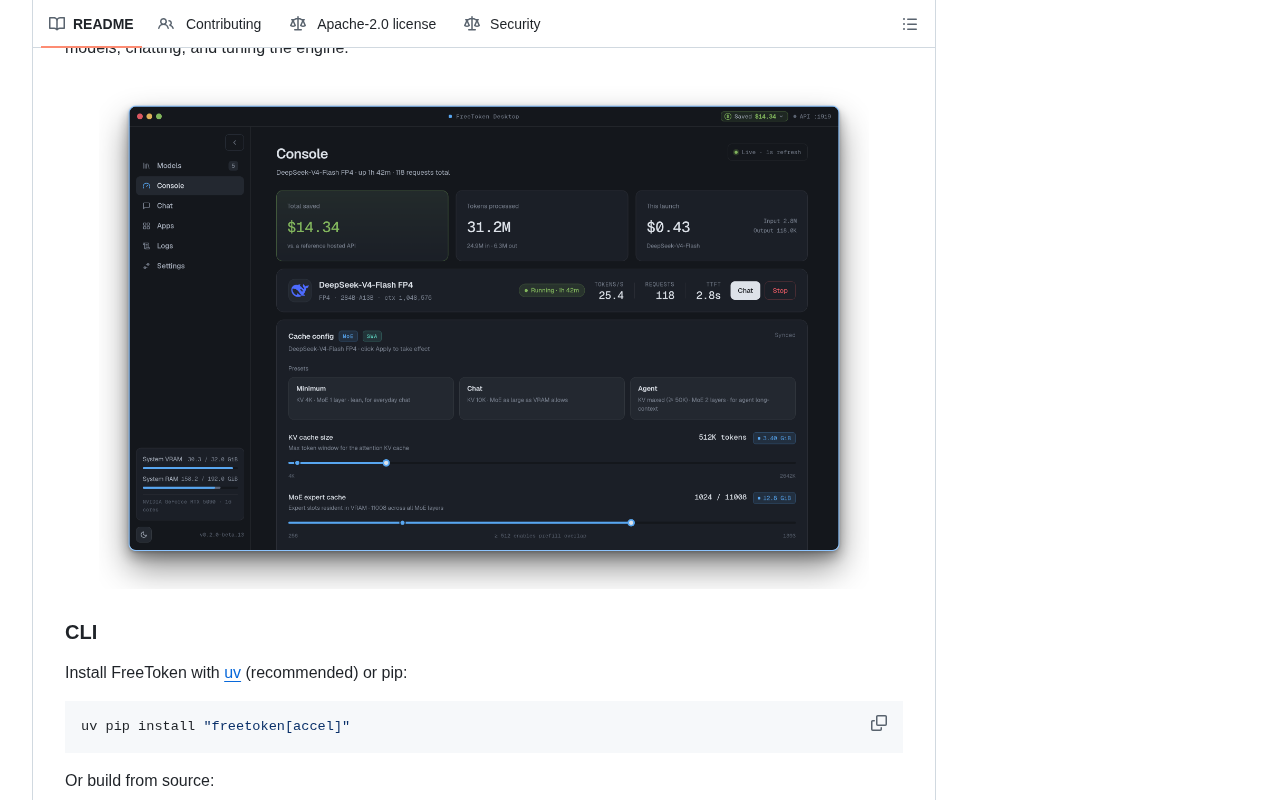
Conversely, if you only occasionally run small models, or if you want an out-of-the-box graphical interface, FreeToken may not be the easiest choice—it leans more toward users with deployment experience.
Its Position in the Open-Source Ecosystem
FreeToken enters a highly competitive space: local inference already has several mature projects. Its differentiation lies in emphasizing the extension of "datacenter-scale" serving capabilities down to the desktop. This positioning addresses a real gap—most tools solve "can it run at all," while FreeToken attempts to solve "can it run like a service."
Python as the implementation language lowers the barrier to secondary development and makes the project easier to integrate into existing toolchains. Over 1,500 forks indicate that the community isn't just watching—they're modifying and extending it.
There are several representative projects in the local inference space: llama.cpp is known for its C++ implementation and GGUF quantization format, focusing on CPU and low-spec hardware; Ollama provides out-of-the-box model management and a command-line experience on top of it; vLLM and SGLang focus on ultra-high server-side throughput and continuous batching. FreeToken's differentiator is its Python implementation and its introduction of server-side scheduling capabilities to the desktop, making it easier to integrate into Python toolchains—though Python typically needs to compensate for its lower-level performance through CUDA extensions or existing inference backends. Understanding this ecological niche helps determine whether it's suitable as a standalone service or as an upper-layer orchestration tool.
Points to Note
High star counts don't equal maturity. FreeToken's original description is brief and doesn't provide a supported model list, hardware requirements, or performance benchmarks. For users preparing to get started, this means compatibility needs to be verified independently. Additionally, the actual performance of "datacenter-scale" on the desktop depends on hardware configuration; the project's claimed "fast" is a relative concept and shouldn't be directly applied to all devices.
Another hidden cost of local inference is maintenance: model updates, dependency conflicts, and driver compatibility all require effort. FreeToken can lower the barrier to running models, but it can't eliminate these engineering burdens.
Conclusion
FreeToken's value proposition is clear: bring server-side model scheduling capabilities to the personal computer, making massive models usable locally. Over 15,000 stars indicate real demand for this direction. For developers willing to tinker and wanting to control their model runtime environment, it offers an option worth trying; for users seeking zero-configuration, they still need to evaluate their own hardware and maintenance costs. The popularization of local inference needs projects like this that make "running at all" solid.
Related articles

AI Tools Quietly Altering Settings: Postman Silently Installs Plugin, Codex Sharing Option Auto-Resets
AI Daily reports: Postman silently installs a Mac plugin and self-approves startup hooks, logged as auto-existing upgrade; Hacker News developers say Codex data-sharing opt-out flips back. Plus Simon Willison's raw float weight experiment with QEN 3.8-27B.

AI Learns to Rewrite AI: MIT's "Weightspace Programming" Redraws the Path to Recursive Self-Improvement
MIT team proposes weightspace programming: GPT-6 Astra reads and edits AI model weights directly. Math scores jump several-fold, hand-written networks beat trained models. Eight experiments analyzed, plus Anthropic's same-day warning and the real boundaries of recursive self-improvement.

Running Qwen 3.8 on a Laptop to Read Raw Weights: 46 Minutes Per Answer
Simon Willison reproduced weight space programming with Qwen 3.8 27B on a laptop: a 17GB model file, 46 minutes per answer, 43,506 reasoning tokens, Pong over an hour, Freeway failed. Suited for interpretability researchers.