Freezing BERT to Find AI Text Detection Neurons: Sparse Probing and Activation Patching Explained

Fewer than 1% of BERT neurons causally drive AI text detection, with instruction tuning leaving a traceable Layer-12 signature.
This arXiv mechanistic interpretability study uses a frozen BERT-base-uncased encoder and sparse probing to identify the critical neuron subset — under 1% of 9,216 total — that drives AI text detection while retaining most accuracy. Bidirectional activation patching confirms true causal relationships rather than mere correlation, while mean ablation reveals redundant signal distribution across the network. Cross-generator analysis finds 30–36% of stable neurons for instruction-tuned generators concentrate in BERT's Layer 12, interpreted as a post-training alignment footprint. Leave-one-family-out evaluation shows the fixed subspace retains 86–94% generalization performance, enabling low-cost cross-domain deployment.
Freezing BERT to Find AI Text Detection Neurons: Sparse Probing and Activation Patching Explained
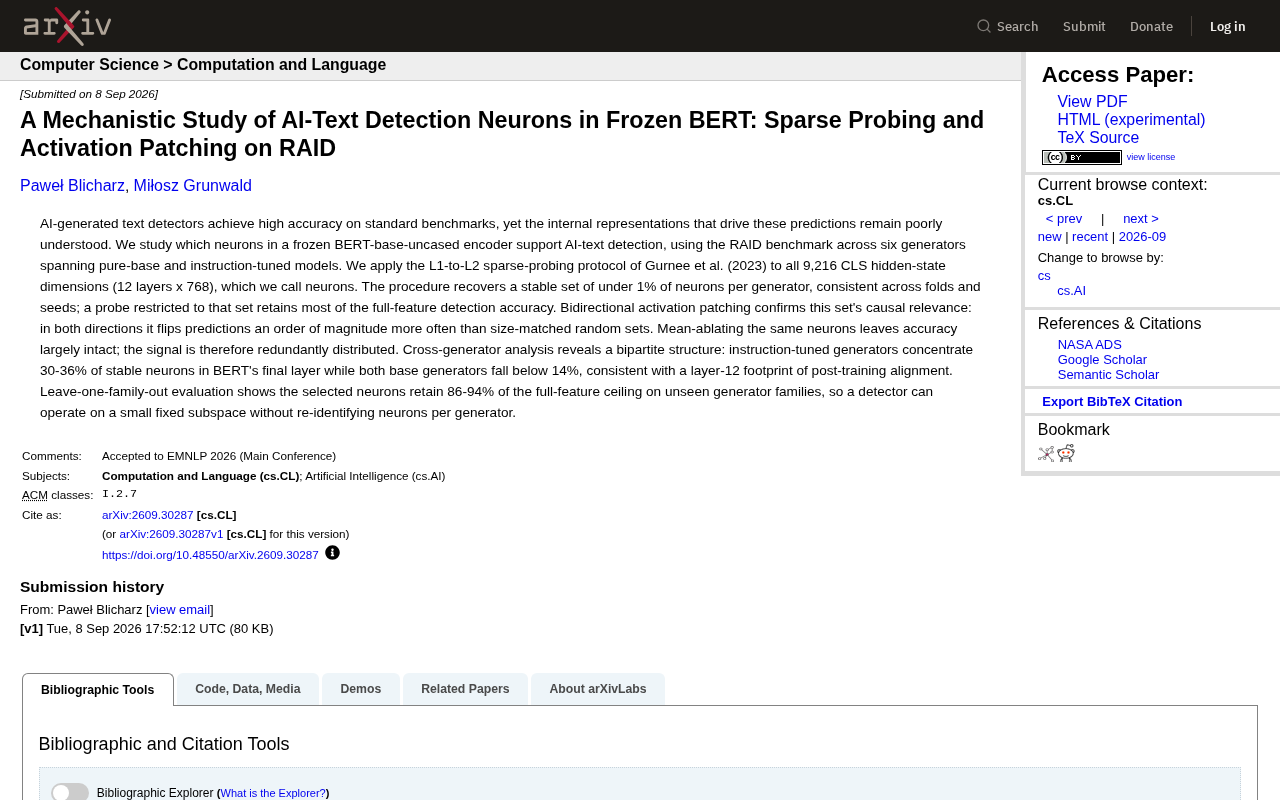
AI-generated text detectors have long achieved high accuracy on standard benchmarks, but a question has remained persistently open: what mechanisms inside these models actually drive their decisions? A new study posted to arXiv (arXiv:2609.30287v1) takes a mechanistic interpretability approach, attempting to localize the neurons within a frozen BERT encoder that are truly responsible for AI text detection — and then using causal interventions to verify their role.
Motivation: From Black Box to Mechanistic Understanding
Most mainstream AI text detectors are used as black boxes — feed in text, get a probability out, and rarely question what happens in between. This creates two risks: we can't explain why a detector fails in certain scenarios, and it's hard to assess its robustness against newer generative models.
The study adopts a clever experimental setup: a frozen BERT-base-uncased encoder (no fine-tuning), with only a lightweight probe added on top. The advantage here is that any detection capability must come from representations BERT already learned during pretraining, rather than features trained specifically for the detection task. The team conducts their analysis on the RAID benchmark, covering six text generators — both pure-base models and instruction-tuned models.
Sparse Probing: Under 1% of Neurons Sustain Detection
The study treats all CLS hidden state dimensions in BERT as "neurons" — 12 layers × 768 dimensions, totaling 9,216 neurons. Using the L1-to-L2 sparse probing protocol from Gurnee et al. (2023), the team filters out the subset of neurons that are truly critical for the detection task.
The results are striking: for each generator, the consistently selected neurons account for less than 1% of the total, and this subset remains highly stable across different cross-validation folds and random seeds. More importantly, probes trained on just this sub-1% of neurons retain the vast majority of full-feature detection accuracy. This shows that the core signal for AI text detection isn't spread diffusely across all dimensions — it's concentrated in a small, identifiable set of neurons.
The L1-to-L2 sparse probing protocol is a method for identifying functional neuron subsets within a neural network. The core idea is to apply L1 regularization during linear probe training, forcing the probe to rely on only a small number of dimensions (producing sparse weights), then using an L2 constraint to measure the actual predictive power of those sparse features. By repeating experiments across multiple random seeds and cross-validation folds, dimensions that are consistently selected are deemed truly critical to the task. The advantage of this approach is that it not only finds "useful" dimensions, but also uses consistency checks to rule out noise dimensions selected by chance — reliably locating functional subsets within high-dimensional hidden states without exhaustively testing every neuron combination.
Activation Patching: Establishing Causality, Not Just Correlation
Proving that certain neurons "correlate" with detection outcomes isn't enough — the key in interpretability research is establishing causal relationships. To this end, the team employs bidirectional activation patching.
The experiments show that swapping activations on these selected neurons flips the model's predictions at a rate an order of magnitude higher than an equivalently sized set of random neurons, and this holds in both directions. This strongly demonstrates that these neurons are causally driving detection decisions.
Redundant Distribution: The Signal Isn't Single-Point Dependent
An interesting finding: when researchers apply mean ablation to these key neurons, accuracy remains largely unchanged. This seems to contradict the activation patching results, but actually reveals a redundant distribution property of the detection signal — the information is encoded in multiple places simultaneously. Simply erasing the mean signal of certain neurons isn't enough to break the overall judgment, but precise activation substitution can change the outcome. This redundancy is both an advantage for detector robustness and a challenge for analysis.
Activation Patching is the standard technique in mechanistic interpretability for establishing causal relationships, systematized by Meng et al. (2022, the ROME paper). The basic operation is: during a forward pass, replace the activation at a specific network location (here, specific neurons) with activations from a different input, and observe whether the output prediction changes accordingly. If the prediction flips after substitution, it indicates that location genuinely carries information in the causal chain, rather than merely correlating with the result. This study uses a "bidirectional" design — replacing activations from the human text pathway into the AI text forward pass (testing whether an AI prediction can be flipped to human), and also doing the reverse substitution. Success in both directions confirms that the neuron set is bidirectionally decisive, ruling out the possibility of one-directional coincidental correlation.
Cross-Generator Analysis: The "Layer-12 Footprint" of Instruction Tuning
The most illuminating finding comes from cross-generator comparison, where the team observes a clear bipartite structure:
- Instruction-tuned generators: their stable neurons have 30%–36% concentrated in BERT's final layer (Layer 12).
- Base generators: both pure-base models show proportions below 14%.
The researchers interpret this as a "Layer-12 footprint of post-training alignment." In other words, the traces left in model output text by instruction tuning (e.g., RLHF and similar alignment methods) are captured precisely by the abstract semantic representations in BERT's upper layers. This provides an intuitive mechanistic explanation for "what detectors are actually distinguishing" — higher-layer neurons are better at sensing the stylistic signatures of alignment-processed text.
Generalization: A Fixed Subspace Can Handle Unseen Generators
Practical utility is unavoidable in detection research. The team tests generalization through leave-one-family-out evaluation: on generator families never seen during selection, the identified neurons still retain 86%–94% of the full-feature performance ceiling.
The significance of this result: a detector can operate on a small, fixed subspace without needing to re-identify neurons for each new generator. For real-world deployment, this means lower computational overhead and better transferability — a single set of neurons is sufficient to handle diverse generation sources.
Conclusion: Interpretability Offers New Tools for AI Detection
The value of this work isn't in pushing detection accuracy higher — it's in advancing AI text detection from empirical black-box operation to mechanistic understanding. It demonstrates the sparsity, causality, and redundancy of detection signals, reveals their connection to post-training alignment, and showcases the cross-domain generalization potential of fixed subspaces.
As generative models continue to evolve, this kind of mechanistic interpretability research may well become the foundational methodology for building trustworthy, auditable AI detection systems. It reminds us: understanding why a model makes a judgment is often just as important as improving how accurately it judges.
Background
Instruction Tuning involves supervised fine-tuning of a pretrained language model on human-annotated instruction-response pairs, enabling the model to better follow user intent. RLHF (Reinforcement Learning from Human Feedback) goes further by using a reward model to score generated content, optimizing output style and safety through reinforcement learning. This kind of "post-training alignment" systematically shifts a model's output distribution: sentence structures become more regular, tone more consistent, and response formats more fixed. BERT, as a bidirectional encoder, has learned to capture abstract semantic and stylistic features in its upper layers (Layer 12). When text generated by an instruction-tuned model is fed into BERT, these stylistic traces are more likely to form recognizable, clustered signals in the representations of the final layers — which is the likely underlying mechanism behind the "Layer-12 bias" observed in this study.
Related articles

JobRunner MCP Server: AI Agents Can Now Fix Failed Java Jobs
JobRunner launches an open-source MCP server enabling AI agents to view cluster status, diagnose failures, and recover Java jobs—incident response from any cloud coding environment or existing agent.

MLAI Digital Launches 9 Security Agents: MCP Server Safeguards the Full Lifecycle of Agentic AI
MLAI Digital launches Security MCP Server with nine built-in specialized security agents covering vulnerability discovery, attack simulation, prompt injection detection, API and infrastructure assessment, and accelerated remediation—embedding security validation across the full Agentic AI lifecycle from development to production.

Running Isaac Lab on H100 GPUs: Exploring Better Approaches
Exploring optimization methods for running Isaac Lab on NVIDIA H100 GPUs, including MIG configuration, mixed precision, TensorRT acceleration, and community experience to improve robotics simulation and reinforcement learning efficiency.