Frequent Grok Bot Failures: The Stability Dilemma for Cursor Ultra Users

Grok Bot's frequent failures in Cursor Ultra expose the stability challenges of multi-model AI coding tools.
Grok Bot's recurring errors within Cursor Ultra have sparked developer frustration, highlighting a critical challenge for AI coding assistants: maintaining service stability across multi-model integrations. The failures stem from API dependency chains, rapid model iteration cycles, and insufficient fault tolerance mechanisms. For products like Cursor, building transparent error reporting, automatic failback strategies, and stronger SLA agreements with model providers is essential to meeting developers' high reliability expectations.
Introduction: A Recurring Problem
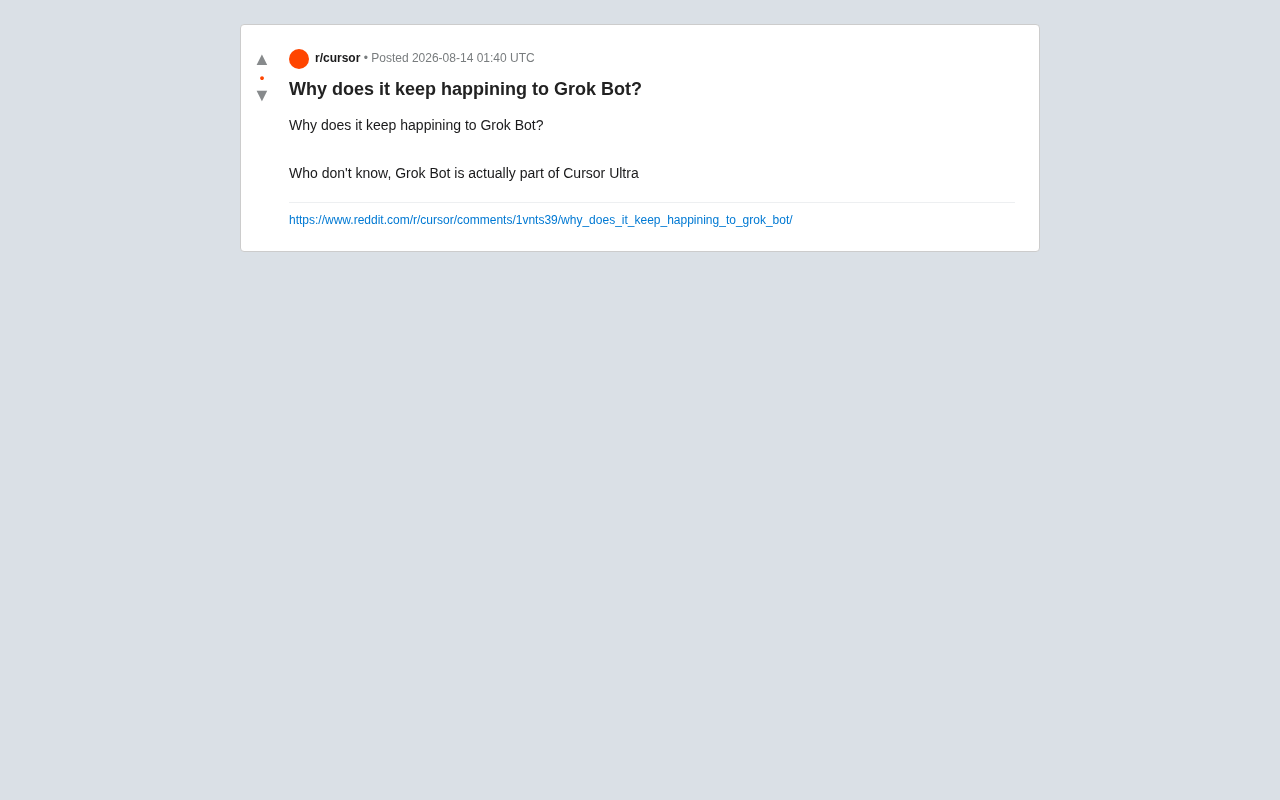
Recently, a discussion about Grok Bot appeared on Reddit with a title that posed a direct question: "Why does it keep happening to Grok Bot?" The poster specifically pointed out that Grok Bot is actually part of the Cursor Ultra subscription tier, meaning its stability issues aren't just a single model's problem — they affect the entire user experience of the AI coding toolchain.
Although the post was brief, it reflects a widespread pain point in the AI coding assistant space: while model capability is certainly important, service stability and consistency are equally critical factors in determining whether users stay or leave.
The Relationship Between Grok Bot and Cursor Ultra
A Brief Overview of the Cursor Ultra Subscription
Cursor is an AI-native code editor that's widely popular among developers. Built on top of VS Code, it deeply integrates large language model capabilities, supporting code completion, natural language editing, intelligent refactoring, and more. From a technical architecture standpoint, Cursor is built on the Electron framework, forked from Microsoft's open-source VS Code project, inheriting its rich extension ecosystem and core editor capabilities. However, unlike the plugin-based integration of VS Code + Copilot, Cursor embeds AI capabilities deeply into the editor's core — including Tab-key smart completion, Cmd+K inline editing, Chat sidebar conversations, and multi-step autonomous coding in Agent mode. This architectural design means AI is no longer an add-on feature but part of the core interaction paradigm, so any failure at the model invocation layer directly impacts the editor's basic usability.
Cursor Ultra is its premium subscription plan, offering higher usage quotas and access to multiple cutting-edge models.
Grok's Role Within Cursor
According to the poster, Grok Bot is integrated into Cursor Ultra's model selection. Grok is a large language model series developed by xAI, emphasizing real-time capabilities and reasoning ability. xAI was founded by Elon Musk in 2023, and its first product, Grok, initially debuted as a built-in AI assistant on the X platform (formerly Twitter). The Grok model series has undergone rapid iteration from Grok-1 to Grok-2 to Grok-3, with Grok-3 reportedly trained on over 100,000 H100 GPUs when released in early 2025, delivering standout performance on benchmarks for mathematical reasoning and code generation. xAI has adopted an aggressive openness strategy, offering model access to third-party applications via API, with Cursor being one of its partners. However, as a relatively young company, xAI's API infrastructure still lags behind predecessors like OpenAI and Anthropic in terms of maturity and stability — which may be one of the underlying reasons Grok frequently encounters issues in third-party integrations.
Integrating Grok into a programming tool like Cursor was intended to give developers more diverse model choices — different models have varying strengths in code comprehension, context length, and response speed, and a multi-model strategy can address the needs of different scenarios.
However, when third-party models are integrated into a unified product experience, problems inevitably arise: instability in any single component gets directly attributed by users to the entire product.
Technical Reasons Behind the Frequent Failures
The Complexity of Multi-Model Integration
AI coding tools connecting to external models are essentially creating API dependency relationships. When Cursor calls Grok, it communicates through interfaces provided by xAI. This chain involves multiple layers:
- Model provider side: xAI's server load, rate-limiting policies, and model version updates can all cause response anomalies.
- Integration layer: Cursor needs to convert user requests into formats compliant with Grok's API specifications and process the returned results — any format mismatch or timeout will cause failures.
- Network and quotas: Usage allocation and concurrency limits for Ultra subscriptions also affect the actual experience.
From a distributed systems perspective, this kind of Failure Propagation is a classic challenge in microservices architecture. When Cursor calls the Grok API, the entire request chain includes: user IDE client → Cursor backend service → authentication and rate-limiting layer → xAI API gateway → model inference cluster → result return. Latency or failure at any node cascades to impact the end-user experience. In distributed systems design, this is typically addressed through the Circuit Breaker Pattern to detect downstream service health and fail fast during outages, Exponential Backoff retry strategies to avoid adding pressure to already overloaded services, and proper timeout controls to prevent requests from blocking indefinitely. The implementation quality of these mechanisms directly determines the stability perceived by users.
When any link in the chain fluctuates, what users see is often just the surface-level symptom of "Grok Bot failed again," with little ability to pinpoint the actual root cause.
Compatibility Risks from Rapid Model Iteration
Another factor that cannot be ignored is the rapid iteration cycle of cutting-edge models. Models like Grok frequently release new versions, adjust interfaces, or modify quota policies. For a product like Cursor that needs to simultaneously interface with multiple models, keeping up with every provider's pace of change is extremely challenging — any lag can trigger compatibility failures.
The User Perspective: Stability Determines Retention
Programming Demands High Reliability
Unlike casual chat-based Q&A, programming is a workflow with extremely strong continuity requirements. When developers are writing code, frequent AI assistant errors or response interruptions not only break their train of thought but can also cause tangible time losses. Psychological research shows that once a developer enters a "Flow State" during deep coding, a single interruption can require 15-25 minutes to return to the same level of focus. Therefore, in the vertical domain of programming tools, stability is arguably just as important as the intelligence of the model itself.
This also explains why a seemingly simple complaint post can resonate — users paying for an Ultra subscription expect a smooth and reliable experience, not frequent troubleshooting sessions.
The Attribution Dilemma Users Face
For average users, they can't tell whether the issue lies with Cursor's integration or Grok's own service, nor can they determine who's responsible. This "black box" failure experience easily builds up frustration. When problems occur repeatedly, complaints naturally transform into distrust of the entire product.
Implications for the AI Coding Tool Ecosystem
Provide More Transparent Error Messages
For products like Cursor that integrate multiple models, one worthwhile area of improvement is providing clearer error feedback. For example, explicitly informing users whether the current failure stems from model-side rate limiting, network timeouts, or quota exhaustion — enabling them to take appropriate action rather than facing a vague failure message.
Establish Multi-Model Redundancy and Fallback Strategies
Mature product design should incorporate fault tolerance mechanisms. When a particular model (such as Grok) becomes unavailable, the system should be able to automatically or suggestively switch to a backup model to keep the workflow uninterrupted. This kind of fallback strategy is standard practice in cloud services, and AI coding tools should gradually adopt it as well.
In engineering practice, multi-model redundancy strategies can be implemented in several ways. The most basic is manual fallback — users switch to another model themselves when they discover one is unavailable. More advanced approaches include: Automatic Failover, where the system detects consecutive failures from a model and automatically routes requests to a backup; load-balanced distribution that dynamically allocates requests based on each model's real-time health status; and hybrid routing strategies that intelligently select the most suitable model based on task type (e.g., low-latency models for code completion, strong reasoning models for complex refactoring). Some AI gateway products like LiteLLM and Portkey already offer these capabilities. If Cursor could more deeply integrate similar mechanisms at the product level, it would dramatically improve the user experience in multi-model scenarios.
Strengthen Collaboration Between Providers and Integrators
From a broader perspective, model providers and tool integrators need to establish closer collaboration mechanisms, including advance notification of interface changes, stable SLA guarantees, and more. SLA (Service Level Agreement) is a core contractual concept in cloud services and the API economy, typically specifying service availability percentages (e.g., 99.9% means no more than approximately 43 minutes of downtime per month), maximum response latency, error rate thresholds, and other metrics. Currently, SLA levels among major model providers vary widely: OpenAI and Anthropic have established relatively comprehensive status pages and incident reporting mechanisms, while some emerging providers still have room for improvement in SLA transparency. For an integrator like Cursor that depends on multiple model providers, the service quality it can ultimately promise users is constrained by its weakest upstream link — this is the "barrel effect" manifesting in the AI toolchain. Only when all parties in the ecosystem work together can the end-user experience truly improve.
Conclusion
Grok Bot's recurring failures may appear to be a minor technical issue on the surface, but they actually reveal a challenge that AI coding tools must confront on their path to maturity: how to ensure service stability and consistency while pushing the boundaries of model capability. As more and more developers incorporate AI assistants into their daily workflows, stability will become one of the core metrics for measuring the maturity of these products. For Cursor and xAI alike, resolving these issues that "keep happening" may be more urgent than rolling out more powerful new features.
Related articles
Claude 3.8 Quietly Goes Live: PRO Users Get First Access via Gradual Rollout
Claude 3.8 quietly launches via gray release, with PRO users getting first access. Community feedback, rollout strategy, and how to check if you have the update.

The Aging Brain Doesn't Forget — It Blends Memories Together
New research reveals aging-related memory issues aren't about losing information but blending memories together. Declining hippocampal pattern separation makes similar experiences hard to distinguish.

Claude 5.1 Leaked on Launch Day: 275,000-Word System Prompt Exposed, Revealing the Truth Behind AI
Anthropic launches Claude 5.1 dual-version flagship with doubled performance and 75% cost cuts, but hackers leak its full 275,000-word system prompt, revealing AI's engineered persona.