From 90s CASE Tools to AI Coding: Engineering Lessons Spanning Three Decades

Lessons from 90s CASE tools reveal why engineering judgment still matters more than AI coding tools.
By examining the rise and fall of 1990s CASE tools alongside today's AI coding assistants, this article reveals striking parallels in their promises—lower barriers, faster development, and reduced human dependency. While AI tools are far more capable, the core lesson from veteran engineers remains: tools amplify ability but can't replace understanding. Developers must maintain code review skills, architectural judgment, and foundational knowledge to avoid accumulating dangerous 'AI debt.'
A Programming Lesson Spanning Three Decades
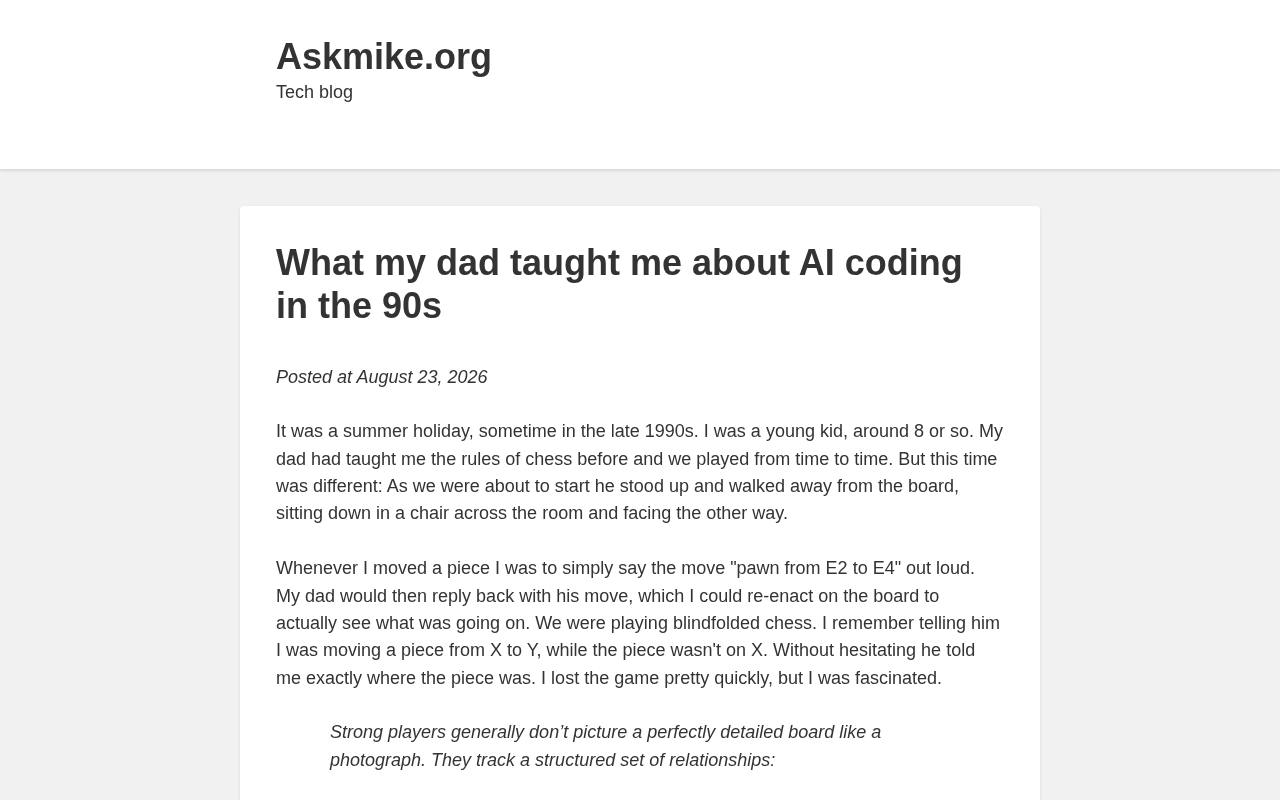
On Hacker News, an article titled What my dad taught me about AI coding in the 90s sparked a lively discussion in the tech community. The article offers a unique perspective: the author reflects on their father's experience using automated programming tools in the 1990s to examine today's red-hot wave of AI-assisted coding.
This "learning from history" approach is worth pondering. When we treat AI coding assistants like GitHub Copilot, Cursor, and Claude Code as unprecedented revolutions, history reminds us that the dream of having machines write code for humans began decades ago. In fact, from the birth of the first compiler in the 1950s (Grace Hopper's A-0 system, which translated mathematical notation into machine code and was considered "automatic programming" at the time), the narrative of "letting machines write code for us" has never truly stopped with each new generation of tools.
Automated Programming in the 90s: The Rise and Fall of CASE Tools
The Automated Programming Experiments of That Era
In the 1990s, the software engineering field experienced a wave of enthusiasm for CASE (Computer-Aided Software Engineering) tools. These tools promised to free developers from tedious manual coding through graphical modeling, code generators, and fourth-generation languages (4GL).
CASE tools reached their peak between the late 1980s and early 1990s, with flagship products including IBM's Rational Rose, Oracle's Designer/2000, and Texas Instruments' IEF (Information Engineering Facility). These tools were typically based on structured analysis and design methodologies (such as the Yourdon method and Information Engineering methodology), allowing developers to describe systems by drawing Entity-Relationship diagrams (ER diagrams), Data Flow Diagrams (DFD), and state transition diagrams, then automatically generating COBOL, C, or SQL code. Fourth-generation languages (4GL) like PowerBuilder, Progress, and Informix-4GL attempted to replace traditional third-generation programming languages with higher-level abstractions closer to natural language. Gartner predicted in the early 1990s that CASE tools would fundamentally transform the software development industry, but by the end of the decade, most enterprises had abandoned their plans for wholesale CASE tool adoption.
The vision back then was strikingly similar to today's AI coding assistants: just describe your requirements clearly or draw your data model, and the tool would automatically generate vast amounts of boilerplate code. Companies rushed to purchase these expensive tool suites, expecting software development productivity to multiply several times over.
The Gap Between Vision and Reality
History proved, however, that CASE tools never truly replaced programmers. Auto-generated code was often verbose, rigid, and hard to maintain; the moment business logic changed even slightly, the generated portions became technical debt. The concept of Technical Debt was first coined by Ward Cunningham in 1992, using a financial metaphor to describe the phenomenon of sacrificing long-term code quality for short-term speed in software development—just as financial debt accrues interest, technical debt causes maintenance and modification costs to continuously escalate. Code generated by CASE tools was a textbook source of this kind of debt: developers often couldn't fully understand the internal logic of auto-generated code, and any modification attempt led to a dead end. Many experienced veteran programmers gradually came to realize: tools can accelerate output, but they cannot replace understanding of the problem itself.
The core lesson that the author's father's generation of engineers distilled was this: tools are always a means to an end; an engineer's judgment is what truly matters. This insight aligns remarkably with a famous theoretical argument in software engineering. In 1986, Fred Brooks proposed in his classic paper No Silver Bullet—Essence and Accident in Software Engineering that the difficulties of software development fall into two categories: essential complexity and accidental complexity. Advances in tools and methodologies can eliminate accidental complexity—better IDEs, type systems, automated testing—but essential complexity arises from the abstraction, conformity requirements, changeability, and invisibility inherent in the problem domain itself, and cannot be eliminated by any single technological breakthrough. Brooks predicted that no "silver bullet" capable of a tenfold productivity increase would appear within a decade. From CASE tools and object-oriented programming to agile methodologies and today's AI coding, every wave of technology has been burdened with "silver bullet" expectations, yet Brooks' core argument still holds.
How History Is Repeating Itself
The Similar Logic of AI Coding Assistants
Today's AI coding assistants are far more powerful than the CASE tools of the past from a technical standpoint—they're built on large language models, can understand natural language, generate context-aware code, and even perform debugging. But from a product narrative perspective, the promises are virtually identical:
- Lowering the coding barrier: Enabling people who aren't proficient in syntax to produce working programs
- Boosting development speed: Freeing developers from repetitive labor
- Reducing reliance on human labor: Companies hoping to accomplish more with fewer people
This similarity spanning three decades reminds us that we should neither over-mythologize nor casually dismiss AI coding.
Key Differences Between AI Coding and CASE Tools
Of course, there are fundamental differences between AI coding and 1990s CASE tools. Today's large language models no longer rely on fixed code templates; instead, they learn patterns from massive amounts of real code, possessing far greater generalization and interactive capabilities.
From a technical standpoint, the mainstream AI coding assistants of today are powered by large language models (LLMs) built on the Transformer architecture. GitHub Copilot was originally based on OpenAI's Codex model (a code-fine-tuned version of GPT-3), trained on billions of lines of open-source code; Cursor deeply integrates multiple models including Claude and GPT-4, providing codebase-level contextual understanding; Claude Code is Anthropic's command-line coding agent, capable of autonomously reading files, executing commands, and performing multi-step reasoning. The core technical breakthrough behind these tools lies in: understanding long-range dependencies in code through the self-attention mechanism, leveraging patterns learned from massive code corpora for next-token prediction, and improving code generation quality and safety through RLHF (Reinforcement Learning from Human Feedback) and instruction fine-tuning. Fundamentally different from CASE tools' template-based and rule-engine-driven code generation, LLMs are probabilistic and generative—which is both an advantage and a risk.
Developers can engage in natural language conversations, iterate repeatedly, and have the AI explain every line of code it generates. But the same risks persist: AI-generated code isn't necessarily correct, doesn't necessarily follow best practices, and certainly doesn't always fit a specific project's architectural design. The probabilistic generation nature of LLMs means they can produce "hallucinations"—generating code that looks plausible but is actually wrong, such as calling nonexistent APIs, using incorrect parameter types, or introducing subtle logic flaws. When developers blindly trust AI output and abandon independent thinking, history's lessons may well repeat themselves.
The Programming Wisdom Left Behind by the Previous Generation
Understanding Before Output
The most valuable aspect of this article is that it shifts the discussion from the tired topic of "can AI replace programmers" back to a more fundamental engineering philosophy. The author's father's generation understood deeply: no matter how advanced the tools, if you don't understand what you're doing, you cannot judge whether the tool's output is reliable.
For today's developers using AI coding assistants, this means three core competencies remain essential:
- Code review ability: Being able to identify errors, security vulnerabilities, and performance issues in AI-generated code
- Architectural judgment: Knowing whether generated code aligns with the project's overall design philosophy
- Debugging and maintenance ability: Being able to independently locate and resolve issues when auto-generated code breaks
Tools Are Leverage, Not Substitutes
A more fitting analogy: AI coding tools are like giving engineers a lever that can move greater output, but the fulcrum is still the engineer's own capability. Without that fulcrum, the lever is meaningless.
This also explains a common phenomenon: senior developers tend to reap greater benefits from AI coding tools. They have enough experience to guide, verify, and correct AI output, while beginners are more likely to be misled by seemingly correct code, accumulating hard-to-detect technical debt. In the AI coding era, this technical debt has taken on a new form—some call it "AI Debt": developers accept large volumes of AI-generated code without fully understanding its logic, filling codebases with "black-box code" that team members can neither explain nor modify. This debt is particularly dangerous because it involves not just code quality issues, but knowledge gaps—when the time comes to modify this code, no one may truly understand how it works. This is far more damaging than traditional technical debt, because repaying it requires not only refactoring the code but also rebuilding understanding of the system.
Practical Takeaways for Today's Developers
From 1990s CASE tools to today's AI coding assistants, technology continues to evolve, but the underlying principles of software engineering remain unchanged. Through the lens of two generations of engineers—father and son—this article offers us a rare sense of historical depth.
For developers who are embracing AI coding, these points are worth keeping in mind:
First, treat AI as a collaborator, not a decision-maker. Let it help you draft initial versions and provide ideas, but keep the final technical judgment in your own hands. This is similar to the Navigator-Driver model in Pair Programming: AI is the fast-typing driver, but you must be the navigator who controls the direction.
Second, continuously invest in foundational technical skills. Data structures, algorithms, and system design—these "fundamentals" won't depreciate because of AI; in fact, they become even more important as you need to review and verify AI output. Being able to judge whether an AI-generated sorting algorithm suits the current data scale, or recognizing whether an AI-recommended architectural pattern will collapse under high concurrency—this judgment comes from solid foundational knowledge, not from the tools themselves.
Third, maintain humility about technology cycles. Every generation believes the technological change they're experiencing is unprecedented, but many so-called "revolutions" are essentially new forms of old problems. From assembly to high-level languages, from hand-written SQL to ORM frameworks, from CASE tools to AI coding—each rise in abstraction level has brought a leap in productivity, accompanied by predictions that "programmers will become obsolete"—and each time, understanding of underlying principles has proven irreplaceable.
As the author's father realized during the CASE tool frenzy of the 1990s: tools will be replaced, hype will fade, but only a deep understanding of the essence of problems remains an engineer's most enduring competitive advantage.
Related articles

Chain of Thought Isn't Just for AI: How Humans Can Use CoT to Improve Thinking Quality
Chain of Thought isn't just a prompt trick for large models. Starting from a Hacker News discussion, this article analyzes why CoT works for human thinking too, breaks down actionable ways to transfer it, and highlights the key differences between human CoT and machine CoT.
Cloudflare Teams Up with OpenAI: Closi…
Cloudflare Teams Up with OpenAI: Closing the Loop from Vulnerability Discovery to Defense with AI
Cloudflare uses OpenAI Daybreak to investigate security vulnerabilities and generate reviewable remediation plans, while developers use Codex to boost coding efficiency and quality.

Orca Multi-Agent Orchestration in Practice: A Guide to Parallel Collaboration with Claude and Codex
Orca is Stable AI's free open-source agent workbench supporting 34 agents like Claude Code and Codex in parallel. Learn its Git worktree isolation, multi-model orchestration, and mobile management.