From AI Power User to AI Leader: A Guide to Building an Enterprise AI Champion System

Enterprise AI champion networks are the highest-ROI AI transformation initiative. This article breaks down role positioning, the four-stage buildout, and the core capability chain.
Based on Nufar's practical experience at dozens of companies, the article systematically explains the AI champion system. Champions are defined as the team's "peer plus one," with roles ranging from ambassador to internal FDE. Building a champion network involves four stages: clarifying goals, nominating the right people, training and certification, and continuous operations. The "day after" certification is the biggest predictor of success, requiring dual HR and AI sponsorship. Champions also need a complete capability chain from use case identification and technical selection to deployment and evaluation, with simplest solutions first.
From AI Power User to AI Leader: A Guide to Building an Enterprise AI Champion System
Every organization has a group of people like this: they are the first to try new models and new products, and they proactively share what works and what is worth following up on. In many companies, this role has already been formalized into an "AI champion" or "AI ambassador" program. According to Nufar's sharing on the AI Daily Brief podcast, among all the enterprise AI transformation practices she has encountered, building an internal champion network is one of the highest-ROI initiatives—"it never fails."
But there is a real dilemma: a team member discovers an excellent AI use case, shows it to two or three people, and then it often stops there, unable to spread into a practice for the entire team. Based on Nufar's frontline experience at dozens of companies, this article systematically breaks down the role definition of AI champions, the methodology for building the network, and the core capability requirements.
What Is an AI Champion: A Spectrum of Three Roles
Nufar defines an AI champion as: the person in the team responsible for driving AI adoption and value realization. She uses "peer plus one" to describe this role—they do the team's core work, but are one step ahead on AI, and are the most enthusiastic and capable AI users in the team.
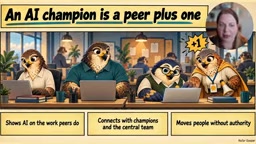
This role varies greatly across companies and roughly falls along a spectrum:
At one end is the "Ambassador." They are the best AI users in the team. Their main responsibility is to drive adoption, demonstrate use cases, train colleagues, and accurately communicate what tools and internal builds the team needs. Their working style is "show what I can do," focusing on real scenarios in colleagues' daily work rather than theory.
At the other end is the "internal FDE" (Forward Deployed Engineer). Nufar defines this as "a professional builder who sits inside the business team" and can take an idea all the way to production launch, covering planning, building, and value realization across the entire workflow. Many of them come from software and AI backgrounds, but a large number of subject matter experts also make a career transition and, with today's powerful tools, build solutions for their own teams.
In the middle is the "ambassador-builder." This is where most companies actually land—they build for themselves and their immediate team, with clear capability boundaries. When they go beyond those boundaries, they play the role of product manager, gathering requirements and handing them off to vendors or internal teams.
FDE (Forward Deployed Engineer) was first popularized by data platform companies such as Palantir. It refers to engineers who are embedded inside customer or business teams, directly face real business problems, and are responsible for end-to-end delivery. Unlike traditional back-office R&D, FDEs do not rely on a complete product requirements document. Instead, they go deep into the business frontline and take full responsibility from problem discovery and solution design to launch and operations, combining engineering capability with business understanding. In the enterprise AI context, "internal FDE" means this person does not just demo AI tools, but can truly turn business pain points into runnable solutions and be accountable for the final value. This is also why Nufar emphasizes that internal FDEs need to cover the entire workflow of planning, building, and value realization—their core value is not technical depth, but shortening the distance from business problem to usable solution.
The Enterprise Side: Four Stages of Building a Champion Network
When companies consider an AI champion program, they often face four core questions at the same time: Who has build permissions? What are the expectations for ordinary users and champions respectively? How does AI spread from the frontline upward? How do champions collaborate with the central team and vendors?
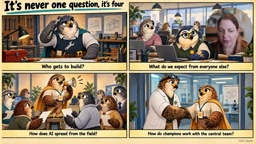
Stage One: Clarify Goals and Positioning
Nufar suggests first answering: What exactly is the champion network supposed to achieve? Many companies get stuck on this question. Next, determine where champions sit on the spectrum—are they purely ambassadors, or full-stack builders?
She gives an example: after repeated reflection, one company realized that what it truly needed was for champions to become a "funnel," bringing frontline use cases to a central team that was "blind" to daily realities. This is a completely different role positioning, training plan, and expectation management from cultivating full-stack builders.
Stage Two: Nominate the Right People
A good champion needs three core signals: they use AI without being asked, colleagues already proactively come to them for advice, and managers are willing to give them time to do AI work for others. The third condition is often where nominations fail most frequently.
In addition, they need: the ability to influence others without authority, a deep understanding of the business, initiative, and curiosity. Nufar specifically reminds us: the champion role itself is a huge career benefit that will make this person highly attractive in the market, so nominate people who truly deserve it.
She lists four common nomination mistakes: executives self-nominating (executives should join the AI council rather than serve as champions), nominating the busiest person (no bandwidth), treating the champion role as a reward (insufficient AI capability), and nominating someone who just joined (does not understand the business).
AI Council is a common cross-functional decision-making body in enterprise AI governance, usually composed of the Chief AI Officer, CTO, compliance lead, business line representatives, and others. It is responsible for setting AI strategic priorities, approving high-risk use cases, allocating budgets and resources, and coordinating AI collaboration across departments. It forms a complementary relationship with the champion network: champions discover and drive use cases from the bottom up, while the AI council sets direction, boundaries, and resource support from the top down. The reason Nufar suggests executives join the AI council rather than serve as champions is that the core value of executives lies in decision-making, resource allocation, and organizational coordination, not in personally building or demoing AI solutions. Making executives champions wastes their decision-making leverage and may also lead to incomplete role fulfillment due to fragmented time, which instead weakens the credibility of the entire network.
Stage Three: Training and Certification
The core principle of training is "train with their own work." Nufar's favorite test is simple: at the end of training, each champion takes a real team use case and shows how they built or drove it. If they can do it, they are ready; if not, they still need polishing.
Training usually ends with a kickoff or certification ceremony, and everyone is full of enthusiasm. But the real test comes on the "day after" certification.
Stage Four: Continuous Operations After Certification
Nufar points out that the biggest predictor of the success or failure of a champion program is what happens on the day after certification. A successful network needs two types of sponsors: one from HR or the people team, responsible for community operations and the people side; the other understands AI, works closely with the Chief AI Officer, sets priorities, and connects all the internal teams that champions depend on.

Among the most successful cases she has seen, one company formed a "dynamic duo" of an L&D expert and an AI expert to continuously stay on top of champions' status, needs, and industry developments. In every company where "the course was great but never translated into business value," the missing link was continuity—no one was responsible for ensuring champions were effectively used and kept learning.
One easily overlooked action is: have a brief conversation with the champion's manager to explain what the champion knows, what they are expected to do, and how to use them effectively. The dilemma of many excellent champions comes precisely from managers having unrealistic expectations or not knowing how to use them.
Finally, the network must be alive—allowing people to enter and leave, ensuring a smooth handoff to other team members when someone leaves, and making it clear how new people can join.
The Champion Side: The Complete Capability from Idea to Production
Even if you are not an official champion, but simply the best AI user in the team, these capabilities still apply. Nufar believes champions need to understand the complete journey of an AI use case from idea to production, divided into three parts: before building (identifying problems worth solving in the domain and understanding the company's allowed boundaries), during building (from POC to production), and after building (deployment, value realization, and retirement).
Use Case Identification: First Ask "Should We Do This?"
Nufar observes a common phenomenon: many people do not ask "should we do this?" at all before building—they just start building. What needs to be checked is: how often does this problem occur? How much value does it create? How high is the cost of making a mistake?

She gives a concrete example: suppose a team spends several hours per week compiling customer renewal summaries. An ambassador-type champion would identify this use case, clearly describe the current cost, explain why it can be solved, and then bring a clean request to the central team or vendor. Once the solution is ready, they ensure the team actually uses it and realizes value—they appear at the beginning and the end. An ambassador-builder would build a version for their own team within the boundaries the company allows, and then other teams would take over productization. An internal FDE can handle the entire process end to end.
Technical Selection: Simplest Solution First
There is currently a tendency to "make everything into an agent." Nufar's advice is the opposite: start with the simplest solution that solves the problem. Sometimes a shared prompt plus files is enough, sometimes a skill is the most streamlined approach, sometimes it is an automated workflow, and only with sufficient justification is it necessary to build a full agent.
Agent in the AI context usually refers to a system that can autonomously perceive the environment, plan steps, call tools, and execute multi-step tasks to achieve a goal, as distinct from single-turn Q&A or fixed-process automation scripts. Building a complete agent often requires defining tool interfaces, designing planning logic, handling error recovery, and configuring memory and state management, with complexity and maintenance costs far higher than prompts or skills. Skill, by contrast, usually refers to an encapsulated, reusable prompt template or lightweight workflow, suitable for tasks with clear boundaries and fixed steps. Behind Nufar's advice of "simplest solution first" is a pragmatic tradeoff: most business problems do not need the autonomy of an agent. A shared prompt, a skill, or an automated workflow can solve them, and they are easier for non-technical colleagues to understand and maintain. Introducing an agent too early not only increases the build burden, but also amplifies security and guardrail risks.
Defining Core Attributes Before Building
Before starting to build, champions need to write down core attributes similar to a requirements document: who it is for ("everyone" is not a good answer—designing for everyone means designing for no one), how people will use it (make sure it is actually used, rather than a "cool vibe coding app" whose URL no one remembers), what it absolutely must not do (specific and detailed guardrails), who checks the output (where the human-in-the-loop judgment points are), and how to know it works (configure test cases early).
Nufar specifically points out that starting from "what it absolutely must not do" often leads to a clearer definition of "what it should do." The process of configuring evaluation cases itself exposes edge cases and evaluation difficulty, and sometimes can even "kill" a project that cannot guarantee quality before it is built.
Human-in-the-loop is a key principle in AI system design. It refers to retaining nodes for human judgment and intervention in automated workflows, rather than letting the system make decisions completely autonomously. In enterprise scenarios, human-in-the-loop usually appears as: AI generates a draft or suggestion, which is reviewed by a human before external use; or a manual confirmation step is set before high-risk operations. When Nufar emphasizes "who checks the output," she is essentially asking: who bears the cost of error for this AI solution, and at which step is it intercepted. Related to this is the guardrail, namely rules and mechanisms that explicitly restrict what AI cannot do, such as prohibiting access to certain data, prohibiting automatic sending of external emails, or prohibiting financial commitments. Working backward from "what it absolutely must not do" to "what it should do" is a risk-anchored design approach that helps teams identify use cases that cannot guarantee quality or compliance before building, avoiding the discovery of a wrong direction only after investment.
Why This Role Is Becoming More Critical
Both Nufar and host Nathaniel believe that with the spread of agentic coding tools, more and more non-technical people are beginning to use code to solve problems in their work. This releases enormous energy, but also brings new challenges such as security, guardrails, and agents "escaping."
Rather than shutting it down out of concern about non-professional builders, it is better to do enablement and infrastructure well, and even train more subject matter experts—because they will focus on the right use cases. This role is not disappearing; it is becoming more critical than ever.
Nathaniel adds an important point: many playbooks for AI champions are not as fleeting as other AI knowledge. Tools change every quarter, but some things remain constant—you still need the right people to have enough time to do this work, you still need to decide whether they stand as ambassadors or builders and write it down, and you still need someone to own the "day after."
Nufar concludes: "If you are the champion yourself, this is one of the best seats in the company. You see the team's problems, collaborate with the team or build yourself, and you understand the beginning and the end of the build path, while most people only know the middle part."
One-line Summary
An enterprise AI champion network is the highest-ROI AI transformation initiative. This article breaks down its role positioning, four-stage buildout, and core capability chain.
Paragraph Summary
Based on Nufar's practical experience at dozens of companies, this article systematically explains the AI champion system. Champions are defined as the team's "peer plus one," with roles spread along a spectrum from ambassador to internal FDE. Building an enterprise champion network requires four stages: clarifying goals, nominating the right people, training and certification, and continuous operations. The "day after" certification is the biggest predictor of success or failure, requiring sustained investment from both HR and AI sponsors. On the champion side, they need to master the complete capability chain from use case identification, technical selection, and core attribute definition to deployment and evaluation, while adhering to the principle of simplest solution first. With the spread of agentic coding, this role is becoming even more critical.
Related articles

Workbuddy for Absolute Beginners: How a Desktop AI Agent Fits Into Real Workflows
A beginner's guide to the Workbuddy desktop AI agent: installation, claiming credits, file management, and building automated workflows—compared with CodeX for fit and cost, helping professionals shift from AI question-askers to AI managers.

OpenAI's New Agent Stack: Computer Use, Decisions API, and Ultra-Fast Workflows
OpenAI Dev Day unveiled a new agent stack: Computer Use outperforms humans, Decisions API delivers ultra-low-latency classification via Luna, Agents API opens the same Computer Use capabilities, and GPT-6.1 Sol costs only one-seventh of Astra. Core updates, benchmark data, and developer insights.

Liang Wenfeng Open-Sources DeepInfo Inference Framework, Takes On U.S. Ban
DeepSeek open-sources its DeepInfo inference framework after its models, featuring GPU/CPU cross-pipelining, small-model prediction with large-model verification, and full Huawei Ascend and NVIDIA chip support—facing the U.S. federal ban head-on. This article analyzes its significance for AI deployment and open-source strategy.