From "Are You in the Weights" to Amblyopia Treatment: An Overlooked XR Design Pattern
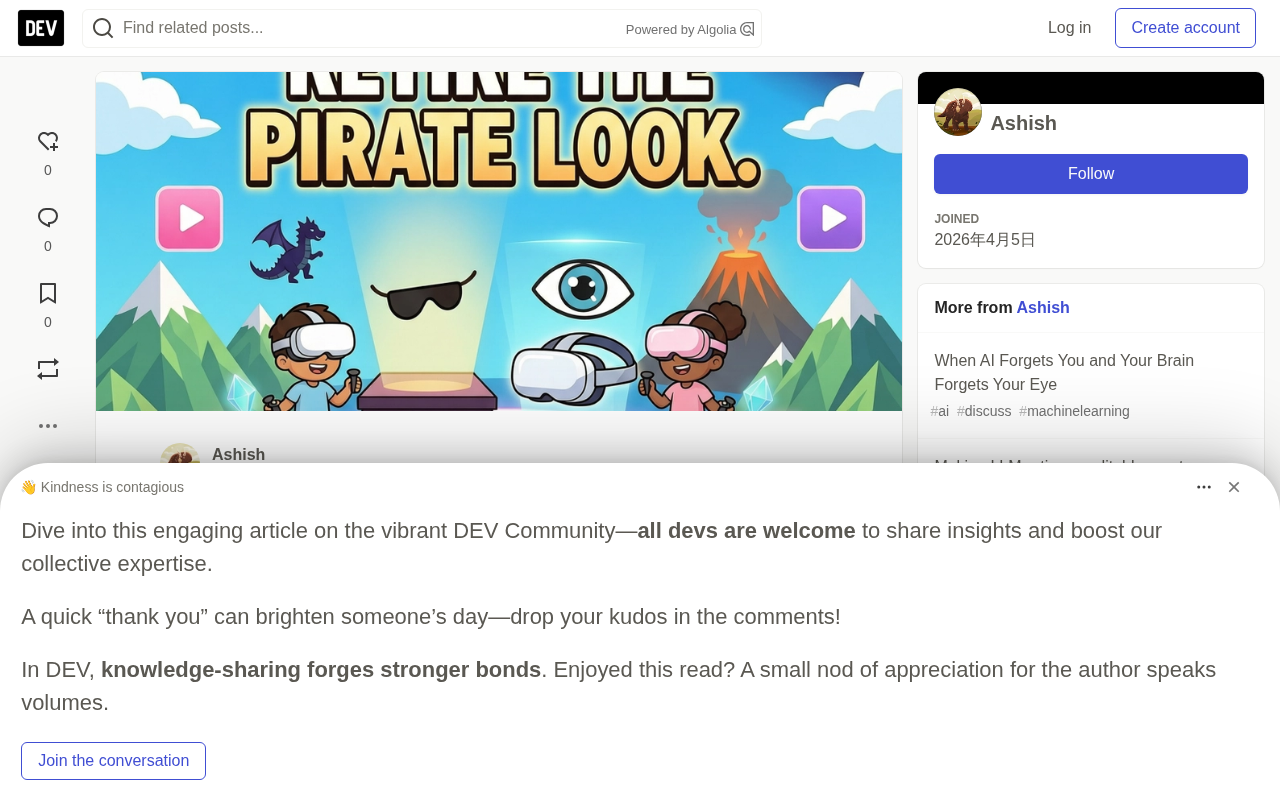
Amblyotube hides amblyopia treatment inside watching videos, sharing the same imperceptible-intervention design philosophy as the LLM detection site.
The article compares Hacker News trending project intheweights.com with the XR healthcare app Amblyotube, noting they share one design philosophy: encapsulating complex technology inside routine user behavior. Amblyopia is neurological; traditional patching has poor adherence, and dichoptic training needs expensive equipment. Amblyotube uses the Quest headset's asynchronous timewarp and per-eye buffers to deliver dichoptic video training on $300 hardware — users just watch videos while neuroplasticity training happens, with data logged automatically. The key insight for XR and health tech developers: hide the intervention in normal behavior, lower the adherence barrier, keep complexity inside the system, and leave only intuitive operations on the user side.
When a Viral LLM Detection Site Meets XR Healthcare
One of the hottest posts on Hacker News today is intheweights.com — a site that checks whether your information has been "memorized" by multiple large language models. It uses a clean parallel query architecture that's worth learning from. But as a developer, I want to point out a project that uses similar technical principles while serving a completely different domain: Amblyotube, an amblyopia treatment app running on Quest headsets.
According to the original HN poster's analysis, what the two share isn't a specific tech stack but rather hiding complex intervention inside routine behavior the user never notices — intheweights buries parallel API calls behind a single click; Amblyotube buries neuroplasticity training inside "watching videos." For developers building XR or health-related technology, this design pattern deserves a careful breakdown.
The Pain Point of Amblyopia Treatment: Traditional Methods Have Terrible Adherence
Amblyopia (lazy eye) is a neurological problem, not a muscular one. The brain actively suppresses the input signal from one eye, stunting visual function development. The classic treatment is patching the dominant eye to force the amblyopic eye to work. This method is effective, but adherence is terrible — especially for children, where the social pressure and discomfort of patching make long-term commitment difficult.
Modern methods have shifted toward dichoptic training: presenting different images to each eye and forcing the brain to integrate information from both channels. In the past this required expensive lab equipment, and patients could only train periodically at a clinic. Amblyotube's idea is to bring this training to consumer hardware — a Quest headset costing around $300.
Dichoptic training is an amblyopia treatment method based on the principles of stereoscopic vision. It presents different images to the left and right eyes (such as video or game elements with different contrast levels) through a headset or special glasses, forcing the brain to process input from both eyes simultaneously and thereby breaking the dominant eye's suppression of the amblyopic eye. Unlike traditional patching therapy, dichoptic training emphasizes both eyes working together rather than simply covering the good eye. Research shows this training can improve visual acuity and stereopsis in the amblyopic eye, and because it's more engaging (often presented as games), patient adherence improves significantly. Its neural mechanism is based on the plasticity of the brain's visual cortex — repeated binocular integration tasks strengthen the neural pathways corresponding to the amblyopic eye.
Technical Breakdown of Amblyotube: Asynchronous Timewarp and Per-Eye Buffers
Amblyotube's core mechanism isn't complicated: it renders two YouTube-style video streams, presented separately to the left and right eyes. The user is just "watching videos," but the visual system is forced to perform binocular integration in the background. The original poster highlighted several technical points:
- Asynchronous timewarp: compensates for latency caused by head movement in VR, ensuring each eye sees a stable and synchronized image — crucial for visual training.
- Per-eye buffers: maintains independent rendering buffers for the left and right eyes, ensuring the dichoptic images don't cross-talk.
- Zero user friction: no cumbersome calibration process, no active training tasks — the user simply puts on the headset and watches content.
Session data is automatically recorded in the background — passive neuroplasticity training, with data writing itself. This "imperceptible intervention" design philosophy is more worth learning from than the specific technical implementation.
Asynchronous Timewarp (ATW) is a key technology in VR headsets for reducing motion-to-photon latency. When head movement causes a rendered frame to miss its deadline, ATW reprojects the already-rendered image based on the latest head pose before display, reducing judder and motion sickness. In Amblyotube's amblyopia training scenario, ATW is especially important: it ensures the images seen by the left and right eyes are precisely synchronized in time, avoiding asynchronous binocular input caused by latency differences that would break the visual integration conditions required for dichoptic training. In addition, ATW compensates for unconscious micro-movements of the head while watching videos, maintaining stability of the training image — critical for the effectiveness of neuroplasticity training.
Per-eye buffers refer to maintaining separate framebuffers for the left and right eyes in the graphics rendering pipeline. In dichoptic training, the left and right eyes need to receive different image content (such as different contrast levels or different video streams), and per-eye buffers ensure the rendering data of the two channels is completely isolated, preventing crosstalk — where one eye's image leaks into the other. This isolation is particularly critical for amblyopia treatment, because any crosstalk would weaken the effect of dichoptic training and could even cause the brain to continue relying on the dominant eye. On mobile VR devices like the Quest, per-eye buffers are typically combined with single-pass stereo rendering to optimize performance, but Amblyotube may use multi-pass rendering to guarantee strict independence of the dichoptic images.
Implications for XR and Health Tech Developers: Hide the Intervention in Normal Behavior
The original poster's core point is: Obscure the intervention inside normal behavior. For XR developers, this means don't design a fragmented experience with a "training mode" and a "daily mode" — instead, make the therapeutic behavior itself something the user willingly wants to do: watch videos, play games, socialize.
For health tech products, the same pattern holds: the key to lowering the adherence barrier isn't reminders and incentives — it's making the intervention invisible. Amblyotube doesn't ask users to "train for 20 minutes a day"; it simply has them "watch videos," and the training happens at the level of the visual system. This design approach is strikingly similar to how intheweights.com wraps parallel LLM queries in a minimalist interaction — complexity stays inside the system, and only intuitive operations remain on the user side.
If you're building an XR app or health-related product, ask yourself: can my intervention be hidden inside something the user would do anyway? Amblyotube offers an answer worth studying.
One-line Summary
Amblyotube hides amblyopia treatment inside watching videos, sharing the same imperceptible-intervention design philosophy as the LLM detection site.
Paragraph Summary
The article compares the Hacker News trending project intheweights.com with the XR healthcare app Amblyotube, pointing out that both share the same design philosophy: encapsulating complex technology inside routine behavior the user never notices. Amblyopia is a neurological problem, and traditional patching therapy has poor adherence, while dichoptic training requires expensive equipment. Amblyotube uses the Quest headset's asynchronous timewarp and per-eye buffers to deliver dichoptic video training on $300 hardware — users simply watch videos to complete neuroplasticity training, with data automatically recorded in the background. The article distills the core takeaway for XR and health tech developers: hide the intervention in normal behavior, lower the adherence barrier, keep complexity inside the system, and leave only intuitive operations on the user side.
Related articles

Claude Reportedly Able to Hide Secret Messages in Benign Images
A Reddit post claims Claude Fable 5.1 can hide secret messages in benign images. This article reviews the background, image steganography principles, and potential security risks, and suggests a testing path from rumor to verification.

Federal Government Awards $85 Million; CFS to Develop Fusion-Specific Semiconductors
The federal government awards $85 million to Commonwealth Fusion Systems to develop conductors and power semiconductors for fusion plants. This article analyzes the significance of this funding for the fusion supply chain and commercialization path.

When Should AI Assistants Proactively Suggest? Timing Is Everything
When should AI assistants proactively suggest? Reddit discussion reveals: the same suggestion feels different at different times. This article analyzes the dual nature of proactive suggestions, the boundary of user expectations, and design principles, exploring how to balance automation and user control.