From Coding Harness to Org Harness: The Evolution of AI Agent Toolchains

A tweet maps the three-tier evolution of AI coding tools: Coding Harness, Personal Harness, and Org Harness.
A brief tweet introduced a three-tier evolutionary framework for AI Agent toolchains: Coding Harness, Personal Harness, and Org Harness. The Harness — the supporting scaffold wrapped around a model that enables file access and tool calls — is the key layer determining AI coding quality. Coding Harness handles single-task execution; Personal Harness crystallizes individual workflows into persistent context; Org Harness tackles team collaboration, access governance, and knowledge sharing. Most tools today remain at the Coding layer, and Org Harness is still a wide-open frontier without even an agreed-upon name.
A Tweet That Sparked an Industry Question
A brief tweet recently made the rounds among AI practitioners and sparked a wave of discussion. The original post said simply:
coding harness -> personal harness -> org harness(company harness? enterprise harness? still figuring out right name, open to suggestions)
What looks like a casual remark actually sketches a clear evolutionary path for AI Agent toolchains. The author even admitted they hadn't settled on a name for the organizational tier, inviting the community to weigh in. Despite its brevity, the post touches on a concept that is rapidly taking shape in AI engineering practice — the Harness (a supporting scaffold that wraps around a model).
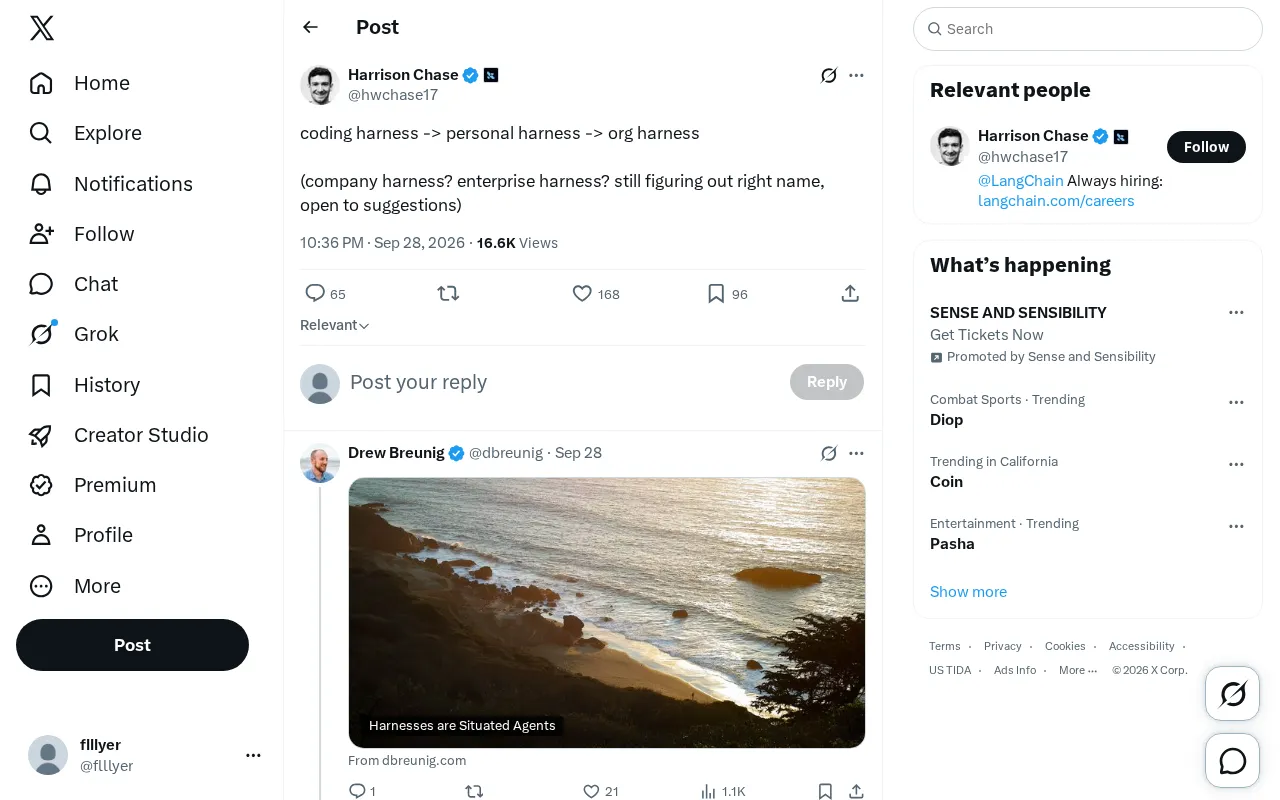
It's worth noting that the tweet itself carries limited information. What follows is largely an extended interpretation of this evolutionary trajectory, grounded in current practices across the AI Agent and coding-tool landscape.
What Is a Coding Harness
In the context of AI-assisted programming, a Harness refers to the entire supporting structure wrapped around a large language model. The model itself only generates tokens; what actually enables it to read files, run tests, call tools, and iteratively revise code is this surrounding "skeleton."
The Coding Harness is the starting point of this chain. It focuses on reliable execution of individual coding tasks. Typical components include injecting code context into the model, managing file read/write permissions, executing shell commands and feeding results back, and handling error retries. Tools like Cursor, Claude Code, and Aider derive much of their competitive edge from the quality of their Harness design — given the same underlying model, the Harness is what determines how wide the gap between a great and a mediocre coding experience actually is.
Put another way: model capability sets the ceiling, but the Harness determines how close you get to it.
The word "harness" has its roots in engineering and testing — a "Test Harness" refers to scaffold code used to drive a system under test and collect results, enabling core logic to run repeatably in a controlled environment. AI coding tools borrow the term with the same intent: the model operates inside an outer structure that governs what inputs it perceives, what actions it can trigger, and how it recovers from failures. This differs from the traditional notions of a "Framework" or "Scaffold": a Framework typically constrains how developers write code, whereas a Harness emphasizes wrapping and taming the execution subject (the model), with an explicit focus on active control and boundary enforcement. Understanding this etymology helps clarify why Harness design centers on context injection, tool-call boundaries, and error-recovery loops — not on the model's own parameters.
A Three-Level Leap: From Individual to Organization
The evolutionary path outlined in the tweet deserves to be unpacked layer by layer.
Personal Harness: Crystallizing Individual Workflows
When a Coding Harness moves beyond single tasks and begins carrying a developer's long-term preferences, habits, and context, it evolves into a Personal Harness. This layer encompasses personal code-style conventions, preferred toolsets, memory of past projects, and private configurations. The goal is for AI to genuinely "know you" — not start from scratch every session.
The concept of a Personal Harness overlaps heavily with Personal Knowledge Management (PKM) reimagined for the AI era. Traditional PKM tools like Obsidian or Notion store static notes; a Personal Harness stores structured context that a model can directly consume — things like personal code-style rule files (e.g.,
.cursorrules), reusable prompt templates, and snippets of successful solutions from past tasks. These aren't just "memories" — they're constraints on model behavior. Some tools are already exploring this direction: Cursor's Rules for AI and Claude's Projects memory feature are both, in essence, building a persistent, user-level context layer. The thicker a Personal Harness becomes, the higher the switching cost for the user — which is precisely one of the core competitive motivations for tool vendors operating at this layer.
Org Harness: A Shared Layer for Team Knowledge
One level higher is the organizational Harness. The problem it must solve shifts from "individual productivity" to "collaboration and governance": shared coding standards across a team, knowledge of internal codebases, permission and security boundaries, and consistency across multiple contributors. This layer is far more complex than the two below it, because it involves access management, knowledge preservation, and compliance constraints.
The author's hesitation over naming the organizational tier (company harness vs. enterprise harness) is itself telling — concepts are outrunning nomenclature, which is a reliable sign that a space is still forming.
The technical challenges facing an Org Harness closely parallel those of building an Enterprise Knowledge Base and an Internal Developer Platform (IDP). On one hand, it must structure the implicit team knowledge scattered across codebases, documentation, Confluence, and Slack history into model-retrievable context — a task requiring ongoing maintenance of a RAG (Retrieval-Augmented Generation) pipeline. On the other hand, it must handle permission isolation: developers in different roles should only be able to expose to the model the code and data they are authorized to access. Regulated industries (finance, healthcare) add yet another requirement — audit logs for every model tool call. These demands make an Org Harness naturally dependent on integration with existing enterprise IAM (Identity and Access Management) and SIEM (Security Information and Event Management) systems, making the complexity far exceed the individual layers. This also explains why mature Org Harness products are nearly nonexistent today — building one requires not just AI capability, but deep enterprise software engineering expertise.
Why This Evolutionary Chain Matters
The progression from individual to organization fundamentally mirrors the universal growth trajectory of software tooling: first solve a point problem, then crystallize personal experience, then elevate it into organizational capability.
AI coding tools are at a critical inflection point — transitioning from "personal toys" to "enterprise infrastructure." Most tools today remain at the Coding Harness stage or even the more basic autocomplete level. Those that do Personal Harness well are already a minority, and a genuine Org Harness remains largely uncharted territory. Whoever manages to elevate AI capability from a personal productivity tool into an organization-scale platform first may well define the standard for the next generation of developer tooling.
Naming matters because naming often signals the birth of a category. When an industry is still debating what to call something, that's precisely the sign that it's moving from fuzzy to defined.
Closing Thoughts
For all its brevity, this tweet precisely captures the layered logic of AI Agent toolchains: Coding Harness handles the task, Personal Harness carries the individual, Org Harness serves the organization. For developers and teams tracking the AI coding space, understanding this evolutionary framework helps assess where existing tools stand today — and where they're headed next. As for whether the organizational layer ends up being called a company harness or enterprise harness, the market will likely settle on an answer sooner than we expect.
Related articles

Chain of Thought Isn't Just for AI: How Humans Can Use CoT to Improve Thinking Quality
Chain of Thought isn't just a prompt trick for large models. Starting from a Hacker News discussion, this article analyzes why CoT works for human thinking too, breaks down actionable ways to transfer it, and highlights the key differences between human CoT and machine CoT.
Cloudflare Teams Up with OpenAI: Closi…
Cloudflare Teams Up with OpenAI: Closing the Loop from Vulnerability Discovery to Defense with AI
Cloudflare uses OpenAI Daybreak to investigate security vulnerabilities and generate reviewable remediation plans, while developers use Codex to boost coding efficiency and quality.

Orca Multi-Agent Orchestration in Practice: A Guide to Parallel Collaboration with Claude and Codex
Orca is Stable AI's free open-source agent workbench supporting 34 agents like Claude Code and Codex in parallel. Learn its Git worktree isolation, multi-model orchestration, and mobile management.