From Demo to Deployment: The Real Challenges of Enterprise AI Adoption

Three AI companies explore what it truly takes to bridge the gap between a compelling demo and enterprise-scale deployment.
This article examines a discussion at TechCrunch Disrupt 2026 featuring Anthropic, Clay, and Gamma, exploring the core challenges of moving AI products from impressive demos to real enterprise deployment. Representing foundation models, productivity tools, and data automation respectively, the three companies offer complementary perspectives on why production environments — with dirty data, complex permissions, compliance demands, and employee habits — are far harder than any demo suggests. Key success factors include prioritizing reliability over peak capability, deep system integration, quantifiable business ROI, and the often-overlooked discipline of organizational change management.
The "Last Mile" Problem in AI Products
At product launches and demo reels, AI tools often appear nothing short of remarkable. But when enterprises actually integrate these tools into daily workflows, reality tends to be far messier than any demo suggests. At the AI Stage of TechCrunch Disrupt 2026, Anthropic, Clay, and Gamma will come together to tackle a central question: what does it actually take for an AI product to move beyond the demo and achieve scaled enterprise deployment?
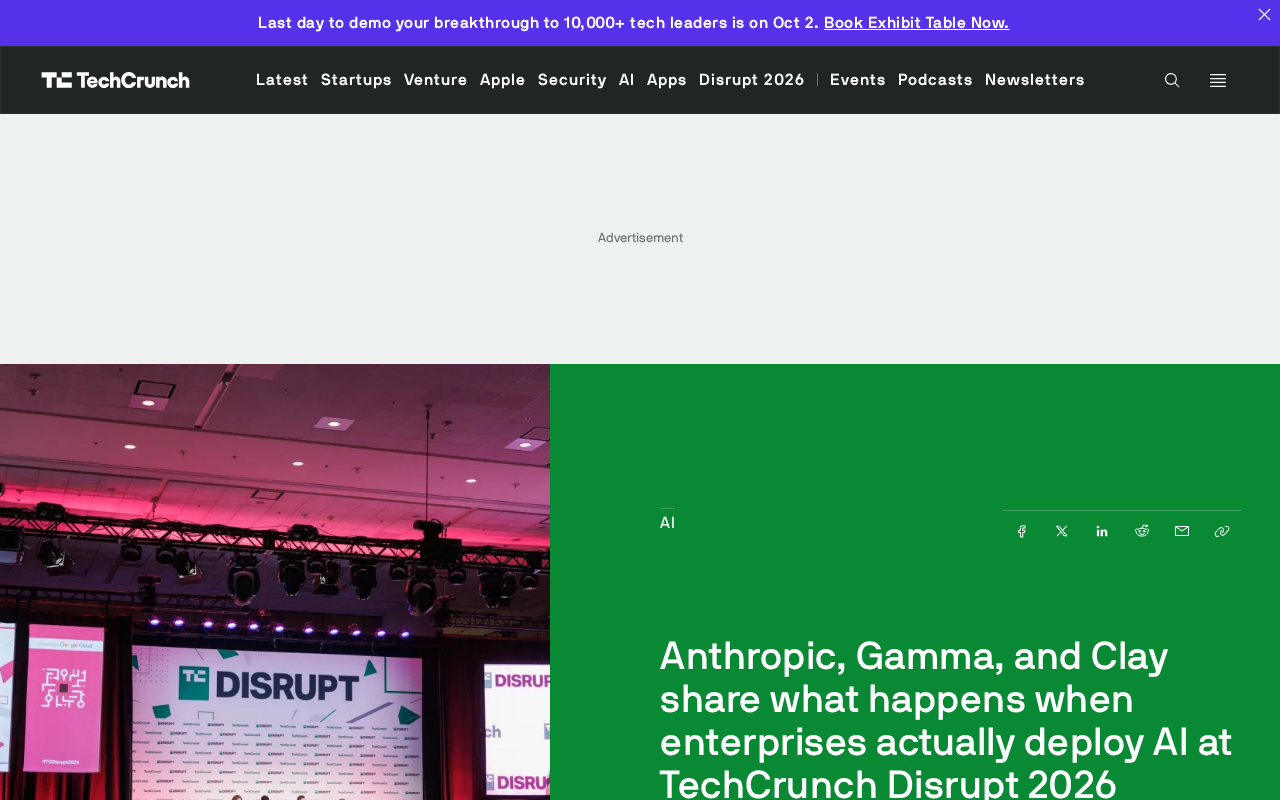
This question matters because a massive gap exists between "looks great in a demo" and "actually works in production." Demo environments are carefully staged ideal scenarios, while real enterprise environments are filled with dirty data, complex permission hierarchies, compliance requirements, and the inertia of established employee habits.
Three Companies, Three Perspectives
The three companies joining the discussion represent distinct positions along the AI deployment chain, offering genuinely complementary viewpoints.
Anthropic: Model Capability and Reliability
As the developer of the Claude model family, Anthropic operates at the foundational model layer. Enterprise deployments tend to care less about a model's peak performance and more about its consistency, controllability, and safety boundaries in real-world tasks. Whether a model can produce reliable outputs when faced with ambiguous instructions — and whether it meets enterprises' strict requirements around data privacy and compliance — are often the deciding factors in purchasing decisions.
Gamma: Real Penetration for Productivity Tools
Gamma focuses on AI-powered content and presentation generation. For end-user productivity tools like this, the central challenge is seamless integration into existing workflows. Even a highly capable tool will struggle to achieve broad organizational adoption if it fails to reduce the learning curve and switching costs for employees.
Clay: Delivering Automation Through Data
Clay specializes in data automation for sales and growth teams. Its deployment experience highlights another dimension: AI's value often hinges on whether it can connect to a company's existing data sources and systems, and whether it can convert outputs into executable business actions — rather than simply generating a block of text.
Clay's approach is often described in the industry as "Data Orchestration." Rather than building its own data, Clay acts as a middleware layer that connects dozens of external data sources — LinkedIn, Clearbit, Hunter.io, and more — with internal CRMs like Salesforce and HubSpot. It then applies built-in AI logic to clean, enrich, and automate that data, ultimately triggering sales actions such as personalized email outreach. This "pipeline" architecture reveals an important principle: the enterprise AI value chain extends well beyond the model itself. Data quality, the efficiency of data flows, and the depth of integration with downstream systems are often the real bottlenecks determining whether automation can truly take hold.
What It Takes to Go Beyond the Demo
Looking across all three companies' positions, a few common factors emerge as essential for successful enterprise AI deployment:
- Reliability over showmanship: Enterprises prioritize stable, predictable performance over occasional moments of brilliance.
- Deep integration capabilities: Whether a tool can seamlessly connect with existing systems, data pipelines, and permission structures is a direct determinant of its practical value.
- Clear return on investment: Enterprises need to see concrete efficiency gains or cost savings from AI — not vague promises of "future potential."
- Organizational adoption and change management: Beyond the technology itself, driving actual employee usage is equally critical to whether a deployment succeeds or fails.
The value of this discussion lies in shifting the focus from "what AI can do" to "how AI actually gets used inside real enterprises" — a reflection of an industry moving from technological enthusiasm toward pragmatic application.
Of these factors, "Change Management" is the one most consistently underestimated by technical teams. When enterprises introduce new tools, employee resistance rarely stems from the technical learning curve. It comes from an instinctive defense against disruptions to established work habits, and from the underlying anxiety of "will AI replace me?" Successful enterprise AI deployments typically require internal training programs, usage incentive mechanisms, and even a redefinition of job responsibilities in order to translate a technology purchase into genuine organizational productivity gains. This is precisely why many enterprises see persistently low active usage rates long after completing their AI tool procurement.
Conclusion
As AI tools become increasingly widespread, the real question for enterprise decision-makers is no longer "should we adopt AI" — it's "how do we make AI generate measurable business value." The perspectives Anthropic, Clay, and Gamma will share at TechCrunch Disrupt 2026 offer front-line insights across three layers: foundation models, productivity tools, and data automation. For teams currently evaluating or deploying AI, understanding the real challenges that lie beyond the demo may ultimately matter more than chasing the latest features.
Related articles

Workbuddy for Absolute Beginners: How a Desktop AI Agent Fits Into Real Workflows
A beginner's guide to the Workbuddy desktop AI agent: installation, claiming credits, file management, and building automated workflows—compared with CodeX for fit and cost, helping professionals shift from AI question-askers to AI managers.

OpenAI's New Agent Stack: Computer Use, Decisions API, and Ultra-Fast Workflows
OpenAI Dev Day unveiled a new agent stack: Computer Use outperforms humans, Decisions API delivers ultra-low-latency classification via Luna, Agents API opens the same Computer Use capabilities, and GPT-6.1 Sol costs only one-seventh of Astra. Core updates, benchmark data, and developer insights.

Liang Wenfeng Open-Sources DeepInfo Inference Framework, Takes On U.S. Ban
DeepSeek open-sources its DeepInfo inference framework after its models, featuring GPU/CPU cross-pipelining, small-model prediction with large-model verification, and full Huawei Ascend and NVIDIA chip support—facing the U.S. federal ban head-on. This article analyzes its significance for AI deployment and open-source strategy.