From Demo to Deployment: The Real Engineering Gap in AI Agent Development

Building an AI Agent prototype is trivial; deploying it reliably to production is a whole different skill.
A developer's "eight evenings to a live deployment URL" course concept cuts to the heart of AI Agent development's biggest pain point: demos are easy, but running Agents stably in production is the genuinely scarce skill. Between a local prototype and a production system lie a series of underestimated challenges — error handling and graceful degradation, token cost and latency optimization, and the full deployment engineering chain. As demo-builders multiply, engineers with real observability, cost control, failure recovery, and iteration capabilities become increasingly rare and valuable.
Why "Building It" and "Shipping It" Are Two Different Things
The barrier to building an AI Agent is dropping fast. With ready-made LLM APIs, open-source frameworks, and scaffolding tools, a developer can piece together a conversational, tool-calling, genuinely impressive agent prototype in a single afternoon. But the moment you try to deploy that prototype online for real users to use continuously, the difficulty spikes sharply.
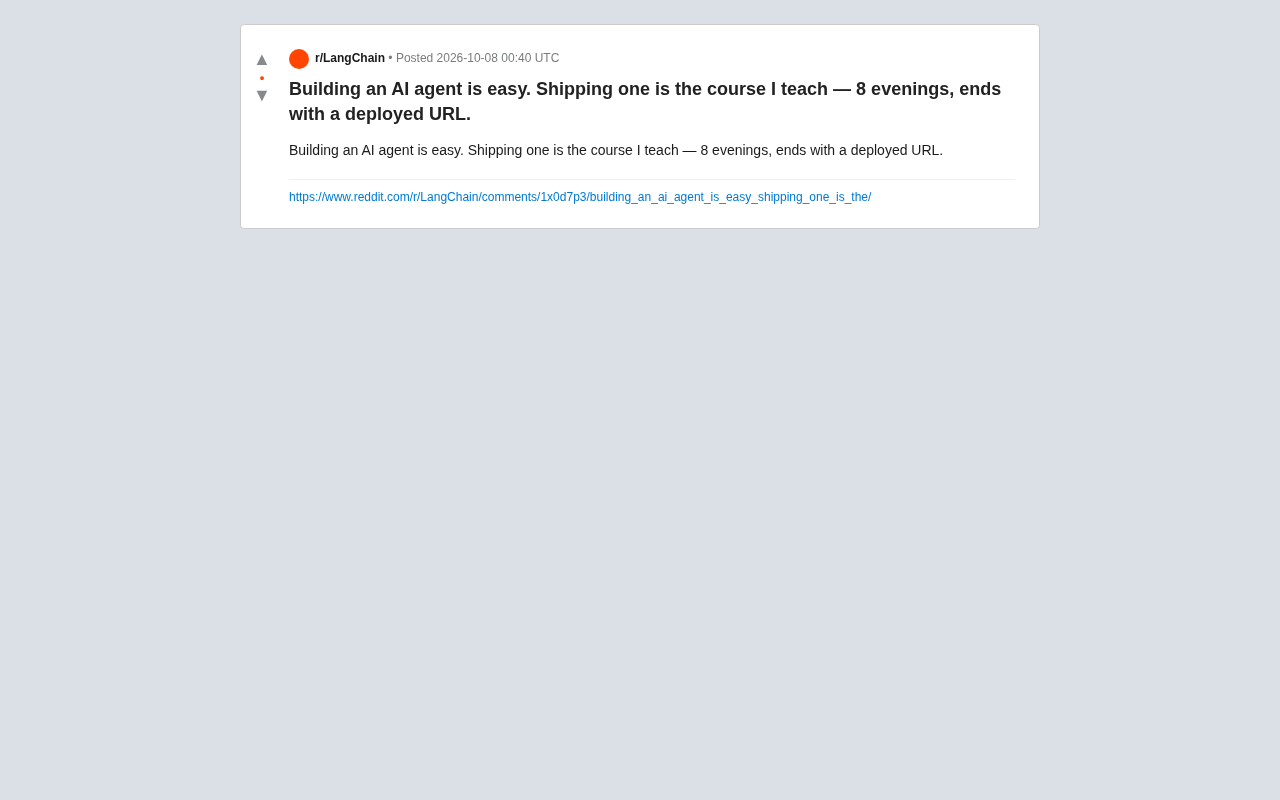
One developer shared an observation in their community: building an AI Agent is easy, but actually shipping it is a skill that requires dedicated training. They distilled that approach into a course — eight evenings, with a live deployment URL as the final deliverable. That design alone highlights a genuine industry pain point: too many Agents remain stuck in the "works on my machine" demo stage and never clear the engineering hurdle to production.
The Gap Between Demo and Production System
Between a locally-running prototype and a production-grade system lies a series of problems that are easy to underestimate. In the prototype phase, developers focus on whether the model gives correct answers. After launch, the challenges are entirely different.
Stability and Error Handling
When an Agent calls external tools, accesses APIs, or executes multi-step reasoning, any single step can fail. The model might return malformed output, a third-party service might time out, or a user might input something completely outside the expected range. These edge cases are typically ignored during the demo phase — but in production, they happen all the time. A production-ready Agent requires robust retry mechanisms, graceful degradation strategies, and comprehensive error fallbacks.
Production-grade Agents typically need structured error-handling patterns. Common approaches include: validating LLM output format (e.g., enforcing a JSON Schema), setting timeouts and exponential backoff retries for external tool calls, and designing "fallback chains" — automatically downgrading to simpler response strategies when the primary model call fails, rather than exposing a 500 error to the user. Observability is especially critical here: through logging, tracing, and alerting, developers can identify exactly where an Agent is failing in production, rather than reverse-engineering the cause from user complaints after the fact. LLM-specific tracing tools like LangSmith and Langfuse exist precisely to fill this gap.
Cost and Latency
Every model call has a real token cost and response latency. As user volume grows, unconstrained multi-turn reasoning and tool calls can rapidly inflate your bill. Engineering for production requires thinking about caching, prompt compression, tiered model routing, and other optimization strategies to balance user experience against cost.
Token cost control is especially complex in multi-turn, multi-tool agentic scenarios. Unlike single-turn Q&A, Agents often need to make multiple model calls within a single user request (ReAct loops, chain-of-thought reasoning, etc.), each carrying a progressively longer context — causing costs to grow non-linearly with conversation depth. Common engineering countermeasures include: semantic caching (reusing existing answers for similar requests), context window compression (summarizing historical messages rather than passing them in full), and routing strategies (using a smaller model to decide whether a larger model call is even necessary). On the latency side, streaming output can dramatically improve perceived performance — even if total generation time stays the same, reducing time-to-first-byte makes a product feel significantly faster.
Deployment and Accessibility
The course uses "delivering a deployment URL" as its endpoint — and that's precisely the point. Letting someone actually access and use your Agent through a browser involves a complete engineering chain: frontend-backend integration, environment configuration, secrets management, and service hosting. These topics are almost never covered in tutorial-style "build an Agent" content, yet they are necessary prerequisites for a product that actually works.
AI Agent deployments also face a challenge that ordinary web applications rarely encounter: long-lived connections and async task management. Since LLM inference latency typically runs in the seconds range, synchronous HTTP requests can easily trigger gateway timeouts. Production deployments often need task queues (like Celery or BullMQ) or WebSocket/SSE to maintain persistent connections, along with secure environment variable management for API keys rather than hardcoding them. Modern hosting platforms like Vercel, Railway, and Fly.io have lowered the operational barrier considerably — but correctly configuring environment variables, handling cold-start latency, and completing inference within the timeout limits of serverless functions are still details that trip up beginners.
What Eight Evenings Can Actually Teach You
Designing a course around eight evenings with a deployment URL as the finish line reflects a clear philosophy: use the smallest possible closed loop to force learners through the entire workflow. Compared to sprawling, multi-dozen-hour comprehensive courses, this short-cycle, outcome-oriented format is much closer to real-world practice.
It's reasonable to infer that such a path would cover: building the core Agent logic, integrating with LLMs and external tools, state management and conversational memory, essential testing and debugging, and finally deploying to production. The point isn't how deep each step goes — it's that learners walk through the complete journey from zero to a live, accessible link, with their own hands.
For developers stuck in the prototype stage, this kind of delivery-oriented training is more valuable than simply learning framework syntax. Because the truly scarce skill isn't "writing an Agent" — it's "keeping it alive in production."
What This Means for AI Developers
This brief observation reflects a widespread reality in AI application development today: entry is trivially easy, production deployment is genuinely hard. As agent tooling proliferates, more and more people can rapidly put together a demo — but those who can turn a demo into a stable, maintainable product with real users remain scarce.
For developers looking to build serious depth in AI, the better investment isn't chasing the latest framework or model — it's building engineering competence: how to implement observability, how to control costs, how to handle failures gracefully, how to deploy and iterate. These "unglamorous" but critical skills are what separates toys from products.
It's worth noting that the original source material is just a brief course promotion — the specific curriculum, technology stack choices, and learning outcomes were not disclosed. The elaborations above on course content are reasonable inferences based on general knowledge. But the core premise it raises — "building is easy, shipping is the real craft" — carries genuine relevance across the entire AI Agent development ecosystem.
Related articles

Chain of Thought Isn't Just for AI: How Humans Can Use CoT to Improve Thinking Quality
Chain of Thought isn't just a prompt trick for large models. Starting from a Hacker News discussion, this article analyzes why CoT works for human thinking too, breaks down actionable ways to transfer it, and highlights the key differences between human CoT and machine CoT.
Cloudflare Teams Up with OpenAI: Closi…
Cloudflare Teams Up with OpenAI: Closing the Loop from Vulnerability Discovery to Defense with AI
Cloudflare uses OpenAI Daybreak to investigate security vulnerabilities and generate reviewable remediation plans, while developers use Codex to boost coding efficiency and quality.

Orca Multi-Agent Orchestration in Practice: A Guide to Parallel Collaboration with Claude and Codex
Orca is Stable AI's free open-source agent workbench supporting 34 agents like Claude Code and Codex in parallel. Learn its Git worktree isolation, multi-model orchestration, and mobile management.