From Dynamics to World Models: A Self-Study AI Mathematics Roadmap

A structured self-study path connecting dynamics, causality, SSMs, and MCTS to understand modern world models.
A Reddit user shared a self-built learning repository mapping the mathematical foundations needed to understand world models like Dreamer and JEPA. The roadmap progresses through dynamical systems, causal inference (do-calculus), state space models (S4/Mamba), Monte Carlo tree search, world models, and meta-learning (MAML), organized by knowledge dependencies rather than model popularity. While the community notes potential ordering issues and missing RL fundamentals, the project exemplifies actively constructing knowledge structures to navigate frontier AI theory.
A Learning Map for "Reverse-Engineering" World Models
In recent years, World Models and Causal Agents have emerged as frontier directions in AI research. From DeepMind's Dreamer series to LeCun's championed JEPA architecture, these systems all rest on a deep mathematical foundation. However, for learners who want to truly understand this field, the biggest challenge is often not a lack of papers, but a lack of a clear, progressive learning path.
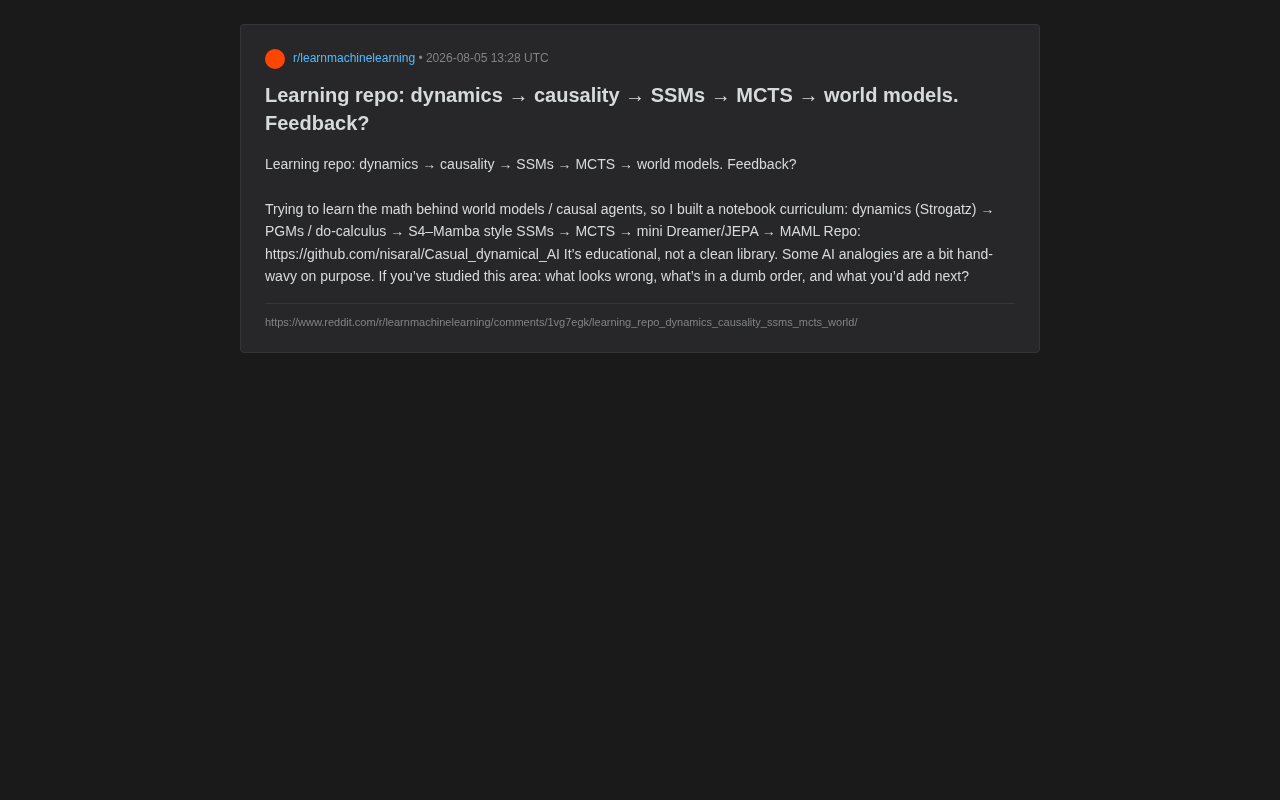
Recently, a Reddit user shared a self-built learning repository (Casual_dynamical_AI), attempting to string together the core mathematical tools needed to understand world models through a series of Notebook courses. He summarized the path as: Dynamics → Causal Inference → State Space Models (SSMs) → Monte Carlo Tree Search (MCTS) → World Models → Meta-Learning.
The author candidly acknowledged that this is an "educational" repository rather than a polished engineering library, and that some AI analogies are "intentionally kept vague." He posed three questions to the community: Where do you see errors? Where is the ordering illogical? What should be added next? This self-deprecating yet open-minded sharing reveals the real struggles of self-studying AI theory.
Unpacking the Logic of This Learning Chain
The cleverness of this roadmap lies in its organization—not by "model popularity" but by knowledge dependency, building layer upon layer. Let's examine the internal logic section by section.
First Stop: Dynamical Systems (Strogatz)
The curriculum begins with Steven Strogatz's classic textbook Nonlinear Dynamics and Chaos. This is a remarkably insightful choice. Strogatz is a professor of applied mathematics at Cornell University, and his textbook has been the standard introductory text in the field since its 1994 publication, renowned for its intuitive explanations and rich physical examples.
The essence of a world model is to let an agent internally construct a simulator of "how the environment evolves over time." Dynamical systems theory is precisely the mathematical language for studying "how states change over time"—differential equations, phase spaces, fixed points, stability analysis. Understanding dynamics is what enables you to truly grasp why a model needs to "remember state" and "predict the next moment."
In the AI context, a world model is essentially learning the dynamical equations of an environment—given the current state and action, predict the next state. This is directly descended from the classical formalism of dx/dt = f(x). Core tools from dynamical systems theory—such as phase portrait analysis (visualizing all possible evolutionary trajectories of a system), bifurcation theory (how tiny parameter changes can cause qualitative shifts in system behavior), Lyapunov exponents (quantifying the degree of chaos), and attractors (the long-term behavioral destinations of a system)—all provide deep insights into the capability boundaries of world models. Chaos theory in particular reminds us that even fully deterministic systems can be extremely sensitive to initial conditions—this sets a theoretical upper bound on world models' long-term prediction accuracy, explaining why systems like Dreamer typically only perform short-horizon imagination.
Second Stop: Probabilistic Graphical Models and do-calculus
The transition from dynamics to Probabilistic Graphical Models (PGMs) and Judea Pearl's do-calculus marks a leap from "deterministic evolution" to "causality and uncertainty." This is the most ambitious step in the entire path.
Judea Pearl's do-calculus is a landmark achievement in causal inference, providing a rigorous mathematical framework for distinguishing between "observation" and "intervention." Traditional statistics deals with conditional probabilities like P(Y|X)—the distribution of Y when X is observed—while do-calculus deals with P(Y|do(X))—how Y would change if X were actively set to a certain value. The distinction is crucial: on days when many people are observed carrying umbrellas, the probability of rain is high, but actively carrying an umbrella doesn't cause rain. Pearl's Structural Causal Models (SCM) use Directed Acyclic Graphs (DAGs) to represent causal relationships between variables, and the do-operator formalizes the effect of intervention through "graph surgery"—cutting all arrows pointing into the intervened variable.
Causal inference answers counterfactual questions like "what would happen if I took a certain action"—which is exactly the core of agent decision-making. For an agent, every decision is an intervention, making causal inference the theoretical foundation for planning and counterfactual reasoning. Placing causal inference before SSMs indicates the author wants learners to first build intuitions about "intervention" and "causal structure" before examining specific sequence modeling tools.
From Sequence Modeling to Planning and Meta-Learning
State Space Models: From S4 to Mamba
The third stop on the path is S4–Mamba-style State Space Models (SSMs). This has been one of the hottest architectural directions of the past two years, viewed as a strong competitor to Transformers for long-sequence modeling.
State space models originate from Rudolf Kalman's control theory work in the 1960s. Their core form is: h'(t) = Ah(t) + Bx(t), y(t) = Ch(t) + Dx(t), where h is the hidden state, x is the input, y is the output, and A/B/C/D are system matrices. In 2021, Albert Gu et al. proposed S4 (Structured State Spaces for Sequence Modeling), which imposed special structure on the A matrix (such as HiPPO initialization, a method based on orthogonal polynomials for compressing historical information) and used efficient diagonalization computation, enabling this classical framework to handle sequence dependencies spanning tens of thousands of steps. In 2023, Gu and Dao further proposed Mamba, introducing an input-dependent selective mechanism (selective scan) that allows SSM parameters to dynamically adjust based on input content, achieving language modeling performance comparable to or even better than Transformers while maintaining linear time complexity.
Interestingly, SSMs themselves were born from the classical state-space representation in control theory—echoing the first stop on dynamics. Learners will discover here that "new architectures" in deep learning are actually continuous with control theory from decades ago. This "old-meets-new" connection is precisely where this roadmap's value lies. The core advantage of SSMs is constant memory overhead and linear time complexity during inference. Compared to the quadratic attention complexity of Transformers, this offers significant advantages on ultra-long sequences—and world models need to handle potentially extremely long environment interaction sequences.
MCTS and Planning
Next comes Monte Carlo Tree Search (MCTS), the planning core of systems like AlphaGo and MuZero.
MCTS is a planning algorithm that combines random sampling with tree search. Its core loop contains four steps: Selection (traversing down the tree to choose the most promising node), Expansion (adding new child nodes at leaf nodes), Simulation (running random rollouts from the new node to a terminal state), and Backpropagation (propagating simulation results back to update statistics for all nodes along the path). The UCT (Upper Confidence bounds applied to Trees) formula elegantly balances exploitation (choosing the branch with the highest current win rate) and exploration (trying less-visited branches) during the selection phase.
In AlphaGo (2016), MCTS was combined with deep neural networks—a policy network guided node priorities during selection, and a value network replaced the full rollouts to terminal states. MuZero (2019) went further by learning an implicit environment dynamics model, allowing MCTS to plan in a learned latent space without access to the true environment rules (such as legal move rules on a board). This marks MCTS's evolution from requiring a perfect environment model to being able to perform imaginative planning within a learned world model—a paradigm of deep integration between world models and planning algorithms.
If SSMs solve "how to predict the future," then MCTS solves "how to make decisions based on predictions." Placing MCTS before world models is logically sound: world models provide the "imagination space" for search, while MCTS is the algorithm for forward-looking planning within that space.
World Models and Meta-Learning
The final two stops are mini Dreamer/JEPA and MAML. The former represents the two major schools of current world models.
The Dreamer series (Hafner et al., 2019-2023) is a flagship work in model-based reinforcement learning. Its core is a Recurrent State Space Model (RSSM) that encodes environment states as latent representations with both deterministic and stochastic components, then "imagines" future trajectories in latent space to train a policy. Dreamer learns representations by reconstructing observations (such as image pixels), making it a generative approach. LeCun's JEPA (Joint Embedding Predictive Architecture), proposed in 2022, represents a fundamentally different philosophy: it directly predicts the target's embedding in representation space rather than reconstructing raw inputs. JEPA argues that pixel-level reconstruction forces models to waste capacity on unpredictable details (like the exact position of leaves or noise textures in video), while prediction in abstract representation space can focus on the structural regularities of the environment. This divergence—reconstruction vs. embedding prediction—is the most central technical debate in the world models field today. The former is easier to train and debug, while the latter is theoretically more aligned with the needs of intelligent systems.
Studying both side by side allows learners to compare two technological philosophies. Concluding with MAML (Model-Agnostic Meta-Learning) extends the perspective to "how to let agents quickly adapt to new environments," ending the entire chain with a note pointing toward generality.
MAML (Finn et al., 2017) is one of the most influential algorithms in meta-learning. Its core idea is remarkably elegant: find a set of initial model parameters θ such that, starting from these parameters, only a few gradient steps are needed to quickly adapt to any new task. Specifically, MAML optimizes the initial parameters in an outer loop, with the evaluation criterion being: for each sampled task, the performance on that task's test set after taking one (or a few) gradient descent steps from θ. This creates a "learning to learn" capability. In the world model context, the value of meta-learning lies in enabling agents to quickly adapt to new environment dynamics—for example, a world model pre-trained across multiple physical environments that needs only a few interactions to calibrate its internal dynamics model when encountering a new environment. This parallels humans' ability to quickly understand new physical rules (such as throwing objects on the Moon).
Points of Debate and Community Perspectives
As a self-study project, this roadmap undoubtedly demonstrates the author's grasp of the field's big picture, but there are several points worth discussing.
Ordering controversies: Placing causal inference (do-calculus) before SSMs is conceptually elegant but may impose cognitive overload on beginners. Causal inference is itself a deep self-contained domain—from Pearl's structural causal models to Rubin's potential outcomes framework, from identifiability conditions to instrumental variables, each sub-topic alone could consume months of study. Introducing it too early may disrupt the natural transition from dynamics to sequence modeling. An alternative approach would be to first complete the "Dynamics → SSM → MCTS → World Models" path focused on sequence modeling and planning, then circle back to add the causal perspective.
The depth vs. breadth tradeoff: This path covers an extremely broad range, spanning from classic textbooks to cutting-edge architectures. The author honestly acknowledges that "some AI analogies are intentionally kept vague." This reminds us that any learning map attempting to "connect everything in one diagram" must inevitably make tradeoffs between depth and breadth. For learners who truly want to go deep, each stop could require months of focused investment.
Missing links: From the community feedback perspective, this chain could benefit from adding reinforcement learning fundamentals (such as the Bellman equation—describing the recursive structure of optimal decisions, policy gradients—directly optimizing policy parameters via gradient ascent, and the Actor-Critic architecture), since both MCTS and Dreamer are deeply rooted in the RL framework. Additionally, information theory (mutual information, KL divergence, information bottleneck) and variational inference (ELBO, variational autoencoders) deserve their own stop as bridges connecting generative models and representation learning—they are key mathematical tools for understanding the RSSM training objective in Dreamer and the representation collapse prevention mechanisms in JEPA.
Conclusion: The True Value of a Self-Study Map
What's most compelling about this repository isn't whether it's "completely correct," but that it demonstrates a learning approach of actively constructing knowledge structures. Rather than passively chasing one isolated paper after another, the author chose to first sketch the skeleton of the field, then seek calibration from the community.
For any learner wanting to enter the interdisciplinary field of world models and causal AI, this "Dynamics → Causality → SSM → MCTS → World Models → Meta-Learning" roadmap, even if not the optimal solution, serves as a highly inspiring starting point. It reminds us that understanding frontier AI often requires returning to those seemingly ancient mathematical foundations.
Related articles

Chain of Thought Isn't Just for AI: How Humans Can Use CoT to Improve Thinking Quality
Chain of Thought isn't just a prompt trick for large models. Starting from a Hacker News discussion, this article analyzes why CoT works for human thinking too, breaks down actionable ways to transfer it, and highlights the key differences between human CoT and machine CoT.
Cloudflare Teams Up with OpenAI: Closi…
Cloudflare Teams Up with OpenAI: Closing the Loop from Vulnerability Discovery to Defense with AI
Cloudflare uses OpenAI Daybreak to investigate security vulnerabilities and generate reviewable remediation plans, while developers use Codex to boost coding efficiency and quality.

Orca Multi-Agent Orchestration in Practice: A Guide to Parallel Collaboration with Claude and Codex
Orca is Stable AI's free open-source agent workbench supporting 34 agents like Claude Code and Codex in parallel. Learn its Git worktree isolation, multi-model orchestration, and mobile management.