From Leibniz to ChatGPT: A 350-Year History of Machines Understanding Human Language

A 350-year intellectual history from Leibniz's universal language dream to modern prompt engineering and AI alignment.
This article traces the 350-year quest to make machines unambiguously understand human intent — from Leibniz's universal symbolic language through Boolean algebra, Gödel's incompleteness theorems, and Turing's halting problem, to today's LLM prompt engineering and alignment challenges. It examines how the symbolicism vs. connectionism debate shaped AI, and why the ancient problem of natural language ambiguity remains unsolved.
An Open Letter from Academia
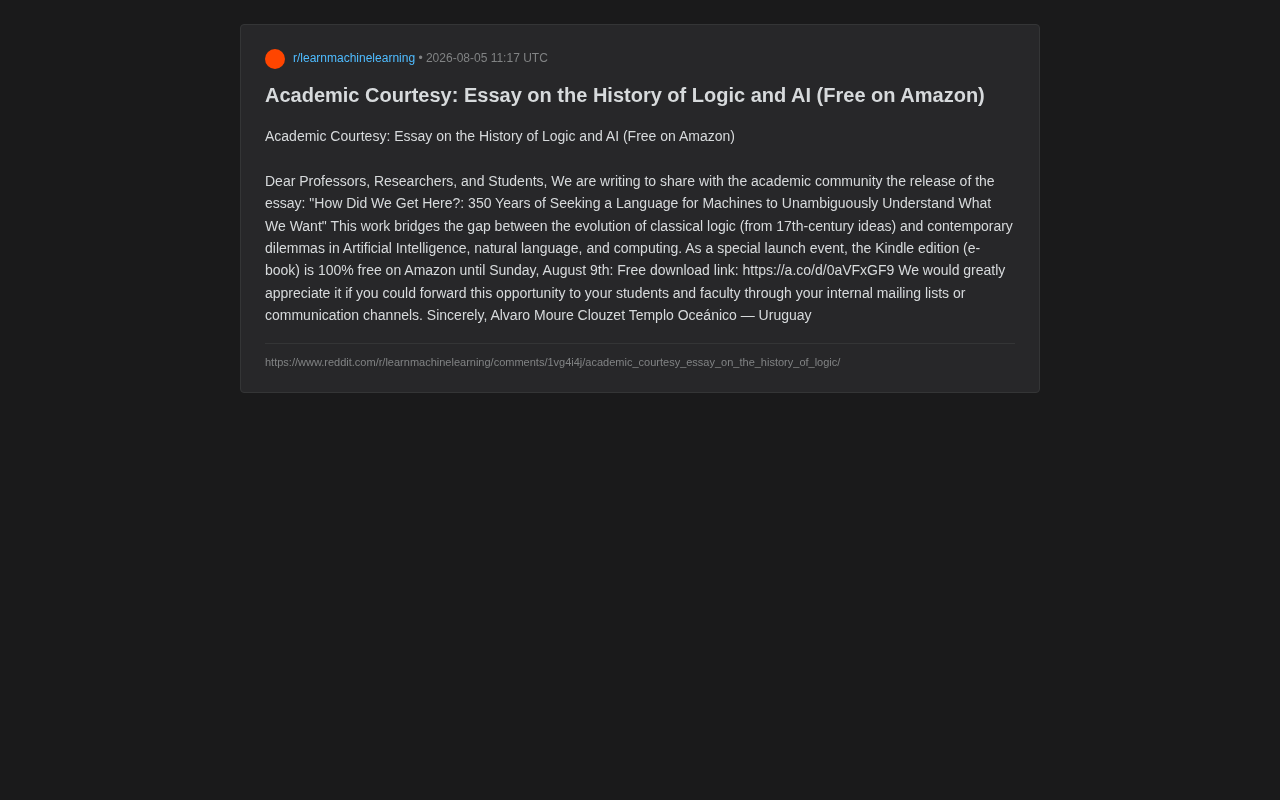
Recently, Uruguayan researcher Alvaro Moure Clouzet posted an open letter to the academic community on Reddit, sharing a newly published work: How Did We Get Here?: 350 Years of Seeking a Language for Machines to Unambiguously Understand What We Want.
This book attempts to build a bridge between the evolution of classical logic and the dilemmas of contemporary artificial intelligence, tracing the long journey from 17th-century intellectual seeds to today's core challenges in natural language processing and computational science. As part of a promotional campaign, the Kindle edition was available for free on Amazon for a limited time (until Sunday, August 9th).
While this is merely an academic promotion, the theme it touches upon — how to make machines unambiguously understand human intent — happens to be one of the most profound and fundamental questions of the large language model era.
The Core Proposition of 350 Years: Eliminating Ambiguity in Natural Language
The book's subtitle highlights a core proposition spanning over three centuries: finding a language that enables machines to unambiguously understand what we want. This pursuit did not begin with ChatGPT — it can be traced back to the 17th century.
Leibniz's Dream of a Universal Symbolic Language
As early as the 17th century, philosopher and mathematician Leibniz envisioned a "universal characteristic" (characteristica universalis) and a "calculus of reasoning" (calculus ratiocinator) — a system that could formalize all concepts in human thought and mechanically compute their truth or falsity. He dreamed that one day, when people disagreed, they would simply say "Let us calculate!" (Calculemus!) and arrive at an answer.
This vision was not Leibniz's alone. Before him, Descartes had conceived of a "universal mathematics" (mathesis universalis), attempting to bring all knowledge into a framework of certainty through a unified methodology. And the 13th-century Catalan philosopher Ramon Llull had invented a mechanical "combinatorial art" (Ars Magna) even earlier in the medieval period, using rotating concentric disks to combine fundamental concepts and automatically generate propositions — something many computer historians consider the earliest prototype of "algorithmic thinking." Leibniz himself explicitly acknowledged being inspired by Llull.
Leibniz's universal symbolic language comprised two layers: the first was assigning unique symbolic codes to all basic concepts, forming an "alphabet of thought"; the second was establishing rules for operating on these symbols, making correct reasoning as mechanically executable as arithmetic. This bears a striking structural correspondence to the distinction between "syntax" and "semantics" in modern programming languages, as well as to the architectural design of knowledge representation and inference engines. One could say that today's formal ontologies (such as OWL), knowledge graphs, and even type systems in programming languages are partial realizations of Leibniz's dream.
This seemingly romantic vision is actually the intellectual origin of modern formal logic and computer science. The core question it raised remains truly unsolved to this day: Can human natural language — vague, polysemous, and context-dependent — be translated into a form that machines can execute precisely?
From Boolean Algebra to Turing Machines: Logic's Relay Race
From Leibniz onward, Boole's Boolean algebra, Frege's predicate logic, Russell and Whitehead's Principia Mathematica, and then Turing's and Gödel's explorations of computability and the boundaries of formal systems form a clear intellectual lineage. Each step attempted to make "meaning" more precise and more mechanically processable.
This lineage deserves more detailed examination. In 1854, George Boole published An Investigation of the Laws of Thought, expressing logical relationships as algebraic equations for the first time — "AND" corresponds to multiplication, "OR" to addition, "NOT" to complementation — thereby proving that logical reasoning can be reduced to symbolic computation. Seventy years later, this system became the mathematical foundation of digital circuit design: every logic gate in every chip today is a physical realization of Boolean algebra.
Frege's Begriffsschrift (Concept Script), published in 1879, advanced Boole's propositional logic to an entirely new dimension — he introduced quantifiers ("for all" and "there exists") and the concept of predicate functions, enabling the logical system to express propositions involving variable binding, such as "all men are mortal." Frege's predicate logic remains the theoretical foundation of mathematical proofs, database query languages (such as SQL's WHERE clauses), and program verification.
However, in 1901 Russell discovered a fatal paradox ("Does the set of all sets that do not contain themselves contain itself?"), shaking the foundations of naive set theory. In response, Russell and Whitehead spent over a decade completing their monumental Principia Mathematica, attempting to rebuild the logical foundations of mathematics within a strict type hierarchy. The work's ambition was to reduce all of mathematics to logic, thoroughly eliminating ambiguity and contradiction.
But in 1931, the 25-year-old Gödel proved two stunning theorems: first, any consistent formal system containing natural number arithmetic necessarily contains propositions that can neither be proved nor disproved within the system (incompleteness); second, such a system cannot prove its own consistency internally. This effectively declared the bankruptcy of Hilbert's program to formalize all of mathematics and prove its consistency. In 1936, Turing further proved that no universal algorithm exists to determine whether an arbitrary program will halt in finite steps (the halting problem), revealing the fundamental boundaries of mechanical computation.
Yet Gödel's incompleteness theorems and Turing's halting problem also revealed the fundamental limitations of this path: any sufficiently powerful formal system contains propositions it cannot prove about itself. This tension — pursuing complete precision while never being able to fully eliminate ambiguity — is precisely the historical thread this book attempts to present. Notably, Turing himself was not paralyzed by these limitations. In his famous 1950 paper "Computing Machinery and Intelligence," he proposed a clever workaround: rather than defining whether a machine "truly understands," judge by behavioral performance — this is the idea behind the Turing Test, and represents a paradigm shift from "precisely defining understanding" to "functionally simulating understanding."
Why This Ancient Proposition Matters for Today's AI
In today's world dominated by large language models, this ancient proposition resurfaces in entirely new forms.
The Essence of Prompt Engineering: Eliminating Ambiguity with Natural Language
When we converse with models like ChatGPT or Claude, the "Prompt Engineering" we practice is essentially attempting to express our intent unambiguously using natural language. Models misunderstanding instructions, producing hallucinations, or giving irrelevant answers — the deep cause of these phenomena is precisely the gap between natural language's inherent ambiguity and the determinism machines require.
To understand the technical causes of this gap, one needs to grasp how large language models fundamentally work. Models like GPT and Claude are essentially autoregressive language models based on the Transformer architecture: given preceding context, they predict the most likely next token. This means the model doesn't "understand" the semantics of instructions — it searches in high-dimensional probability space for the output sequence with the strongest statistical association to the input sequence. When instructions are ambiguous, the model may "waver" between multiple plausible interpretations, or choose the interpretation that appeared more frequently in training data rather than the user's actual intent.
The technical root of the "hallucination" problem lies in this: the model's training objective is to maximize the prediction probability of the next token, not to guarantee factual accuracy of output content. When the model encounters questions with no reliable information support in its parameter space, it still generates fluent and confident text — because "fluency" is precisely what it was optimized for. This is essentially a goal misalignment problem: we want "accurate understanding and execution of intent," but the model is trained for "generating statistically plausible text."
The various techniques of prompt engineering — such as Chain-of-Thought prompting, Few-shot examples, role-setting, and structured output format requirements — are all essentially using additional linguistic constraints to narrow the model's output distribution, guiding it toward probability regions closer to user intent. This shares a spiritual lineage with Leibniz's attempt to eliminate communicative ambiguity through more precise symbolic systems.
In other words, the problem Leibniz faced 350 years ago is one we still face today — only the tools have changed from symbolic logic to neural networks and massive parameters.
Symbolicism vs. Connectionism: Two Radically Different Paths
Interestingly, modern large models have taken a path almost opposite to classical logic. Classical logic attempts to build a precise, unambiguous formal system top-down; deep learning bottom-up statistically learns language patterns from massive corpora, using probability to approximate "understanding."
These two paths correspond to the most fundamental paradigm dispute in AI history. Symbolicism, also called "Good Old-Fashioned AI" (GOFAI), was the dominant paradigm in AI from the 1956 Dartmouth Conference through the late 1980s. Its core belief is that intelligence can be achieved through formal operations on symbols. This path produced expert systems (like the MYCIN medical diagnosis system), automated theorem provers, semantic networks and knowledge graphs (such as the Cyc project's attempt to encode common sense in millions of formal rules), and logic programming languages like Prolog. Symbolicism's advantage lies in transparency and interpretability — every reasoning step has clear logical justification; but its fatal weakness is brittleness and the knowledge acquisition bottleneck: real-world knowledge is nearly impossible to fully formalize, and slight variations in circumstances can collapse carefully crafted rule systems.
Connectionism took a radically different path. Starting with Rosenblatt's Perceptron in 1958, going dormant after Minsky's devastating critique of its limitations in 1969, reviving through the popularization of backpropagation in 1986, and finally exploding after AlexNet won the ImageNet competition in 2012. Connectionism presupposes no explicit symbolic rules, instead letting networks "learn" patterns from data on their own. The Transformer architecture proposed by Google in 2017 revolutionarily solved the long-range dependency problem through the Self-Attention mechanism, making it possible to train ultra-large-scale language models on trillion-token-level text, thus giving rise to the GPT series, Claude, and other contemporary large models.
However, the opposition between these two paths is being reconciled by an emerging direction: Neuro-Symbolic AI. This cutting-edge research direction attempts to combine the advantages of both paradigms — using neural networks for perception and pattern recognition, and symbolic systems for reasoning and knowledge representation. For example, DeepMind's AlphaGeometry system combines a neural language model with a symbolic geometric reasoning engine to solve Olympiad-level geometry problems. Organizations like OpenAI and Anthropic are also exploring Tool Use to let language models interact with formal systems, which is also essentially a form of neuro-symbolic fusion.
The former is precise but brittle; the latter is flexible but uninterpretable. By examining both paths within the same historical framework, this book may help readers understand: why today's AI is both so powerful and so difficult to truly "understand" what we want.
An Intellectual History Merging Logic, Philosophy, and AI
Based on available information, this is an intellectual history work aimed at both academia and general readers, with the author hoping to disseminate it to faculty and students through university mailing lists. Works that weave together the history of logic, AI development, and philosophical inquiry hold unique value amid today's technology hype.
It should be noted that the book is a self-published work, and its academic depth and rigor of viewpoint require readers' own judgment. The free download promotion is a common strategy for new book launches, and readers should approach it with an open yet discerning attitude.
Implications for AI Practitioners and Researchers
For AI researchers and engineers, looking back on these 350 years of history offers at least two insights:
First, the "intent alignment" problem facing current AI is not entirely new — it has deep roots in philosophy and logic, and understanding history helps avoid repeating the intellectual traps of predecessors.
"Alignment" is one of the most central topics in AI safety today, referring to keeping AI systems' behavior consistent with human values, intentions, and expectations. This problem is extremely difficult precisely because human "intent" itself is often vague, self-contradictory, and context-dependent — exactly the fundamental obstacle that 350 years of formalization efforts have always faced. The current industry primarily achieves alignment through RLHF (Reinforcement Learning from Human Feedback): human annotators rank model outputs by preference, then a reward model is trained to guide policy optimization. Anthropic's "Constitutional AI" goes further, attempting to guide model behavior with an explicit set of principles (a "constitution") — spiritually akin to Leibniz's approach of governing reasoning through formal rules. However, as Gödel's theorems revealed, no finite set of rules can cover all situations, and the alignment problem is destined to be an open challenge requiring continuous iteration.
Philosophically, 20th-century philosophy of language provides profound insights into this problem. In his early work Tractatus Logico-Philosophicus, Wittgenstein held a "picture theory of language" — believing that language's meaning lies in its logical correspondence to facts in the world, highly compatible with the formalization ideal. But in his later work Philosophical Investigations, he completely pivoted to "language game" theory: meaning is not about corresponding to some fixed referent, but about how words are used within specific "forms of life." This implies that "eliminating ambiguity" may fundamentally be a misguided goal — because meaning is dynamically generated in use, not statically fixed in advance. This insight has profound implications for AI: perhaps we should not pursue making machines "perfectly understand" human intent, but instead design systems that can continuously clarify and negotiate meaning through interaction.
Second, the problem of language and meaning will never be definitively "solved" — it will only keep reappearing in new forms. Acknowledging this fundamental limitation may be more conducive to rational AI use than blindly believing in technological omnipotence.
Conclusion: We Are Still on Leibniz's Path
From Leibniz's "Let us calculate!" to today's iterative prompt-tweaking in chat interfaces, humanity has always been doing the same thing: searching for a way to make machines accurately understand our intent. The value of How Did We Get Here? may not lie in providing answers, but in reminding us — this question has been pursued for three and a half centuries, and we are still on the journey.
For readers seeking a broader perspective on artificial intelligence, an intellectual history connecting logic, philosophy, and computational science is well worth reading during its free period.
Related articles

ICANN Revokes Bulletproof Registrar Trustname's Accreditation: Impact and Analysis
ICANN has officially revoked bulletproof registrar Trustname's accreditation, severing its ability to harbor cybercrime. This article analyzes the impact on internet security governance.

ChatGPT Voice Mode Clones User's Voice: Root Cause Analysis and Security Implications
Reddit user reports ChatGPT voice mode cloning their voice. Analysis of OpenAI's disclosed unauthorized voice generation risk, technical causes, and safety guardrail limitations.

Building a Neural Network from Scratch: A Practical Guide to Backpropagation and Gradient Computation
A detailed guide on building neural networks from scratch with Python and NumPy, covering forward propagation, backpropagation, gradient checking, and numerical stability.