From Efficiency AI to Opportunity AI: A Practical Guide to Becoming an 'Agent Boss'

Microsoft PM Jack Roboff's 'Agent Boss' framework shows how humans shift from doers to accountable AI lifecycle managers.
Microsoft Copilot Studio's Jack Roboff introduced a practical AI implementation framework distinguishing 'Efficiency AI' (optimizing existing processes) from 'Opportunity AI' (unlocking previously impossible tasks), while warning against skeuomorphic thinking. His 'Agent Boss' concept emphasizes that humans must 'deputize' rather than simply 'delegate' to agents, maintaining accountability across the full AI lifecycle. He identifies critical thinking, judgment, and systems thinking as irreplaceable human skills, and flags four turbulence points — unclear ROI, consumption-cost surprises, trust/accountability gaps, and surface-level adoption — with organizational change management as the top reason AI projects fail to launch.
Microsoft Copilot Studio Product Marketing Manager Jack Roboff didn't showcase a flashy demo in his closing keynote at a recent tech conference. Instead, he posed a more grounded question: when you walk back into the office on Monday and face your day-to-day work, how do you actually put these powerful AI technologies into practice? His concept of the "Agent Boss" and the accompanying implementation framework are worth serious consideration for anyone driving AI initiatives forward.
Efficiency AI vs. Opportunity AI: Stop Using AI to Repeat the Past
Roboff breaks down AI's value into two distinct layers. The first is Efficiency AI — the most intuitive and fastest-to-show-results approach for most people: you understand your workflows, you know where time gets wasted and where friction exists, so you use AI to optimize those specific areas and shorten time-to-value.
But he makes a pointed observation about Efficiency AI's fundamental limitation: "You're just improving the same thing you do every day" — without ever touching the work that was previously impossible. The second layer, Opportunity AI, represents a much larger and often overlooked space. AI brings on-demand intelligence that unlocks entirely new problems — ones that were previously unaddressable due to a lack of people, compute, or capability.
He uses customer support as an example: Efficiency AI means "sprinkling a little AI" at the top of a support ticket so agents can quickly see a case summary. Opportunity AI means evaluating customer signals before the ticket is ever created and intervening proactively — a process that simply couldn't have existed before.
Beware the Skeuomorphism Trap
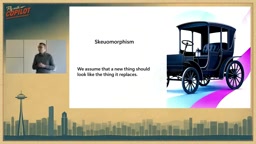
To explain why people tend to apply old mental models to new technology, Roboff invokes the concept of skeuomorphism. The most iconic example: the save icon in Word is still a floppy disk. The first cars were designed to look like horse-drawn carriages. Early websites looked like marketing brochures. In each case, people defaulted to familiar forms when imagining something new.
His warning is blunt: "If we only improved ground transportation from cars to trains, we never would have taken flight." When building AI projects, don't let them "just do what I used to do, with a little AI sprinkled on top." Break out of the frame and challenge problems that have never been solved.
The word "skeuomorphism" comes from Greek, and originally referred to a design practice of using digital elements to mimic the look and feel of physical objects — think Apple's early iOS, with its leather-textured Calendar app and wood-grain iBooks bookshelf. The concept sparked a long-running debate in the design world: critics argued skeuomorphism was a cognitive crutch — it lowered the barrier to entry for new users but simultaneously constrained people's imagination of what the new medium could do. In the context of AI product design, Roboff extends the concept into a broader critique of path dependency: organizations introducing new technology unconsciously treat it as an accelerator for old processes, rather than questioning whether those processes deserve to exist at all. This inertia isn't just a UI issue — it runs deep in process design, role definitions, and organizational culture. Breaking free from skeuomorphic thinking requires actively asking: if we had no historical baggage, how would we design this process today?
From Author to Orchestrator: The Birth of the Agent Boss
Roboff traces the evolution of how humans interact with AI: from early retrieval (RAG-based conversational queries), to using LLMs to plan and execute tasks (sending emails, scheduling meetings, updating a CRM), to the more recent emergence of autonomous capabilities — where you can give a vague goal and let an agent plan, compare options, and complete the task on its own.
As AI becomes more autonomous, the human role evolves as well. He proposes four "human-to-AI ratio" modes:
- Author: You create, AI refines — for example, rewriting an email in your voice;
- Editor: AI produces a first draft, you iterate — for example, generating a strategy doc and then revising it;
- Director: You set the goal and expected outcomes, AI plans its own path using tools, memory, and instructions;
- Orchestrator: A higher-order autonomous collaboration experience.
In the latter two modes, the human's job is far more than simply "reviewing outputs." This is where he introduces his core concept — the Agent Boss.
Agent Boss Is Not Just "Someone Who Uses Agents"
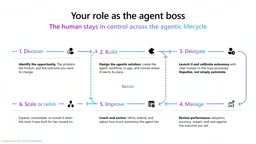
Roboff is clear: Agent Boss refers to the role that holds accountability across an agent's full lifecycle — from discovery, building, and delegation, through management, optimization, and deployment. The critical distinction is: "deputize" rather than "delegate."
Delegating sounds like handing off work to an agent and walking away with no one responsible. Deputizing means you, as the user, remain the accountable party. He cites an EY employee as a perfect example: she spends one hour a week talking with her agent, refining it, and making sure it stays aligned with her goals. That's what being an Agent Boss looks like.
He also uses this framing to address the anxiety of "will AI replace me?": humans are indispensable at every step — you're the one who decides what AI should automate and what should stay human.
The RAG (Retrieval-Augmented Generation) that Roboff mentions is a key technical concept for understanding the early stage of AI interaction. The core idea: when querying a large language model (LLM), you first retrieve relevant content snippets from an external knowledge base (such as enterprise documents or databases), then feed those snippets along with the question into the model, so the model generates its answer grounded in retrieved results. This approach effectively reduces LLM "hallucination" — the tendency of models to confidently fabricate answers when they lack reliable grounding — while also allowing enterprise-proprietary knowledge to be safely injected into AI systems without expensive fine-tuning of the base model. RAG represented the first mainstream paradigm for enterprise AI deployment. The evolution Roboff describes — from RAG to autonomous agents — is fundamentally a leap from AI systems that "passively retrieve and respond" to systems that "actively plan and execute."
Three Skills That Make You Irreplaceable
As AI capabilities continue to grow, Roboff argues that three skills will make individuals uniquely valuable and irreplaceable:
- Critical Thinking: Questioning why AI handled something a certain way, evaluating the evidence, and deciding whether to trust the output;
- Judgment: Deciding what's worth doing and whether an output is relevant and usable — this circles back to accountability. "AI can never be responsible for consequences, because it doesn't understand the larger picture and its implications";
- Systems Thinking: You are the subject matter expert (SME) on business processes — you understand the logic behind the data, the people, and the workflows. That's your "secret sauce" when designing AI automation.
Bring Your Team Along: The Blind Spot That Kills Projects
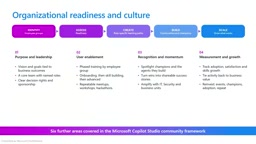
Roboff points out that the biggest mistake people make when launching AI projects is over-focusing on the technology and impressive demos, while neglecting everything an organization actually needs to make a technology land successfully. Research he shared (based on scoring across multiple companies) shows that organizations investing across four key pillars can move from prototype to production significantly faster.
He highlights the number-one reason AI projects never make it to production: "failing to bring people along on the journey." Many employees receive nothing more than an email saying "you now have access to Copilot" — and that's the last they hear of it.
Drawing on lessons from the Power Platform community, he outlines a path to building an AI community: identify the affected groups (IT developers, knowledge workers, etc.), assess their readiness for AI and specific tools, and create role-customized learning content. Running a community effectively requires four things: clear purpose and executive sponsorship; defined user enablement (hackathons, workshops, office hours); recognition and momentum (celebrating champions, even using small incentives to drive adoption); and metrics tied to business KPIs (cost reduction, productivity gains, revenue growth).
Four Types of "Turbulence": Why AI Projects Stall
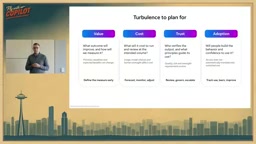
Roboff is candid: no project goes perfectly, and four factors almost always appear. You need to anticipate them:
- Value: It's not "this demo is cool so we can scale it." Every use case needs a clear ROI. Think through which KPIs to monitor and how to report value upward when building the business case — not after the fact with a "show first, ask for budget later" approach;
- Cost: Frontier models aren't cheap, and the industry is shifting from per-seat to consumption-based pricing. Organizations need to forecast costs, establish chargeback strategies to encourage responsible usage, and allocate resources differentially across user segments — rather than a blanket "$100 AI budget per employee";
- Trust: Understanding how the technology works and who is accountable for erroneous outputs. He references the well-known case of an automaker's public-facing chatbot that was manipulated into agreeing to sell a car for $1 — how such incidents are escalated and handled tests an organization's accountability mechanisms;
- Adoption: Adoption isn't just tokens consumed or Copilot credits spent. It requires tracking behavioral change — daily and monthly active use, and validating through surveys and interviews that employees have genuinely integrated AI into their work, rather than treating it as a one-off transaction.
The pricing model shift Roboff mentions is worth unpacking further. Enterprise AI services currently operate under two primary pricing logics: per-seat pricing charges a fixed monthly fee per user granted access — costs are predictable, but it's easy for low-frequency users to "free ride"; consumption-based pricing charges based on actual token usage, API call volume, or compute consumed — theoretically fairer, but when "AI power users" emerge, costs can spike dramatically and become difficult to forecast. This shift creates real challenges for enterprise financial planning: as AI moves from pilot to organization-wide rollout, the cost structure transforms from a predictable fixed expense into a variable spend tightly coupled to usage intensity. Some organizations have begun exploring internal cost-transfer mechanisms — allocating AI usage costs to individual business units — to encourage business teams to actively evaluate the value of their usage, rather than treating AI as free IT infrastructure.
Your Homework: Choose a Destination
Roboff closed with a homework assignment, asking everyone to pick one workflow — either an existing process or a problem that's never been solved — and work through it step by step:
- Define the output: What does today's output look like, or what output do you need in the future?
- Map the work: Use systems thinking to map the people, inputs, outputs, and systems involved;
- Walk the process: Identify bottlenecks and time sinks;
- Prioritize: Focus on one core KPI and get an MVP out the door;
- Technology comes last: Start with the business problem before selecting the solution;
- Continuously optimize: Revisit and improve regularly as an Agent Boss;
- Choose the right human-AI mode: Select Author / Editor / Director / Orchestrator based on the scenario, and find the right balance for human involvement.
His closing question ran throughout: when you walk back into the office on Monday morning, what will you "put into flight"? Whether it's Copilot Chat, Copilot Studio, or GitHub Copilot — the technology is ready. The real choice belongs to each individual user.
Related articles

JobRunner MCP Server: AI Agents Can Now Fix Failed Java Jobs
JobRunner launches an open-source MCP server enabling AI agents to view cluster status, diagnose failures, and recover Java jobs—incident response from any cloud coding environment or existing agent.

MLAI Digital Launches 9 Security Agents: MCP Server Safeguards the Full Lifecycle of Agentic AI
MLAI Digital launches Security MCP Server with nine built-in specialized security agents covering vulnerability discovery, attack simulation, prompt injection detection, API and infrastructure assessment, and accelerated remediation—embedding security validation across the full Agentic AI lifecycle from development to production.

Running Isaac Lab on H100 GPUs: Exploring Better Approaches
Exploring optimization methods for running Isaac Lab on NVIDIA H100 GPUs, including MIG configuration, mixed precision, TensorRT acceleration, and community experience to improve robotics simulation and reinforcement learning efficiency.