From Executing Tasks to Pursuing Goals: The Paradigm Shift in AI Agents
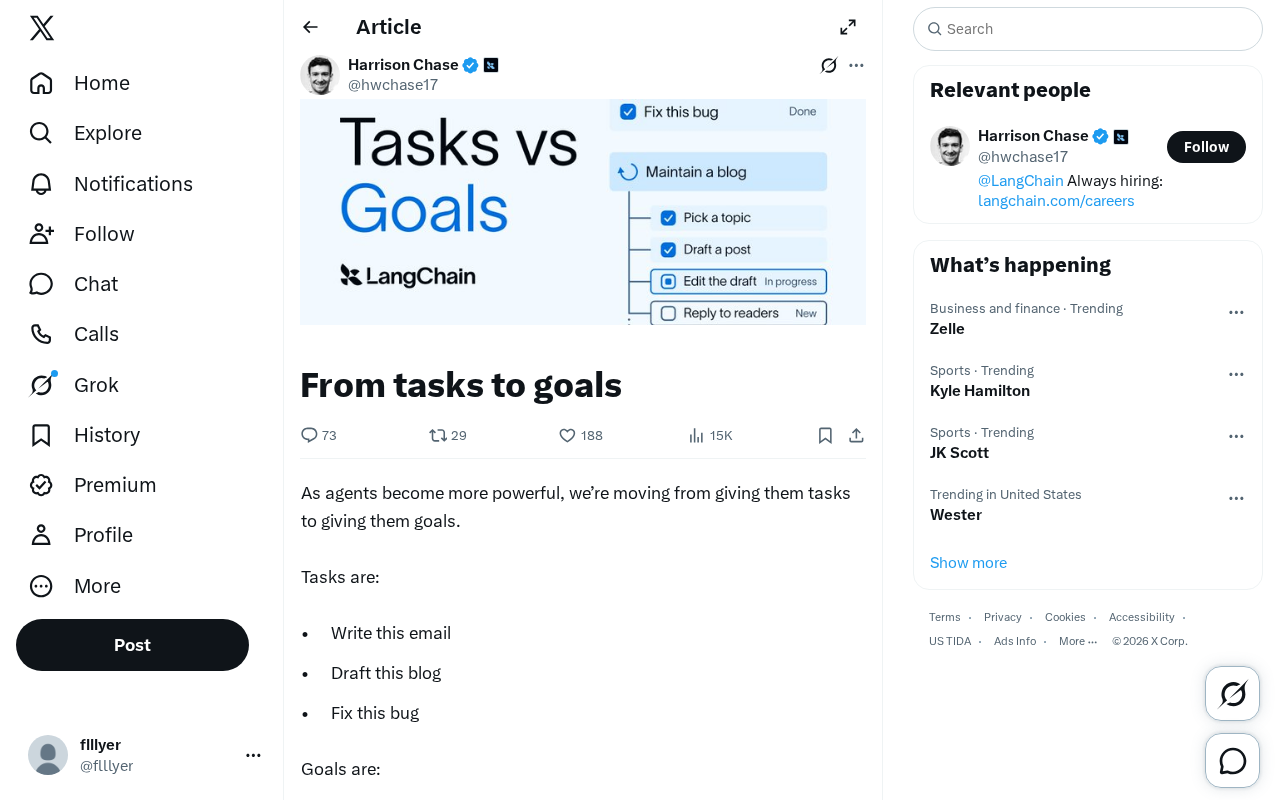
Improving model capabilities are driving AI agents from executing explicit tasks to autonomously pursuing high-level goals.
Based on a technical observation on Twitter, this article discusses the architectural evolution of AI agents from "executing tasks" to "pursuing goals." Traditional agents complete explicit instructions like checking weather or sending emails; goal-oriented agents receive high-level goals and must autonomously plan, decompose subtasks, and dynamically adjust strategies. This shift brings structural changes in capability requirements: autonomous planning, environment interaction, long-term memory, and context management become essential, and architecture upgrades from simple "sense-react" to a composite system of planner, executor, and memory module. Construction methods change accordingly, with developers moving from writing task flows to designing goal description languages, reward mechanisms, and safety constraints, while addressing explainability and controllability challenges. Human-computer interaction shifts from command-based to goal-setting and feedback collaboration, closer to human collaboration but raising trust and transparency issues. The article notes the trend has broad implications for automating complex enterprise workflows but still requires solving planning reliability, safety alignment, and evaluation standards, and currently comes from a single source.
The New Definition of Agents: From Task Executors to Goal Seekers
According to a technical observation on Twitter, as model capabilities improve, AI agents are shifting from "executing tasks" to "pursuing goals." This shift is reshaping agents' behavioral patterns, requirement structures, construction methods, and forms of human-computer interaction. The tweet included a detailed blog link and sparked discussion about the evolution of agent architecture.
Traditional agents are typically designed to complete clear, specific tasks, such as checking the weather, sending an email, or booking a flight. Goal-oriented agents, by contrast, are given a high-level goal and must autonomously plan, decompose tasks, and dynamically adjust strategies until the goal is achieved. This shift means agents need stronger reasoning capabilities, environmental awareness, and long-term planning abilities.
Core Capability Requirements for Goal-Oriented Agents
When agents begin pursuing goals rather than executing tasks, their capability requirements change significantly. First, agents need autonomous planning capabilities—the ability to break abstract goals into executable subtasks and replan based on feedback during execution. Second, environment interaction capabilities become crucial: agents must understand environmental states, identify available tools, and dynamically invoke resources. In addition, long-term memory and context management become essential to support multi-step, cross-session goal pursuit.
These capability requirements demand that agent architecture upgrade from a simple "sense-react" model to a composite system comprising a planner, executor, and memory module. The blog may further explore specific technical implementations, but the tweet only outlines the trend direction.
The "sense-react" model (a simplified version of Sense-Plan-Act) originates from classical robotics: the agent periodically reads sensor states and maps them directly to actions according to preset rules, with no internal world model and no cross-step memory. Its advantages are low latency and predictable behavior, but it fails when tasks require multi-step reasoning or environmental changes—because each step only looks at the current input and cannot trace back history or anticipate what comes next. Goal-oriented architecture introduces a planner and memory module, essentially inserting a maintainable intermediate representation (subgoal stack, plan tree, or state graph) between "perception" and "action," enabling the agent to compare the gap between the current state and the goal state during execution and rewrite the plan accordingly. This upgrade also brings new engineering costs: the planner needs verifiable tool descriptions, and the memory module needs retrieval and forgetting strategies; otherwise, plan drift or context bloat can easily occur.
Changes in Construction Methods and Interaction Patterns
Goal-oriented agents also face fundamental changes in how they are built. Developers no longer merely write task flows; they need to design goal description languages, reward mechanisms, and safety constraints. Agents must be able to make autonomous decisions in open environments, which imposes higher requirements for explainability and controllability.
Human-computer interaction patterns are evolving as well. Users shift from giving specific instructions to setting goals and providing feedback, while agents proactively report progress, request clarification, or suggest alternatives. This interaction is closer to collaboration between humans, but it also brings challenges related to trust and transparency. The tweet emphasizes that "this changes what agents do, what they need, how they are built, and how we interact with them," highlighting the comprehensiveness of the shift.
Reward mechanisms and safety constraints are designs at two different levels in goal-oriented agents. The reward mechanism (reward model or scoring function) answers "what counts as good," guiding the agent to choose among multiple feasible paths; safety constraints (guardrails, permission boundaries, policy-as-code) answer "what must never be done," typically implemented as hard blocks rather than soft incentives. Mixing the two is a common mistake: writing safety requirements as reward terms means that under high-pressure goals, the agent may trade safety for score. Explainability is especially critical in goal-oriented scenarios because developers can no longer review task flows one by one—only the goal description and constraint set. The intermediate plans autonomously generated by the agent therefore need traceable logs; otherwise, once deviations occur, it is difficult to determine whether the cause is vague goal definition, missing constraints, or a reasoning error in the planner itself.
Industry Impact and Future Outlook
This trend has broad implications for AI application development. In enterprise scenarios, goal-oriented agents are expected to automate complex workflows, such as market analysis, customer service, or R&D assistance. However, realizing this vision still requires solving issues such as planning reliability, safety alignment, and evaluation standards.
Currently, this viewpoint mainly comes from the observation of a single technical blog, and there are not yet more independent sources to corroborate it. But given the industry's ongoing exploration of autonomous agents, the shift from tasks to goals is undoubtedly a direction worth watching. As model capabilities further improve, the design philosophy and engineering practices of agents will undergo deeper innovation.
Related articles

AI Code Generation Is Getting Cheaper—Validation Is the Real Challenge
Code generation is getting cheaper, and the bottleneck is shifting to validation. Drawing on Satya Nadella's interview, this piece analyzes coding agents' specifications, multi-model review, separation of permissions, organizational changes, and how engineers can turn a single fix into reusable team capability.

Saparo: The Shopping AI Agent That Stacks Discounts Automatically, Topping Product Hunt
Saparo is an AI shopping agent that automatically stacks discounts, topping Product Hunt. It finds the same item, matches sizes, combines promo codes and cashback, ranks by total cost including shipping and taxes, and leaves final payment to the user.

Tripmojo: The AI Travel Agent That Checks You In
Tripmojo is the #2 AI travel agent on Product Hunt: it syncs booking emails into a shared itinerary and lets Mojo attempt check-in, save boarding passes, and flag delays.