From Frontend to AI Agent Developer: Why Pure Frontend Roles Are Disappearing

Pure frontend roles are fading fast as AI code generation pushes employers to hire Agent+full-stack engineers instead.
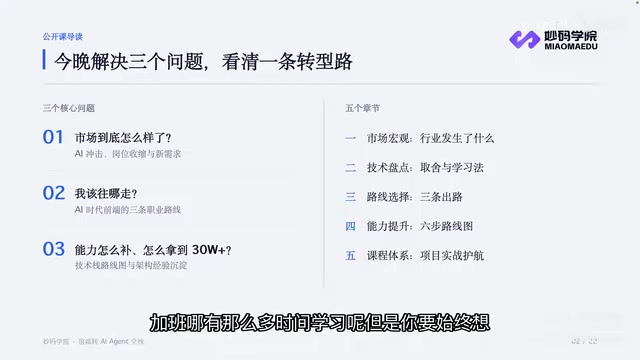
As AI models like Codex and Claude Code leap from code completion to full-project automated generation, the value of writing code is rapidly declining. Employers now prefer one or two AI-capable full-stack engineers over traditional teams of four or five, making pure frontend roles increasingly rare. In their place, job listings demand "AI Frontend," "Agent direction," or "Full-Stack + AI" skills. For experienced frontend developers, three transition paths emerge: AI Agent Engineer, FDE (Front-line Deployment Engineer), and remote/freelance work. The deeper takeaway is to prioritize continuous learning over daily output, and to anchor career planning around the "full-capability Agent + broad frontend" profile.
Why Pure Frontend Roles Are Getting Harder to Find
Recently, many frontend developers with three to five years of experience have noticed their resumes going unanswered — and when they do land interviews, they struggle to get offers. What's really going on? A frontline AI architect puts it bluntly: there are almost no pure frontend roles left.
Browse any major job platform and you'll see that frontend positions haven't vanished — they've just transformed. Job descriptions that simply say "Frontend Developer" are increasingly rare. In their place, you'll find "AI Frontend," "Frontend Agent," or simply "Full-Stack + AI." Employers are quietly dropping the phrase "pure frontend" from their hiring criteria.

Behind this shift lies a harsh reality: the act of writing code itself is rapidly losing its value. For mid-level frontend developers whose work revolves around CRUD operations, boilerplate page building, and framework assembly, AI can already do the job faster and cheaper.
The AI Disruption Timeline: From Code Completion to Full-Project Generation
Tracing the pace of this disruption reveals a clear technology evolution path. AI's real impact on development roles actually began two years ago — but tools like Cursor and GitHub Copilot were still in the code-completion phase at the time, more of a convenience than a true replacement for human developers.

The inflection point came with the next major model iteration. Once the models powering tools like Codex and Claude Code received significant upgrades, AI leaped from "snippet completion" to "full-project code generation," closing the loop between output and validation in an automated cycle. Writing code shifted from high-value work to low-value work — and pure frontend and pure backend roles were the first to feel it.
What's especially notable is the collapse at the entry level. Because the technical barrier for AI Web Coding is inherently low, junior and mid-level frontend, backend, QA, and DevOps roles have essentially caved overnight — these are precisely the positions that relied most heavily on copy-paste and repetitive labor.

Codex is OpenAI's language model designed specifically for code generation and the foundational technology behind GitHub Copilot. Claude Code is Anthropic's extended code-capable version of the Claude model. Unlike early Copilot, which could only complete a few lines at the cursor position, the new generation of models possesses "task-level" understanding — developers describe requirements in natural language, and the model automatically breaks down the task, generates multi-file project structures, writes test cases, and executes validation, forming an automated "generate–run–fix" loop. This leap was enabled by a dramatic expansion of large model context windows (from thousands of tokens to hundreds of thousands), allowing models to "comprehend" an entire codebase at once rather than focusing on just a few dozen lines in the current file.
Why Job Postings Have Shifted to "Agent + Full-Stack"
Understanding how employers think makes it clear why demand for Agent and full-stack skills is growing. The core business logic is straightforward: replace a team of four, five, or even six or seven people with just one or two.
Run the numbers and it's obvious. In a first-tier city, a development team of five or six people averaging 20K RMB per month in salary — plus social insurance and housing fund contributions — easily exceeds 100K+ RMB per month in total cost. Even if a business owner doesn't fully understand what Agent development or AI Web Coding can do, the instinct is clear: hire one person who knows AI and replace the entire frontend, backend, and development pipeline.
This echoes a familiar pattern in the industry. In the early days, frontend and backend weren't separated — everything was built as one integrated system. Companies eventually split the roles, which caused frontend positions to multiply. Now the trend is reversing — roles are consolidating again around Agent and full-stack profiles. For developers with a bachelor's degree or above, Agent + full-stack is widely considered the most worthwhile career investment right now.
FDE (Front-line Deployment Engineer) is an emerging role born from the growing demand for AI deployment, and there's currently no standardized definition in China — different companies use different titles and draw different boundaries around the responsibilities. The core characteristic is someone who understands both the capabilities and limitations of AI models and can independently handle the full cycle from requirements analysis and system design to deployment, while working closely with clients or business teams to embed AI capabilities into real-world workflows. These roles typically require product thinking, strong communication skills, and some project management experience. Compensation ceilings are generally higher than for traditional senior frontend engineers, but the bar is also higher — making this path best suited for developers with three or more years of experience and a solid understanding of a specific vertical industry.
Three Transition Paths: Agent Engineer, FDE, and Freelancing
For developers looking to make the shift, there are three main paths to consider:
AI Agent Development Engineer
This is the most mainstream job-seeking direction, suited for developers who systematically build Agent development skills and then join a company. The core task is filling the gaps in AI application development and Agent orchestration — transitioning from "building pages" to "owning the full production pipeline across frontend, backend, and QA."
FDE (Front-line Deployment Engineer)
For developers who already have strong capabilities and some business experience, FDE-type roles are worth pursuing. These positions demand stronger all-around competence and business acumen, and typically come with higher compensation.
Remote Work and Independent Freelancing
Once skills are up to par, Remote Work is another option — as is setting up an independent studio and taking on client projects. This path offers more freedom, but requires stronger all-around ability and self-motivation.
Whichever path you choose, agonizing over tech stack choices (Java, Python, or Node.js) shouldn't be an excuse to delay — setting the right direction matters far more than picking the right language.
AI Agent refers to an AI system capable of perceiving its environment, autonomously planning steps, and invoking tools to complete multi-step tasks — fundamentally different from a chatbot that simply answers one-off questions. The core work of an Agent engineer is "orchestration": defining the Agent's goals and constraints, breaking large tasks into executable sub-steps, integrating external tools (such as code executors, databases, browsers, and APIs), and handling exceptions and feedback loops during execution. Leading Agent development frameworks include LangChain, LlamaIndex, AutoGen, and Anthropic's Model Context Protocol (MCP). For frontend developers, transitioning to Agent engineering doesn't require learning machine learning from scratch — the focus is on learning how to translate business logic into Agent-executable workflows and how to interface with large model APIs to deliver end-to-end functionality.
Continuous Input Matters More Than Continuous Output
Here's a career trap that's easy to overlook: working as a developer at a company is fundamentally an exercise in continuous "output." If you only output without taking in new knowledge, and your technical skills, solution design, and architectural thinking stagnate — by the time the company no longer needs you, it's often too late to find your footing again.
When the market was booming, companies competed aggressively for talent. Now they pick and choose like shoppers at a market — can you do AI? Can you build Agents? Are you full-stack? These have become mandatory questions. This has left many developers mentally exhausted and anxious, some even questioning whether to continue in programming at all.
The real key is closing the information gap: knowing what to learn, what to skip, and in what order to learn it. Learning is fundamentally an investment in yourself — especially now, when the shape of roles is changing so dramatically. Aiming to become a pure frontend expert is no longer a sound goal. "Full-capability Agent + broad frontend" is a far more resilient career anchor.
Conclusion
This wave of AI Agent growth represents both a crisis and a window of opportunity for frontend developers. The decline of pure frontend roles is irreversible — but demand for Agent + full-stack is expanding. Rather than debating whether to make the move, set your direction early and systematically build out your AI application and full-stack capabilities. In this track, an annual salary of 300K+ RMB might just be the starting point.
Related articles

Why Does the Tesla Roadster Need to Fly? A Deep Dive into Musk's Wild Demo
Tesla's Roadster launch showed wall-climbing, upside-down driving, and flying stunts—but The Vergecast notes the demo car may lack a battery, the Rocket version is invite-only and not street-legal, and the website terms don't guarantee delivery. After nine years of delays, why does this car still need to exist?

AI Is Not a Replacement: Human-AI Collaboration Through the Lens of Factory Root Cause Analysis
Starting from factory root cause analysis, this article explains how AI accelerates evidence chain construction rather than replacing human experts, exploring the pragmatic implementation logic and business value of 'AI supporting people rather than replacing them.'

AI Agent Decision Auditing: Building an Evidence Chain in Regulated Workflows
Starting from a Reddit discussion, this article analyzes three core issues in AI agent decision auditing within regulated workflows: what fields audit records should contain, how to handle feedback latency for erroneous decisions, and how to continuously calibrate LLM judge consistency with human judgment.