From Idea to Reality: How AI Tools Are Becoming the Vehicle for Everyday People's Dreams

A tweet captures how AI tools are shifting from professional utilities to creative vehicles for everyday people.
This article analyzes a Twitter post to distill the core product philosophy shaping today's AI and low-code space: technology's value lies in being a "vehicle" that carries ordinary people from idea to reality. The piece examines two key dimensions — how new-generation products have shifted their target user from professional developers to creative non-technical individuals, and how the word "vehicle" (vs. "tool") signals an expectation of end-to-end, all-in-one experiences. Ultimately, it argues that "who you build for" is becoming the hidden dividing line in AI-era product competition.
The Product Philosophy Behind a Single Tweet
This brief post from Twitter captures a product philosophy that a growing number of AI and tech companies are adopting as their north star: the real value of technology isn't showing off what it can do — it's serving as the vehicle that helps ordinary people turn their ideas into reality.
The original text reads: "This is who we show up for. People like @cheneypiano with ideas, solutions, and dreams, who just need a vehicle to turn them into a reality."
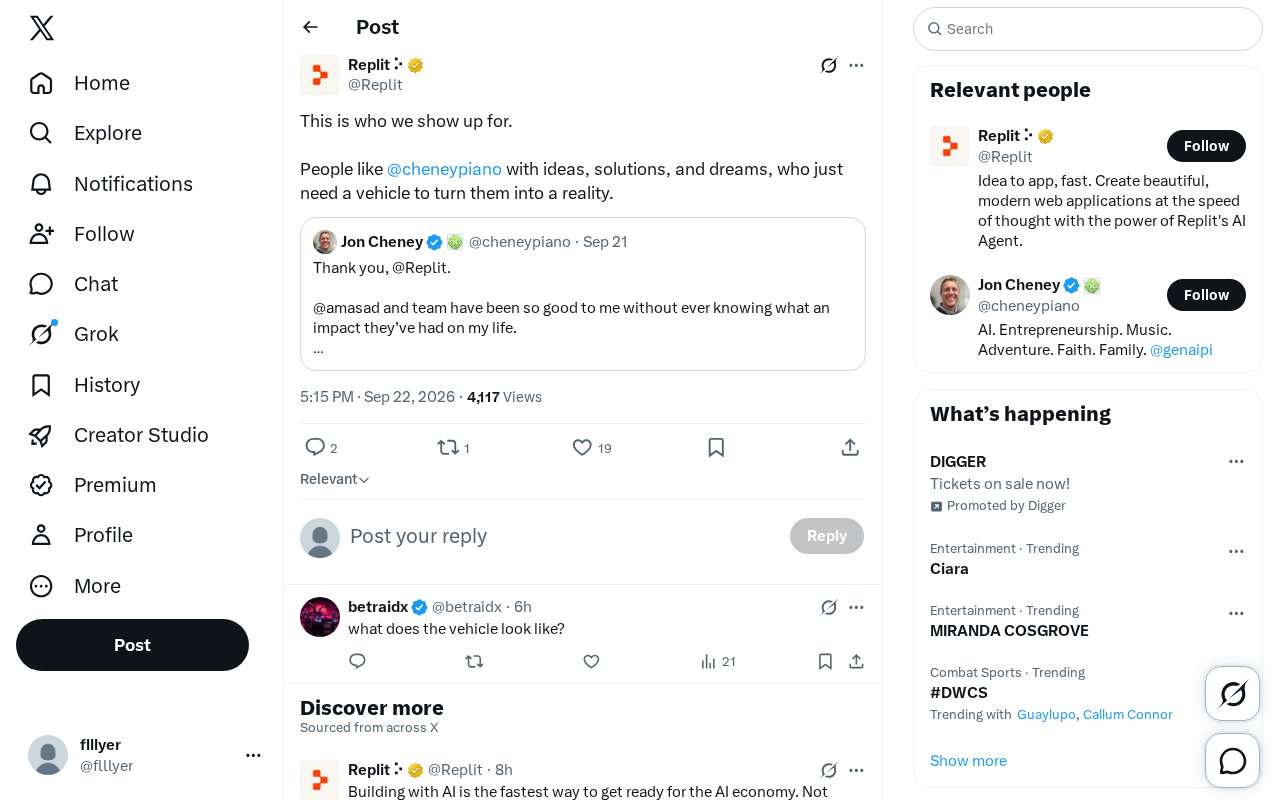
In just two sentences, it captures the shared narrative logic driving today's low-code platforms, AI-assisted creation tools, and creator tooling space: give the power to execute back to individuals who have creativity but lack technical expertise.
"Who You Serve" Shapes What You Build
What makes this tweet so worth examining is that it places the user profile at the very center of the product story — not developers, not engineers, but "ordinary people with ideas and dreams."
This reflects a clear shift in how tech products have evolved in recent years. Traditional tools often assumed a certain level of professional competence — the ability to write code, understand design, or navigate complex software. The new generation of AI products aims to lower those entry barriers as much as possible, making creativity itself the only scarce resource.
In other words, the product's role has shifted from "an efficiency tool for professionals" to "a capability amplifier for everyone." When all someone needs to do is clearly articulate what they want to build, and the tool and AI handle the rest, the population of people who can create expands dramatically.
What the "Vehicle" Metaphor Really Means
The post uses the word "vehicle" rather than "tool" — a subtle distinction worth paying attention to.
A tool emphasizes function — it helps you complete a specific task. A vehicle emphasizes transport — it carries you, moving you from Point A (an idea) to Point B (reality). This implies a more complete, end-to-end product experience: users don't have to stitch together multiple steps themselves, but instead board a system that can carry their creative vision all the way to the finish line.
This is precisely the direction many AI applications are pushing toward: moving beyond single-point features toward an all-in-one experience that covers the full arc of "ideation → generation → execution." Whoever can make that journey smoother is closest to the ideal of being a true "vehicle."
End-to-end experience is the key concept here. In software product terms, end-to-end means complete coverage of a process from start to finish, without requiring users to manually switch between different tools or handle data format conversions at intermediate steps. Traditional toolchains tend to be "point solutions": users have to combine copywriting tools, design tools, and publishing tools on their own to complete a single task — and every switch introduces friction and a new learning curve. AI-native products try to connect these nodes, building a continuous experience from "I have an idea" to "the idea is live." This is the technical substance of the "vehicle" metaphor — not a helper for one leg of the journey, but the carrier for the whole trip. In today's market, products like Notion AI, Canva AI, and Gamma are all evolving in this direction. Competition is increasingly shifting away from the strength of individual features toward the smoothness of the end-to-end flow.
What This Means for Creators and Product Practitioners
For creators, this kind of narrative is a positive signal: technical barriers are being systematically dismantled, and people with distinctive ideas have more power than ever to put them into practice.
For product practitioners, this tweet serves as a reminder that product positioning should return to "who are we actually building for?" rather than "what features have we shipped?" A clear user profile and sense of mission often build stronger brand identity than any feature list.
It's worth noting that this tweet is, at its core, a brand or product philosophy statement — it doesn't reveal a specific product name, feature details, or data. It reads more like a declaration of values than a product announcement. Its value, therefore, lies in helping us read the directional winds of industry narrative, not in extracting specific technical information.
Closing Thoughts
"Who do we show up for" — this simple act of self-positioning is quietly becoming the hidden dividing line in AI-era product competition. When technology is powerful enough, what determines how far a product goes may no longer be what it can do, but who it chooses to stand beside.
Background Context
This shift has concrete technical underpinnings at the industry level. Low-code and no-code platforms were already trying to lower technical barriers before AI went mainstream — but even then, users still needed to understand concepts like data structures and process logic. The emergence of generative AI made "natural language as interface" genuinely possible: users simply describe their intent in everyday language, and the model handles multi-step tasks spanning understanding, planning, and execution.
This paradigm is sometimes called intent-driven computing. Its core assumption is that creativity and judgment are humanity's core advantages, while the technical details of execution can be absorbed by the system. This explains why text-to-image, text-to-video, AI coding assistants, and similar tools all emphasize a "no professional background required" promise to users — it's not just marketing language, but a product logic that naturally emerges from a genuine leap in underlying technical capability.
Related articles

@ai-sdk/vue 3.0.306 Patch Release Syncs with [email protected] Update
@ai-sdk/vue 3.0.306 released, synced with [email protected]. A routine patch release for the Vercel AI SDK ecosystem with no public API changes; the Vue adapter layer stays version-aligned with the core package.

Gemini 4 Argon API Launches: The Era of Million-Token Output Begins
Google launches Gemini 4 Argon with sparse MoE architecture, up to 1M output tokens, and a 68.90% Vals Index score, available across API, AI Studio, and the Gemini app.

DukaanAI: Turning Product Photos into Inventory Lists with Open-Source AI
DukaanAI is an AI inventory tool for small retailers that turns product photos into inventory entries using the open-source Gemma 3 model, with local inference, editable fields, and CSV export.