From Intuition to Reasoning: The Paradigm Shift Between LRMs and Traditional LLMs

LLMs guess answers via pattern matching; LRMs construct reasoning programs — a paradigm shift that unlocks genuine fluid intelligence.
This article presents a framework for understanding the essential difference between LLMs and LRMs: the former uses a transductive paradigm, directly outputting answers based on learned patterns; the latter uses an inductive paradigm, constructing a reasoning chain before arriving at a solution. This shift unlocks "fluid intelligence" — the ability to reason dynamically through novel problems. ARC benchmark data makes the contrast stark: foundation LLMs hover at 10–15% regardless of 100,000× scale increases, while comparable LRMs have already saturated the benchmark. The real breakthrough isn't bigger models — it's the move from memorizing answer distributions to constructing solution programs.
What exactly sets large language models (LLMs) apart from the large reasoning models (LRMs) that have been getting so much attention lately? A popular answer points to tool use — the ability to call on symbolic tools. But that framing may be missing the point. The real dividing line lies deeper, in the fundamental paradigms these two types of models use to approach problems.
Transductive vs. Inductive: Two Fundamentally Different Problem-Solving Approaches
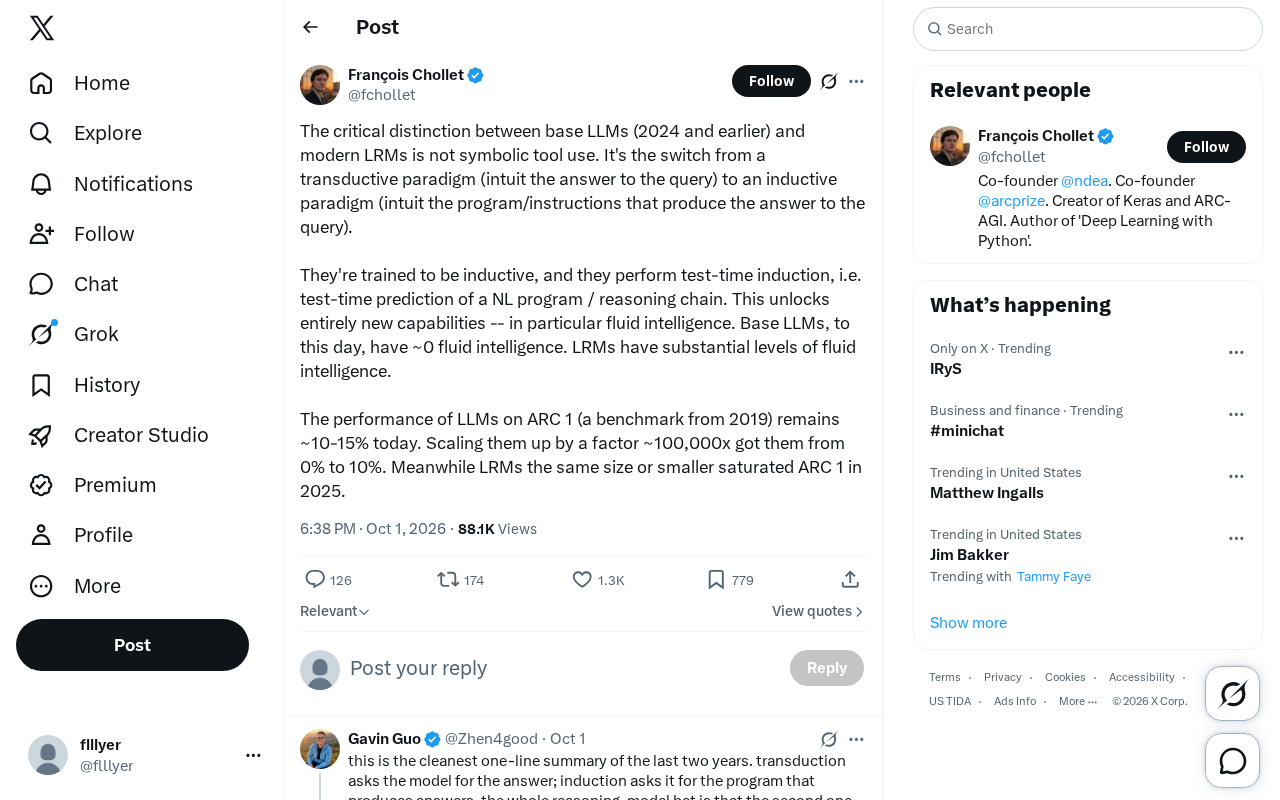
Traditional foundation LLMs (roughly corresponding to the earlier generation of models) operate under a transductive paradigm — they answer queries directly by intuition. You ask a question, the model draws on the vast patterns learned during training, and outputs a result that "feels right." The whole process resembles highly sophisticated pattern matching: the answer is essentially being guessed outright.
Modern large reasoning models, by contrast, follow an inductive paradigm. Instead of guessing the answer directly, they first intuit a "program" or "sequence of instructions" capable of producing the answer, then execute that process to arrive at the result. In other words, LRMs predict not the answer itself, but the natural-language program / chain of reasoning that leads to the answer.
This distinction sounds abstract, but its implications run deep. When a model learns to generate and execute reasoning steps rather than jumping straight to an answer, its ability to handle unfamiliar problems changes qualitatively.
The term "transduction" originates in statistical learning theory, introduced by Vladimir Vapnik, and refers to a mode of learning that maps directly from known training samples to specific test samples without deriving general rules. "Induction," by contrast, means extracting generalizable rules or programs from concrete cases and applying them to new situations. The fundamental difference between the two paradigms lies in how generalization works: transductive models rely on training distribution coverage of test problems and tend to fail on out-of-distribution inputs; inductive models attempt to dynamically construct solution paths at test time, giving them stronger adaptability to unseen problems in principle. It's worth noting that in NLP, "transduction" sometimes refers to sequence-to-sequence mapping tasks, but the usage here is closer to its original statistical learning theory meaning.
Test-Time Induction and Unlocking "Fluid Intelligence"
A key concept in this framing is that LRMs are trained to be inductive models and perform test-time induction during inference — constructing a chain of reasoning or natural-language program on the fly when encountering a new task.
This capability unlocks something models have barely possessed before: fluid intelligence. Fluid intelligence refers to the ability to reason through entirely new problems, identify patterns, and adapt — all without prior experience to draw on. It stands in contrast to "crystallized intelligence," which relies on accumulated knowledge.
The original argument makes a striking claim: the fluid intelligence of foundation LLMs remains close to zero even today, while LRMs have developed a substantial degree of it. If this holds, it implies a capability gap between the two model classes that is categorical rather than merely a matter of scale.
The distinction between "fluid intelligence" (fluid intelligence) and "crystallized intelligence" (crystallized intelligence) comes from psychologist Raymond Cattell's two-factor theory of intelligence, proposed in the 1940s. Crystallized intelligence refers to knowledge and skills accumulated through learning and experience — vocabulary, historical facts, and the like. Fluid intelligence refers to the ability to reason abstractly, identify patterns, and solve novel problems without relying on prior experience — relatively independent of specific knowledge stores. Borrowing this concept for the AI context draws a distinction between two kinds of capability: "remembering" answer distributions from massive training data (analogous to crystallized intelligence) versus reasoning through novel problem types that never appeared in the training set (analogous to fluid intelligence). "Test-time induction" is the mechanism by which fluid intelligence is realized — rather than relying on pre-stored knowledge, the model dynamically constructs a solution program during inference. This process of generating reasoning chains on the fly gives the model generalization power beyond its training distribution.
The Stark Contrast on the ARC Benchmark
The Abstraction and Reasoning Corpus (ARC) is a benchmark specifically designed to test fluid intelligence. It requires models to induce rules from very few examples and apply them to new instances. Because these tasks cannot be solved by memorizing training data, ARC serves as a litmus test for "genuine reasoning."
The data points cited in the original argument are telling:
- Foundation LLMs score roughly 10%–15% on ARC 1 — and that figure holds even today;
- Scaling model size by approximately 100,000× moves the needle from roughly 0% to only about 10%;
- Meanwhile, LRMs of comparable or even smaller scale have already saturated ARC 1, pushing scores to near 100%.
The core lesson from this comparison: simply stacking compute or scaling parameters cannot give a transductive model fluid intelligence. A hundred-thousand-fold increase in scale yields only a modest percentage-point gain — effectively hitting the ceiling of the paradigm. The paradigm shift itself — from guessing answers to constructing reasoning programs — is what produced the qualitative leap.
ARC (Abstraction and Reasoning Corpus) was introduced by François Chollet in 2019, with a design philosophy explicitly targeting a fundamental flaw in AI evaluation at the time: most benchmarks could be "gamed" by memorizing patterns in training data, without any genuine task understanding. Each ARC problem consists of pairs of input-output grid images with rules embedded within them; the solver must infer the rule from 3–5 examples and apply it to a new input. Chollet deliberately used basic concepts that human children grasp intuitively — symmetry, counting, object recognition — while making the benchmark extraordinarily challenging for machine learning systems, because no two problems share the same solution rule, making memorized patterns useless. ARC-AGI 1 (referred to as ARC 1 in this article) has long served as an important reference point for measuring genuine reasoning ability, and saturating it — achieving near-100% accuracy — is considered a significant milestone in AI capability.
What This Means for Understanding AI Progress
This perspective offers a framework for reexamining recent AI advances. We often attribute improvements in model capability to more parameters, more data, or more tools. But the more fundamental shift being highlighted here is this: models have learned the process of reasoning, not just the distribution of answers.
For practitioners, this suggests several things worth reflecting on:
First, when evaluating models, traditional knowledge-based benchmarks may mask the absence of fluid intelligence — tasks like ARC are better at exposing paradigm-level differences. Second, if fluid intelligence truly stems from the inductive paradigm and test-time computation, future capability gains may come more from advances in reasoning mechanism design than from blindly scaling up models. Third, the hype around "reasoning models" isn't mere marketing — it corresponds to a genuine structural shift in model capabilities.
It should be noted that the arguments above originate from a single social media thread, and some claims (such as "foundation LLMs have zero fluid intelligence") represent fairly strong personal judgments that remain open to debate. But the transductive vs. inductive framework it proposes, along with the empirical contrast on ARC, offers a clear and valuable lens for understanding the leap this generation of models represents.
Related articles

JobRunner MCP Server: AI Agents Can Now Fix Failed Java Jobs
JobRunner launches an open-source MCP server enabling AI agents to view cluster status, diagnose failures, and recover Java jobs—incident response from any cloud coding environment or existing agent.

MLAI Digital Launches 9 Security Agents: MCP Server Safeguards the Full Lifecycle of Agentic AI
MLAI Digital launches Security MCP Server with nine built-in specialized security agents covering vulnerability discovery, attack simulation, prompt injection detection, API and infrastructure assessment, and accelerated remediation—embedding security validation across the full Agentic AI lifecycle from development to production.

Running Isaac Lab on H100 GPUs: Exploring Better Approaches
Exploring optimization methods for running Isaac Lab on NVIDIA H100 GPUs, including MIG configuration, mixed precision, TensorRT acceleration, and community experience to improve robotics simulation and reinforcement learning efficiency.